Pound Sterling outperforms US Dollar as Trump tariffs strike US economic activity
- The Pound Sterling demonstrates strength around 1.3580 against the US Dollar as the Greenback suffers from downbeat US economic data for May.
- Tariff uncertainty further weighs on the US Dollar as US President Trump raised tariffs on steel and aluminum to 50% on Wednesday.
- BoE’s Bailey reiterated a ‘gradual and cautious’ monetary expansion approach.

The Pound Sterling (GBP) rises to near 1.3580 against the US Dollar (USD) during European trading hours on Thursday. The GBP/USD pair gains as the US Dollar struggles to gain ground after a sharp sell-off on Wednesday. The USD suffers due to a string of disappointing United States (US) economic data for May in the wake of the tariff policy imposed by US President Donald Trump after returning to the White House.
The US Dollar Index (DXY), which tracks the Greenback’s value against six major currencies, struggles near the six-week low around 98.60 posted on Tuesday.
On Wednesday, the US ADP Employment Change report showed that the private sector hired 37K fresh workers, surprisingly lower than 60K in April and missing the market expectation of 115K by a wide margin. This was the lowest reading since January 2021, raising concerns about labor market stability.
Additionally, an unexpected decline in service sector activity prompted the risk of an economic contraction, given that the service sector accounts for two-thirds of the overall economic activity in the US. This week, the ISM Manufacturing PMI report for May also showed that the factory sector activity declined at a faster pace.
The overall contraction in business activity reflects the consequences of tariff uncertainty driven by the ever-changing statements from US President Trump. The “stop and go” announcements on the tariff policy by Washington have forced domestic manufacturers to hold their strategic developments and expansion plans.
This week, Donald Trump doubled import duties on steel and aluminum to 50%, aiming to boost domestic steel production. However, market experts have warned that this could lead to an increase in inflation, a move that would discourage the Federal Reserve (Fed) from lowering interest rates.
On Wednesday, President Trump reiterated his criticism of the Fed after the release of the poor ADP Employment data in a post on Truth Social for not lowering interest rates. “ADP NUMBER OUT!!! “Too Late” Powell must now LOWER THE RATE. He is unbelievable!!! Europe has lowered NINE TIMES," Trump wrote.
US Dollar PRICE Today
The table below shows the percentage change of US Dollar (USD) against listed major currencies today. US Dollar was the weakest against the Australian Dollar.
| USD | EUR | GBP | JPY | CAD | AUD | NZD | CHF | |
|---|---|---|---|---|---|---|---|---|
| USD | -0.00% | -0.12% | 0.34% | -0.12% | -0.26% | -0.21% | 0.17% | |
| EUR | 0.00% | -0.06% | 0.34% | -0.08% | -0.24% | -0.26% | 0.19% | |
| GBP | 0.12% | 0.06% | 0.45% | -0.03% | -0.16% | -0.21% | 0.25% | |
| JPY | -0.34% | -0.34% | -0.45% | -0.47% | -0.63% | -0.63% | -0.17% | |
| CAD | 0.12% | 0.08% | 0.03% | 0.47% | -0.17% | -0.18% | 0.27% | |
| AUD | 0.26% | 0.24% | 0.16% | 0.63% | 0.17% | -0.05% | 0.41% | |
| NZD | 0.21% | 0.26% | 0.21% | 0.63% | 0.18% | 0.05% | 0.47% | |
| CHF | -0.17% | -0.19% | -0.25% | 0.17% | -0.27% | -0.41% | -0.47% |
The heat map shows percentage changes of major currencies against each other. The base currency is picked from the left column, while the quote currency is picked from the top row. For example, if you pick the US Dollar from the left column and move along the horizontal line to the Japanese Yen, the percentage change displayed in the box will represent USD (base)/JPY (quote).
Daily digest market movers: Pound Sterling gains as BoE Bailey reiterates graudal policy expansion
- The Pound Sterling shows strength against its major peers, except antipodeans, on Thursday in a light United Kingdom (UK) economic calendar week. The major triggers for the British currency in the remaining week will be market expectations for the Bank of England’s (BoE) monetary policy outlook and trade discussions between the US and China.
- This month, the BoE is unlikely to lower interest rates again, given escalating inflationary pressures and stable labor market conditions. Meanwhile, BoE Governor Andrew Bailey reaffirms a “gradual and careful” monetary expansion approach amid uncertainty over the global economic front.
- Andrew Bailey said before the Parliament’s Treasury Committee on Tuesday, "I think the path remains downwards, but how far and how quickly is now shrouded in a lot more uncertainty," Reuters reported.
- The uncertainty over trade negotiations between Washington and Beijing is also expected to keep the UK economy under pressure. Given that China enjoys a low-cost competitive advantage across the globe, UK business owners would face the heat of a price war in the international market if the world’s two largest nations fail to close a trade deal.
- On Wednesday, US President Trump signaled in a post on Truth Social that it is difficult to make a deal with Chinese leader Xi Jinping. "I like President Xi of China, always have, and always will, but he is VERY TOUGH, AND EXTREMELY HARD TO MAKE A DEAL WITH!!!" Trump wrote. However, market experts are slightly optimistic on the US and China closing a trade deal as Trump’s post indicated that he has started direct conversations with President Xi.
- During European trading hours, Beijing urged the US to resolve disputes via dialogue, Chinese Ministry of Commerce reported.
- This week, the US NFP data will be a key trigger for the GBP/USD pair, which is scheduled to be released on Friday.
Technical Analysis: Pound Sterling holds key 20-day EMA
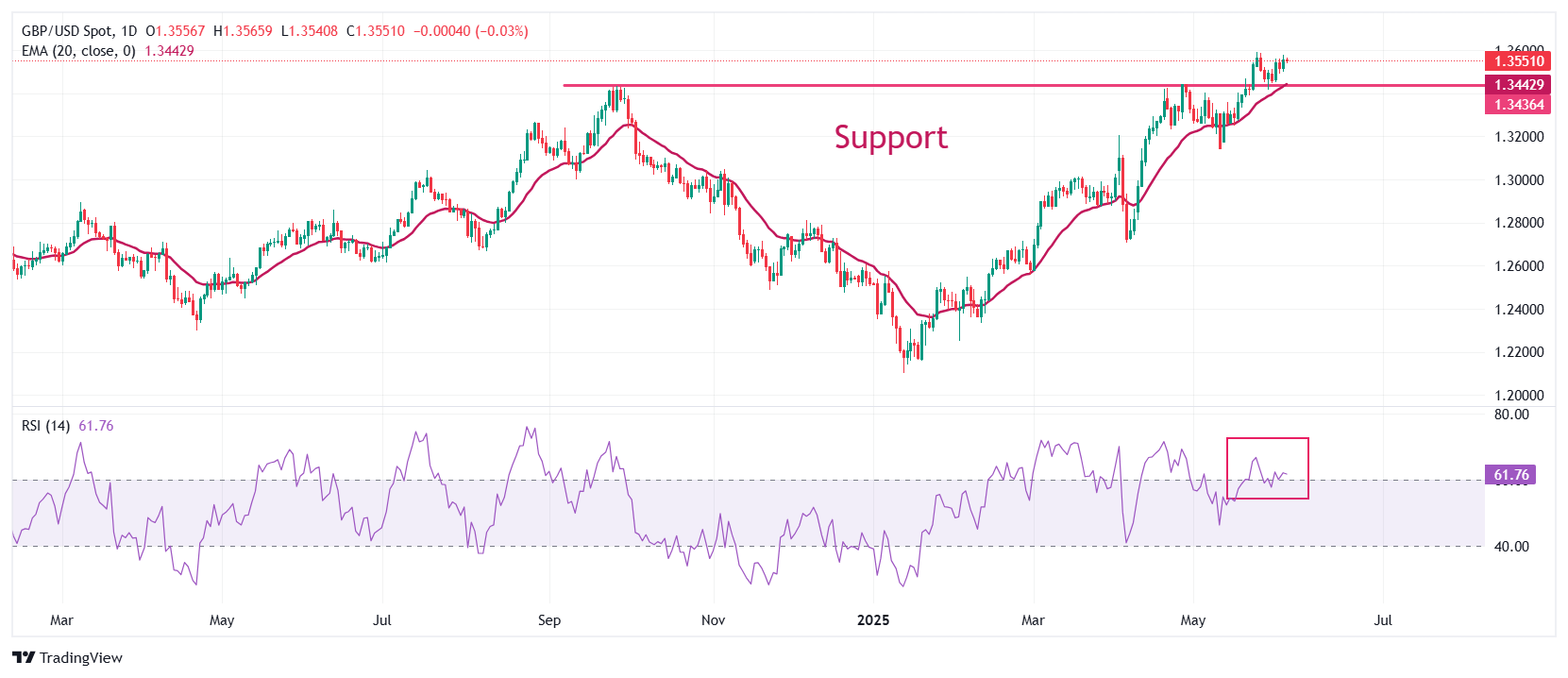
The Pound Sterling rises to near 1.3580 against the US Dollar on Thursday, trading firmly near the previous day's high. The GBP/USD pair holds the key horizontal support plotted from the September 26 high of 1.3434. The outlook for the pair remains firm as the 20-day Exponential Moving Average (EMA) slopes higher around 1.3443.
The 14-day Relative Strength Index (RSI) indicator holds above 60.00, suggesting that the bullish momentum is intact.
On the upside, the January 13, 2022, high of 1.3750 will be a key hurdle for the pair. Looking down, the 20-day EMA will act as a major support area.
Economic Indicator
ISM Services PMI
The Institute for Supply Management (ISM) Services Purchasing Managers Index (PMI), released on a monthly basis, is a leading indicator gauging business activity in the US services sector, which makes up most of the economy. The indicator is obtained from a survey of supply executives across the US based on information they have collected within their respective organizations. Survey responses reflect the change, if any, in the current month compared to the previous month. A reading above 50 indicates that the services economy is generally expanding, a bullish sign for the US Dollar (USD). A reading below 50 signals that services sector activity is generally declining, which is seen as bearish for USD.
Read more.Last release: Wed Jun 04, 2025 14:00
Frequency: Monthly
Actual: 49.9
Consensus: 52
Previous: 51.6
Source: Institute for Supply Management
The Institute for Supply Management’s (ISM) Services Purchasing Managers Index (PMI) reveals the current conditions in the US service sector, which has historically been a large GDP contributor. A print above 50 shows expansion in the service sector’s economic activity. Stronger-than-expected readings usually help the USD gather strength against its rivals. In addition to the headline PMI, the Employment Index and the Prices Paid Index numbers are also watched closely by investors as they provide useful insights regarding the state of the labour market and inflation.
Author

Sagar Dua
FXStreet
Sagar Dua is associated with the financial markets from his college days. Along with pursuing post-graduation in Commerce in 2014, he started his markets training with chart analysis.