Pound Sterling flattens against US Dollar as yearly US core PCE Inflation cools down
- The Pound Sterling turns flat against the US Dollar as US core PCE inflation cools on year in January.
- US President Trump proposes an additional 10% tariffs on China.
- The BoE is expected to follow a moderate policy-easing cycle.

The Pound Sterling (GBP) trades flat to near 1.2600 against the US Dollar (USD) in Friday’s North American session. The GBP/USD pair flattens as the US Dollar gives up intraday gains due to an expected slowdown in the United States (US) core Personal Consumption Expenditure Price Index (PCE) data for January. The US Dollar Index (DXY), which tracks the Greenback’s value against six major currencies, holds onto Thursday's gains around 107.40.
The report showed that the core PCE inflation – which excludes volatile food and energy prices – decelerated to 2.6% year-over-year, as expected, from 2.8% in December. Month-on-month inflation data rose by 0.3%, expectedly, faster than the former reading of 0.2%.
An expected cooldown in the US core PCE inflation, which is the Federal Reserve's (Fed) preferred inflation gauge, is expected to force trades to pare bets supporting the central bank to leave interest rates in the current range of 4.25%-4.50% for longer. Such a scenario would be unfavorable for the US Dollar's outlook.
However, fresh tariff threats by US President Donald Trump would continue to restrict the downside in the Greenback. On Thursday, Trump announced more levies on China and provided more clarification on the timeline for 25% import duties on Canada and Mexico and reciprocal tariffs.
In his tweet at Truth.Social, Trump said that 25% tariffs on Canada and Mexico will come into effect on March 4. His tweet confirmed that he is not providing an additional month-long extension to his North American allies as “drugs are still pouring” into the economy. Trump announced an additional 10% levy on China, arguing that drugs entering the US are in the form of fentanyl, which is made in and supplied by China. He added that reciprocal tariffs could come into full force and effect on April 2. Investors see Trump’s fresh tariff threats as a critical escalation in the global trade war that could lead to an economic slowdown across the globe.
Daily digest market movers: Pound Sterling remains cautious
- The Pound Sterling trades with caution against its major peers on Friday despite investors expecting the Bank of England’s (BoE) monetary easing cycle to be more moderate this year than other central bankers from major economies. Traders have fully priced in two interest rate cuts by the BoE. On the contrary, the European Central Bank (ECB) is expected to cut interest rates thrice and the Federal Reserve (Fed) is anticipated to reduce them by 60 basis points (bps).
- Market participants have been expecting a slower BoE policy easing cycle due to strong wage growth. Average Earnings Excluding bonuses in three months ending December accelerated to 5.9%, the highest level seen since April 2024.
- BoE Deputy Governor Dave Ramsden also said in his speech at Stellenbosch University in South Africa during early European trading hours on Friday that wage growth is “stronger than he expected”. However, Ramsden remained confident that the “core disinflationary process remains intact”. On the global front, he said it is difficult to ascertain whether the impact of US President Donald Trump’s tariffs will be “inflationary or deflationary” for the economy.
- Meanwhile, the meeting between United Kingdom (UK) Prime Minister Keir Starmer and the US President on Thursday concluded without a deal. However, Trump said there was "a very good chance" of a trade deal "where tariffs wouldn't be necessary." Trump added that such a deal could be made "pretty quickly," BBC reported.
British Pound PRICE Today
The table below shows the percentage change of British Pound (GBP) against listed major currencies today. British Pound was the strongest against the Japanese Yen.
| USD | EUR | GBP | JPY | CAD | AUD | NZD | CHF | |
|---|---|---|---|---|---|---|---|---|
| USD | -0.05% | 0.06% | 0.71% | -0.15% | 0.37% | 0.55% | 0.38% | |
| EUR | 0.05% | 0.11% | 0.75% | -0.10% | 0.41% | 0.59% | 0.42% | |
| GBP | -0.06% | -0.11% | 0.65% | -0.21% | 0.30% | 0.48% | 0.32% | |
| JPY | -0.71% | -0.75% | -0.65% | -0.84% | -0.35% | -0.17% | -0.33% | |
| CAD | 0.15% | 0.10% | 0.21% | 0.84% | 0.50% | 0.70% | 0.52% | |
| AUD | -0.37% | -0.41% | -0.30% | 0.35% | -0.50% | 0.19% | 0.02% | |
| NZD | -0.55% | -0.59% | -0.48% | 0.17% | -0.70% | -0.19% | -0.17% | |
| CHF | -0.38% | -0.42% | -0.32% | 0.33% | -0.52% | -0.02% | 0.17% |
The heat map shows percentage changes of major currencies against each other. The base currency is picked from the left column, while the quote currency is picked from the top row. For example, if you pick the British Pound from the left column and move along the horizontal line to the US Dollar, the percentage change displayed in the box will represent GBP (base)/USD (quote).
Technical Analysis: Pound Sterling finds cushion near 20-day EMA
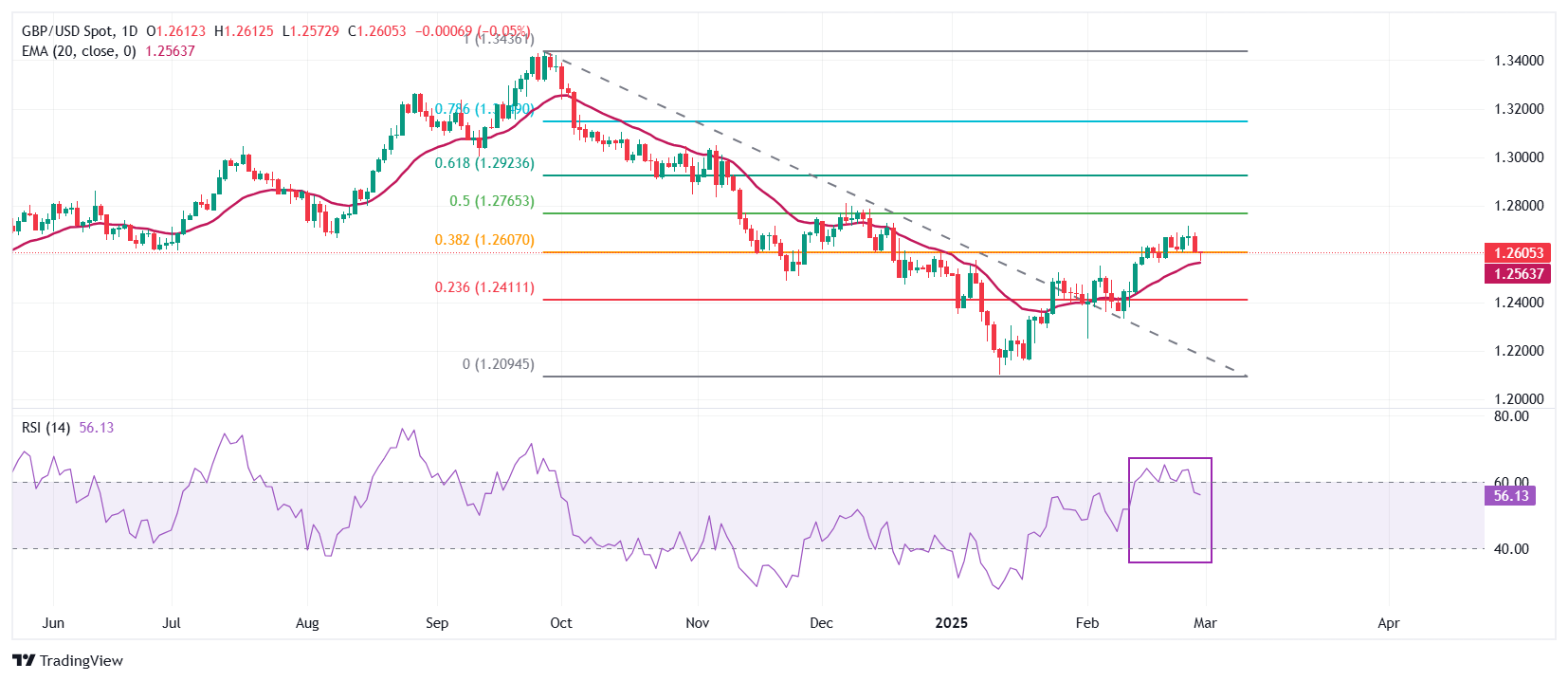
The Pound Sterling struggles to hold above the 38.2% Fibonacci retracement from the end-September high to the mid-January low downtrend against the US Dollar around 1.2610 on Friday. The 20-day Exponential Moving Average (EMA) near 1.2560 continues to provide support to the pair.
The 14-day Relative Strength Index (RSI) falls back down within the 40.00-60.00 range, suggesting that the bullish momentum has concluded for now. However, the positive bias remains intact.
Looking down, the February 11 low of 1.2333 will act as a key support zone for the pair. On the upside, the 50% Fibonacci retracement at 1.2765 will act as a key resistance zone.
Inflation FAQs
Inflation measures the rise in the price of a representative basket of goods and services. Headline inflation is usually expressed as a percentage change on a month-on-month (MoM) and year-on-year (YoY) basis. Core inflation excludes more volatile elements such as food and fuel which can fluctuate because of geopolitical and seasonal factors. Core inflation is the figure economists focus on and is the level targeted by central banks, which are mandated to keep inflation at a manageable level, usually around 2%.
The Consumer Price Index (CPI) measures the change in prices of a basket of goods and services over a period of time. It is usually expressed as a percentage change on a month-on-month (MoM) and year-on-year (YoY) basis. Core CPI is the figure targeted by central banks as it excludes volatile food and fuel inputs. When Core CPI rises above 2% it usually results in higher interest rates and vice versa when it falls below 2%. Since higher interest rates are positive for a currency, higher inflation usually results in a stronger currency. The opposite is true when inflation falls.
Although it may seem counter-intuitive, high inflation in a country pushes up the value of its currency and vice versa for lower inflation. This is because the central bank will normally raise interest rates to combat the higher inflation, which attract more global capital inflows from investors looking for a lucrative place to park their money.
Formerly, Gold was the asset investors turned to in times of high inflation because it preserved its value, and whilst investors will often still buy Gold for its safe-haven properties in times of extreme market turmoil, this is not the case most of the time. This is because when inflation is high, central banks will put up interest rates to combat it. Higher interest rates are negative for Gold because they increase the opportunity-cost of holding Gold vis-a-vis an interest-bearing asset or placing the money in a cash deposit account. On the flipside, lower inflation tends to be positive for Gold as it brings interest rates down, making the bright metal a more viable investment alternative.
Author

Sagar Dua
FXStreet
Sagar Dua is associated with the financial markets from his college days. Along with pursuing post-graduation in Commerce in 2014, he started his markets training with chart analysis.
















