Pound Sterling slumps after poor UK Retail Sales, flash PMI data
- The Pound Sterling faces selling pressure amid UK Retail Sales declining 1.1% and S&P Global PMI dropping sharply.
- Investors await the US flash S&P Global PMI data for November.
- Fed’s Hammack said that high inflation is the real issue of the economy.

The Pound Sterling (GBP) falls sharply against its major currency peers on Friday, following the release of poor United Kingdom (UK) Retail Sales data for October, and preliminary S&P Global Purchasing Managers’ Index (PMI) data for November.
The Office for National Statistics (ONS) reported that Retail Sales, a measure of consumer spending, declined by 1.1% month-on-month, a worse-than-expected outcome as analysts forecasted sales to remain flat. In September, the indicator rose by 0.7%, revised higher from the 0.5% initially estimated.
On an annual basis, Retail Sales grew by 0.2% against estimates of 1.5% and the prior release of 1%, which was downwardly revised from 1.5%.
The report showed that sales receipts at Textile clothing and footwear stores fell 3.3% on month, which remained a major drag on overall retail sales.
Meanwhile, the UK's S&P Global Composite PMI dropped sharply to 50.5 from the October’s final reading of 52.2. The overall business activity also came in lower than the estimates of 51.8. Weak service sector activity led to a sharp slowdown in the overall private sector activity growth, which dropped to 50.5 from 52.3 in October.
Surprisingly, the Manufacturing PMI returns to the expansion phase. A figure above 50.0 is considered an expansion in the business activity. The Manufacturing PMI rises to 50.2, beating estimates of 49.3 and the prior reading of 49.7.
A sharp decline in Retail Sales and slower PMI growth are expected to further intensify Bank of England (BoE) dovish expectations, which have already accelerated significantly this month due to cooling inflationary pressures and weakening job market conditions.
Going forward, the major trigger for the Pound Sterling will be the UK Autumn Budget announcement on November 26, in which Chancellor of the Exchequer Rachel Reeves is expected to raise income taxes on households to fill the £22 billion shortfall in the government's finances.
Pound Sterling Price Today
The table below shows the percentage change of British Pound (GBP) against listed major currencies today. British Pound was the weakest against the Japanese Yen.
| USD | EUR | GBP | JPY | CAD | AUD | NZD | CHF | |
|---|---|---|---|---|---|---|---|---|
| USD | 0.05% | 0.10% | -0.55% | -0.05% | 0.17% | -0.07% | -0.08% | |
| EUR | -0.05% | 0.05% | -0.61% | -0.10% | 0.12% | -0.12% | -0.13% | |
| GBP | -0.10% | -0.05% | -0.68% | -0.15% | 0.07% | -0.17% | -0.18% | |
| JPY | 0.55% | 0.61% | 0.68% | 0.53% | 0.73% | 0.48% | 0.48% | |
| CAD | 0.05% | 0.10% | 0.15% | -0.53% | 0.21% | -0.04% | -0.03% | |
| AUD | -0.17% | -0.12% | -0.07% | -0.73% | -0.21% | -0.25% | -0.26% | |
| NZD | 0.07% | 0.12% | 0.17% | -0.48% | 0.04% | 0.25% | -0.00% | |
| CHF | 0.08% | 0.13% | 0.18% | -0.48% | 0.03% | 0.26% | 0.00% |
The heat map shows percentage changes of major currencies against each other. The base currency is picked from the left column, while the quote currency is picked from the top row. For example, if you pick the British Pound from the left column and move along the horizontal line to the US Dollar, the percentage change displayed in the box will represent GBP (base)/USD (quote).
Daily digest market movers: Pound Sterling underperforms US Dollar
- The Pound Sterling slides to near 1.3050 against the US Dollar (USD) during the European trading session on Friday. The GBP/USD pair remains broadly under pressure also due to a stronger US Dollar, which is supported by increasing speculation that the Federal Reserve (Fed) could refrain from cutting interest rates again in the December policy meeting.
- At the press time, the US Dollar Index (DXY), which tracks the Greenback’s value against six major currencies, trades close to its over five-month high of 100.36.
- According to the CME FedWatch tool, the probability of the Fed cutting interest rates by 25 basis points (bps) to 3.50%-3.75% in the December meeting is at 33.1%, down from 44.4%a week ago.
- Traders have pared Fed dovish bets as officials have been stressing the need to bring inflation down, which has remained well above the central bank’s 2% target. On Thursday, Cleveland Fed Bank President Beth Hammack stated that high inflation is the “real issue” of the economy, adding that “inflation is still too high and trending in the wrong direction”, which calls for the need to keep the monetary policy “somewhat restrictive”.
- The Federal Open Market Committee (FOMC) minutes of the October policy meeting, released on Wednesday, also showed that many officials expressed the need to hold interest rates steady in December to control inflation.
- In Friday’s session, investors will focus on the preliminary UK and US S&P Global PMI data for November. Private-sector activity growth in both countries is expected to have slowed down.
Technical Analysis: Pound Sterling sees further downside towards 1.2700
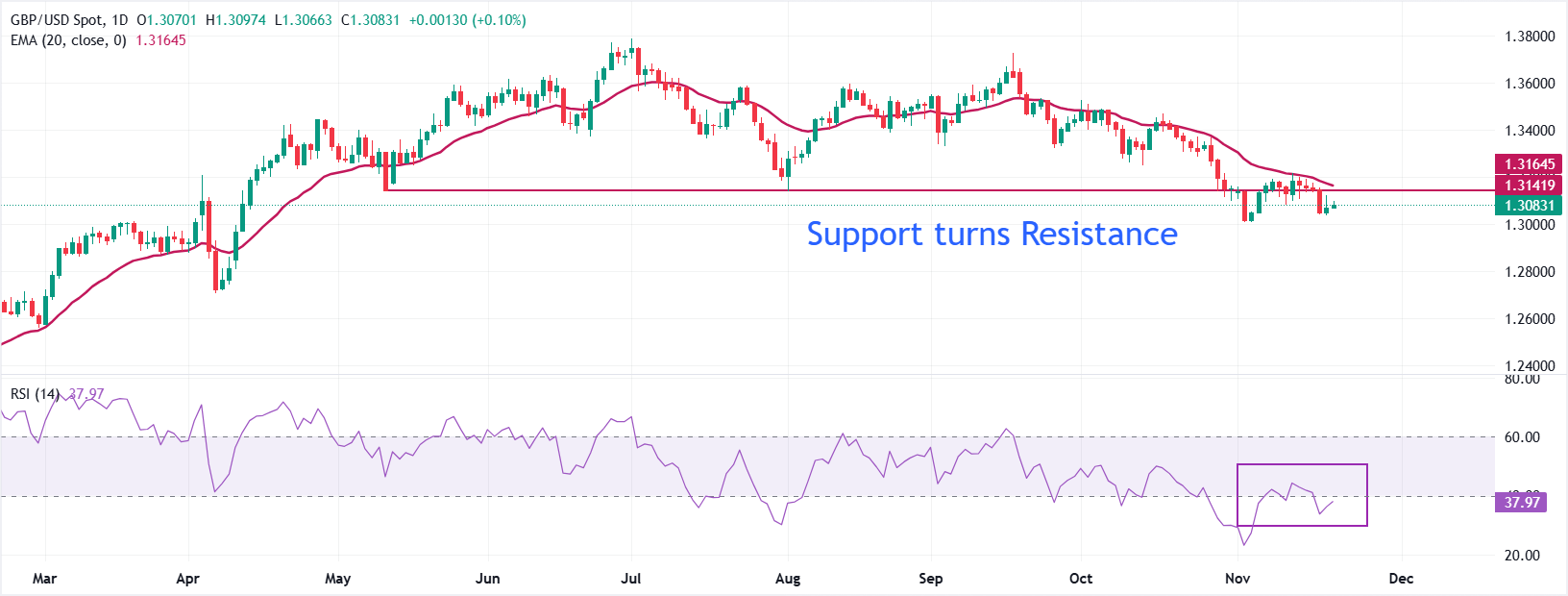
The Pound Sterling continues to struggle near a two-week low around 1.3030 against the US Dollar. The overall trend of the GBP/USD pair remains bearish as the 20-day Exponential Moving Average (EMA), which trades around 1.3165, slopes downwards. The Cable resumed its downside journey after falling below the August low of around 1.3140, which had been a key support zone.
The 14-day Relative Strength Index (RSI) remains below 40.00, indicating a fresh bearish momentum ahead.
Looking down, the April low near 1.2700 will act as a key support zone. On the upside, the October 28 high around 1.3370 will act as a key barrier.
Author

Sagar Dua
FXStreet
Sagar Dua is associated with the financial markets from his college days. Along with pursuing post-graduation in Commerce in 2014, he started his markets training with chart analysis.