Pound Sterling wobbles as focus shifts to UK Employment
- The Pound Sterling declines against US Dollar as investors await the UK Employment data for the three months ending September.
- The UK Unemployment Rate is estimated to have increased to 4.1%.
- The US Dollar will be influenced by the US inflation data for October.

The Pound Sterling (GBP) exhibits a mixed performance against its major peers on Monday, in a calm start of the week as investors keep their powder dry ahead of the United Kingdom (UK) labor market data for the three months ending September, which will be released on Tuesday. The jobs data could significantly influence market expectations for the Bank of England (BoE) monetary policy decision in the December meeting.
Economists expect that the Unemployment Rate rose to 4.1% in the three months to September from 4.0% in the quarter ending August. Investors will also pay close attention to the Average Earnings data, a key measure of wage growth that drives consumer spending. The growth in earnings has been a major contributor to high inflation in the services sector, which is closely tracked by BoE officials for decision-making on interest rates.
The Average Earnings Excluding bonuses are expected to have grown by 4.7%, slower than the former reading of 4.9%. Softer wage growth would lift expectations of more interest rate cuts by the BoE as it will suggest a further decline in inflation in the service sector. On the contrary, higher wage growth would do the opposite. Average Earnings including bonuses are estimated to have accelerated to 3.9% from the prior release of 3.8%.
Last week, the BoE reduced its interest rates by 25 basis points (bps) to 4.75%, as expected. BoE Governor Andrew Bailey signaled a more gradual policy-easing approach and emphasized that the bank is committed to bringing inflation down sustainably to the desired rate of 2%.
British Pound PRICE Today
The table below shows the percentage change of British Pound (GBP) against listed major currencies today. British Pound was the strongest against the Japanese Yen.
| USD | EUR | GBP | JPY | CAD | AUD | NZD | CHF | |
|---|---|---|---|---|---|---|---|---|
| USD | 0.59% | 0.37% | 0.65% | 0.30% | 0.10% | -0.01% | 0.43% | |
| EUR | -0.59% | -0.26% | 0.13% | -0.19% | -0.40% | -0.51% | -0.08% | |
| GBP | -0.37% | 0.26% | 0.30% | 0.06% | -0.14% | -0.26% | 0.14% | |
| JPY | -0.65% | -0.13% | -0.30% | -0.33% | -0.62% | -0.55% | -0.23% | |
| CAD | -0.30% | 0.19% | -0.06% | 0.33% | -0.15% | -0.32% | 0.08% | |
| AUD | -0.10% | 0.40% | 0.14% | 0.62% | 0.15% | -0.13% | 0.29% | |
| NZD | 0.01% | 0.51% | 0.26% | 0.55% | 0.32% | 0.13% | 0.41% | |
| CHF | -0.43% | 0.08% | -0.14% | 0.23% | -0.08% | -0.29% | -0.41% |
The heat map shows percentage changes of major currencies against each other. The base currency is picked from the left column, while the quote currency is picked from the top row. For example, if you pick the British Pound from the left column and move along the horizontal line to the US Dollar, the percentage change displayed in the box will represent GBP (base)/USD (quote).
Daily digest market movers: Pound Sterling weakens against US Dollar
- The Pound Sterling drops to near 1.2900 against the US Dollar (USD) in North American trading hours on Monday. The GBP/USD pair declines as the US Dollar extends Friday’s recovery and aims to revisit a four-month high. The US Dollar Index (DXY), which gauges Greenback’s value against six major currencies, climbs above 105.30.
- The Greenback strengthens on expectations of higher investment and spending in the United States (US) as Republicans look set to take control of both the Senate and the House of Representatives, a scenario that would allow the Trump administration to implement fiscal policies quickly.
- The expected change in government policies, from higher import tariffs to lower taxes, would boost the US fiscal deficit and inflationary pressures, a scenario that could force the Federal Reserve (Fed) to opt for a restrictive policy stance. However, Fed Chair Jerome Powell pushed back expectations of any near-term impact on the monetary policy last Thursday after the central bank cut interest rates by 25 basis points (bps) to 4.50%-4.75%.
- This week, a slew of Fed officials are lined up for commentary on Thursday’s interest rate decision and guidance for monetary policy action in the last meeting of this year in December. In addition to Fed speeches, investors will also focus on the US Consumer Price Index (CPI) data for October, which will be published on Wednesday. The CPI report is expected to show that the annual headline inflation accelerated to 2.6% from 2.4% in September, with core figures growing steadily by 3.3%.
Technical Analysis: Pound Sterling slides below 1.2800
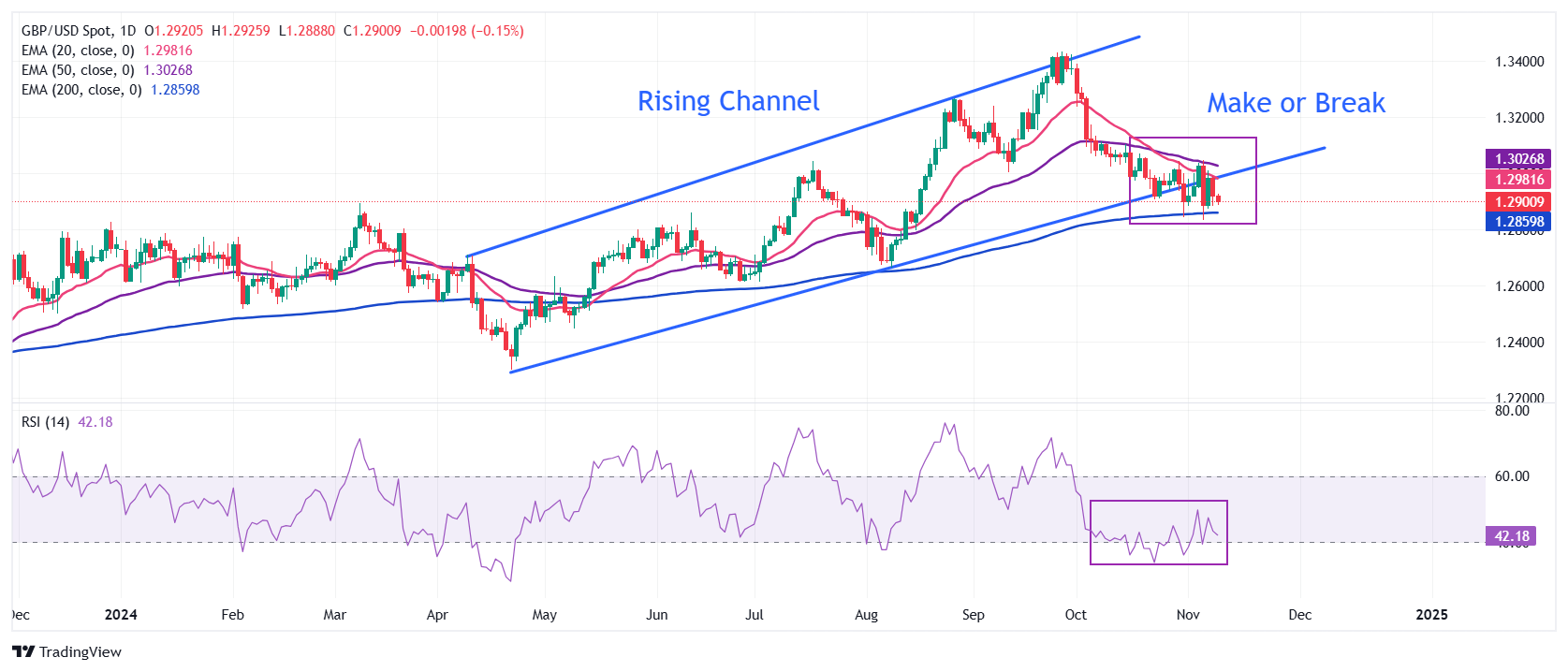
The Pound Sterling trades at a make or a break against the US Dollar near the breakdown region of the rising channel pattern. The near-term trend of GBP/USD remains bearish as the 20-day and 50-day Exponential Moving Average (EMAs) around 1.3000 and 1.3035, respectively, are declining. However, the pair remains well-supported by the 200-day Exponential Moving Average (EMA) around 1.2860.
The 14-day Relative Strength Index (RSI) hovers near 40.00. A bearish momentum would resume if the RSI (14) fails to hold above this level.
Looking down, the August low at 1.2665 will be a major cushion for Pound Sterling bulls. On the upside, the Cable will face resistance near the psychological figure of 1.3000.
Employment FAQs
Labor market conditions are a key element to assess the health of an economy and thus a key driver for currency valuation. High employment, or low unemployment, has positive implications for consumer spending and thus economic growth, boosting the value of the local currency. Moreover, a very tight labor market – a situation in which there is a shortage of workers to fill open positions – can also have implications on inflation levels and thus monetary policy as low labor supply and high demand leads to higher wages.
The pace at which salaries are growing in an economy is key for policymakers. High wage growth means that households have more money to spend, usually leading to price increases in consumer goods. In contrast to more volatile sources of inflation such as energy prices, wage growth is seen as a key component of underlying and persisting inflation as salary increases are unlikely to be undone. Central banks around the world pay close attention to wage growth data when deciding on monetary policy.
The weight that each central bank assigns to labor market conditions depends on its objectives. Some central banks explicitly have mandates related to the labor market beyond controlling inflation levels. The US Federal Reserve (Fed), for example, has the dual mandate of promoting maximum employment and stable prices. Meanwhile, the European Central Bank’s (ECB) sole mandate is to keep inflation under control. Still, and despite whatever mandates they have, labor market conditions are an important factor for policymakers given its significance as a gauge of the health of the economy and their direct relationship to inflation.
Author

Sagar Dua
FXStreet
Sagar Dua is associated with the financial markets from his college days. Along with pursuing post-graduation in Commerce in 2014, he started his markets training with chart analysis.














