Pound Sterling falls back after strong US ISM Services PMI report
- The Pound Sterling drops against the US Dollar after strong US Services PMI report.
- Market speculation for the Fed reducing interest rates in September strengthens.
- The BoE is expected to deliver two rate cuts this year.

The Pound Sterling (GBP) drops from 1.2800 against the US Dollar (USD) in Wednesday’s American session. The GBP/USD pair comes under pressure as the US Dollar extends recovery after the release of the stronger-than-expected United States (US) Institute for Supply Management’s (ISM) Services Purchasing Managers Index (PMI) data for May.
The ISM Services PMI, which gauges the service sector activity that accounts for two-thirds of the economy, returns to expansion at a faster pace than expected. The PMI rose to 53.8, from the estimates of 50.5 and the former release of 49.4. Apart from Services PMI figures, another subcomponent, such as New Orders Index, which reflects the demand outlook, jumps to 54.1 against the prior reading of 52.2.
The US Dollar Index (DXY), which tracks the Greenback’s value against six major currencies, jumps to 104.40. However, the near-term outlook of the US Dollar remains uncertain amid growing speculation that the US Federal Reserve (Fed) will start cutting interest rates in the September meeting.
According to the CME FedWatch tool, 30-day Fed Funds futures pricing data suggests a 65% chance of interest rates declining from their current levels in September. The probability has risen significantly from 47% recorded a week ago. Weak US ISM Manufacturing PMI report for May and downwardly revised Q1 Gross Domestic Product (GDP) data have prompted Fed rate-cut bets for September.
Daily digest market movers: Pound Sterling edges down as US Dollar rebounds
- The Pound Sterling falls from 1.2800 against the US Dollar after strong US ISM Services PMI data. The GBP/USD pair falls on backfoot as the US Dollar recovers further. However, the near-term outlook remains uncertain as this week, the major event will be the Nonfarm Payrolls (NFP) data for May, which will be published on Friday. The labor market data will provide fresh cues about the interest rate outlook.
- Meanwhile, recent Employment indicators suggest that the US labor market is normalizing. The US Automatic Data Processing (ADP) agency showed that fresh private payrolls came at 152K in May, lower than the estimates of 173K and the prior release of 188K in April, downwardly revised from 192K. Also, the US JOLTS Job Opening data for April showed that job postings were lower at 8.06 million from the expectations of 8.34 million and the former release of 8.35 million.
- The United Kingdom's (UK) economic calendar lacks top-tier events this week. Therefore, potential moves in the GBP/USD pair will be guided by the US Dollar, which is expected to remain active due to a data-packed week in the US. In the United Kingdom region, investors look for fresh cues about when the Bank of England (BoE) will start reducing interest rates. Currently, financial markets expect that the BoE will deliver two rate cuts this year and will choose the August meeting as the earliest point to start the policy normalization process.
Technical Analysis: Pound Sterling trades close to 78.6% Fibo retracement
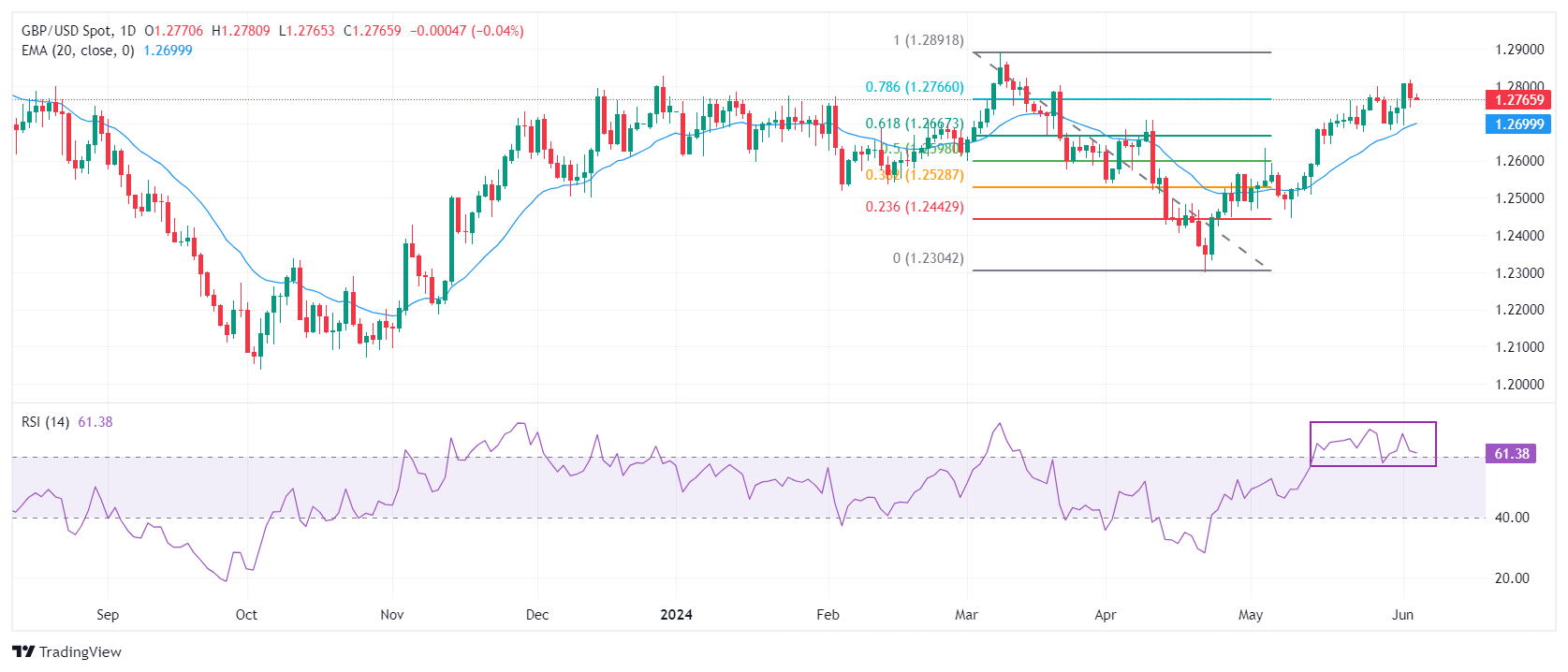
The Pound Sterling trades inside Tuesday’s trading range, suggesting indecisiveness among market participants. The GBP/USD pair struggles to sustain above the 78.6% Fibonacci retracement support (plotted from the March 8 high of 1.2900 to the April 22 low at 1.2300) at 1.2770.
The Cable is expected to remain bullish as the 20-day Exponential Moving Average (EMA) at 1.2700 is sloping higher, indicating a strong uptrend.
The 14-period Relative Strength Index (RSI) has shifted into the 40.00-60.00 range, suggesting that the momentum has leaned toward the upside.
Economic Indicator
ISM Services PMI
The Institute for Supply Management (ISM) Services Purchasing Managers Index (PMI), released on a monthly basis, is a leading indicator gauging business activity in the US services sector, which makes up most of the economy. The indicator is obtained from a survey of supply executives across the US based on information they have collected within their respective organizations. Survey responses reflect the change, if any, in the current month compared to the previous month. A reading above 50 indicates that the services economy is generally expanding, a bullish sign for the US Dollar (USD). A reading below 50 signals that services sector activity is generally declining, which is seen as bearish for USD.
Read more.Last release: Wed Jun 05, 2024 14:00
Frequency: Monthly
Actual: 53.8
Consensus: 50.8
Previous: 49.4
Source: Institute for Supply Management
The Institute for Supply Management’s (ISM) Services Purchasing Managers Index (PMI) reveals the current conditions in the US service sector, which has historically been a large GDP contributor. A print above 50 shows expansion in the service sector’s economic activity. Stronger-than-expected readings usually help the USD gather strength against its rivals. In addition to the headline PMI, the Employment Index and the Prices Paid Index numbers are also watched closely by investors as they provide useful insights regarding the state of the labour market and inflation.
Author

Sagar Dua
FXStreet
Sagar Dua is associated with the financial markets from his college days. Along with pursuing post-graduation in Commerce in 2014, he started his markets training with chart analysis.