Pound Sterling gains sharply against US Dollar on slower US inflation growth
- The Pound Sterling gains against the US Dollar after the release of the UK employment and the US inflation data.
- The US inflation cooled down in April, the headline CPI decelerated to 2.3%.
- Soft UK labor market data paves the way for more BoE interest-rate cuts.

The Pound Sterling (GBP) jumps to near 1.3250 against the US Dollar (USD) during North American trading hours on Tuesday. The GBP/USD pair strengthens as the US Dollar falls back after the United States (US) Consumer Price Index (CPI) report showed that inflationary pressures cooled down in April. The US Dollar Index (DXY), which tracks the Greenback’s value against six major currencies, retraces to near 101.40 from its monthly high around 102.00 posted on Monday.
The US headline CPI rose by 2.3% year-on-year, slower than estimates and the March reading of 2.4%. In the same period, the core CPI - which strips off volatile food and energy prices - grew steadily by 2.8%, as expected. On month, both headline and core CPI rose moderately by 0.2%, compared to estimates of 0.3%.
Soft CPI data is unlikely to drive Federal Reserve (Fed) dovish bets higher as officials are still concerned about inflation moving higher despite the US and China have agreed to lower tariffs for a 90-day period.
After the temporary US-China trade truce, Fed Governor Adriana Kugler stated that tariffs are still steep and will result in an increase in inflationary pressures and an economic slowdown. “[I] still expect an increase in prices and slowdown in the economy, though not at the same rate as before,” Kugler said, downplaying the chances of reducing interest rates. Kugler also said that the 90-day pause on import levies at levels that threatened to shut down bilateral trade reduces chances that the US central bank will need to lower interest rates in response to an economic slowdown, Reuters reported.
On Monday, the US and China agreed to a 90-day truce after a two-day meeting in Switzerland over the weekend. In a joint statement, the US and China have announced that they have lowered tariffs by 115 percentage points.
Washington reported that import duties on Beijing still have the 20% fentanyl levy, but assured that there have been “constructive discussions” to resolve it. However, Beijing reported in a statement during European trading hours that the fentanyl issue is a matter for the US and not its responsibility. The Chinese Foreign Ministry added that the 20% tariffs imposed on China due to the matter are "unreasonable".
Daily digest market movers: The next trigger for Pound Sterling will be UK Q1 GDP data
- The Pound Sterling trades mixed against its peers on Tuesday after the release of the United Kingdom (UK) labor market data for the three months ending March. The Office for National Statistics (ONS) reported that the ILO Unemployment Rate accelerated to 4.5%, as expected, from 4.4% in the three months ending February. In the same period, the economy added 112K fresh workers, significantly lower than the prior release of 206K.
- Slowing UK job growth reflects the impact of the increase in employers’ contributions to social security schemes and caution among business owners in anticipation of tariffs by US President Donald Trump. The report didn’t capture any effects from the tariff reduction agreement between the US and the UK, as it was announced way after the collection of the data.
- Additionally, cooling Average Earnings data is also unfavorable for the British currency. Average Earnings Excluding Bonuses, a key measure of wage growth, grew moderately by 5.6%, against estimates of 5.7% and the prior release of 5.9%. The wage growth measure including bonuses rose by 5.5%, faster than expectations of 5.2% but slower than the former reading of 5.6%.
- Cooling employment and softening wage growth pave the way for more interest rate cuts by the Bank of England (BoE). Last week, the BoE slashed its borrowing rates by 25 basis points (bps) to 4.25% and retained a “gradual and careful” monetary expansion approach.
- This week, investors brace for more volatility in the Pound Sterling as the preliminary UK Q1 Gross Domestic Product (GDP) and Industrial and Manufacturing Production data will be released on Thursday. The UK economy is expected to have grown by 0.6% in the first quarter of the year. Before that, US data will be published during Tuesday’s session.
Technical Analysis: Pound Sterling holds 200-period EMA
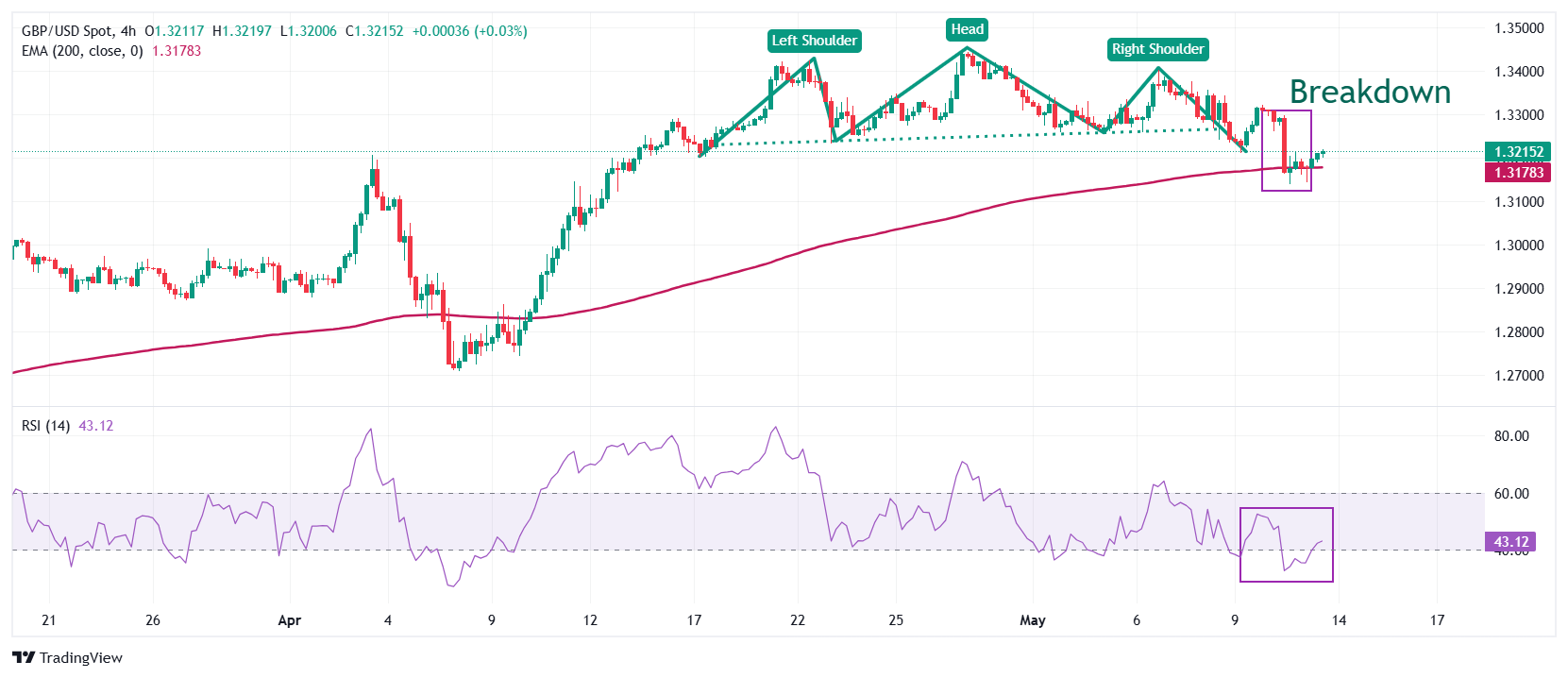
The Pound Sterling rises to near 1.3240 against the US Dollar on Tuesday. However, the outlook of the pair has turned bearish after breaking down from a Head and Shoulder (H&S) formation on the four-hour timeframe. A breakdown of the H&S chart pattern leads to a bearish reversal, and its formation near a critical resistance level increases its credibility.
The Cable slides near the 200-period Exponential Moving Average (EMA), which is around 1.3190, suggesting a bearish trend.
The 14-period Relative Strength Index (RSI) rebounds above 40.00 after sliding to near 33.00, indicating that the downside momentum has been defused. However, the bearish bias still prevails.
On the upside, the three-year high of 1.3445 will be a key hurdle for the pair. Looking down, the psychological level of 1.3000 will act as a major support area.
Inflation FAQs
Inflation measures the rise in the price of a representative basket of goods and services. Headline inflation is usually expressed as a percentage change on a month-on-month (MoM) and year-on-year (YoY) basis. Core inflation excludes more volatile elements such as food and fuel which can fluctuate because of geopolitical and seasonal factors. Core inflation is the figure economists focus on and is the level targeted by central banks, which are mandated to keep inflation at a manageable level, usually around 2%.
The Consumer Price Index (CPI) measures the change in prices of a basket of goods and services over a period of time. It is usually expressed as a percentage change on a month-on-month (MoM) and year-on-year (YoY) basis. Core CPI is the figure targeted by central banks as it excludes volatile food and fuel inputs. When Core CPI rises above 2% it usually results in higher interest rates and vice versa when it falls below 2%. Since higher interest rates are positive for a currency, higher inflation usually results in a stronger currency. The opposite is true when inflation falls.
Although it may seem counter-intuitive, high inflation in a country pushes up the value of its currency and vice versa for lower inflation. This is because the central bank will normally raise interest rates to combat the higher inflation, which attract more global capital inflows from investors looking for a lucrative place to park their money.
Formerly, Gold was the asset investors turned to in times of high inflation because it preserved its value, and whilst investors will often still buy Gold for its safe-haven properties in times of extreme market turmoil, this is not the case most of the time. This is because when inflation is high, central banks will put up interest rates to combat it. Higher interest rates are negative for Gold because they increase the opportunity-cost of holding Gold vis-a-vis an interest-bearing asset or placing the money in a cash deposit account. On the flipside, lower inflation tends to be positive for Gold as it brings interest rates down, making the bright metal a more viable investment alternative.
Author

Sagar Dua
FXStreet
Sagar Dua is associated with the financial markets from his college days. Along with pursuing post-graduation in Commerce in 2014, he started his markets training with chart analysis.

















