Pound Sterling tumbles against US Dollar, Fed Powell's speech in focus
- The Pound Sterling falls sharply below 1.3000 against the US Dollar despite Trump’s reciprocal tariffs have dampened the US economic outlook.
- The US economy hired 228K new workers in March. The Unemployment Rate accelerated to 4.2%.
- The UK economy appears to be in a better position among all US trading partners after the release of Trump’s detailed reciprocal tariff plan.

The Pound Sterling (GBP) gives up significant Thursday gains and plunges below 1.3000 against the US Dollar (USD) during North American trading hours on Friday. The GBP/USD pair weakens as the US Dollar (USD) rebounds after United States (US) President Donald Trump's reciprocal tariffs-driven sell-off came on Thursday. However, the outlook of the US Dollar remains weak as investors expect Trump's tariffs will stoke inflation and weigh on domestic economic growth.
In the US, firms were already worried that tariffs could potentially impact business activity, and now, harsher-than-expected duties would weaken their confidence further. The Institute for Supply Management (ISM) showed this week that the New Orders Index of March in both the manufacturing and the services sector came in significantly lower than in February.
During North American trading hours, upbeat US Nonfarm Payrolls (NFP) data has also provided some support to the US Dollar. According to the NFP report, the economy added 228K fresh workers, significantly higher than the estimates of 135K and the former reading of 117K, downwardly revised from 151K. The Unemployment Rate accelerated to 4.2% against estimates and the prior release of 4.1%.
Average Hourly Earnings, a key measure of wage growth, rose moderately by 3.8% year-on-year compared to expectations of 3.9% and the former reading of 4%.
The impact of the employment data would be limited on market expectations for the Federal Reserve's monetary policy outlook as officials are more concerned about upside risks to inflation due to Trump’s tariffs.
In Friday's session, investors will also focus on Fed Chair Jerome Powell’s speech to know how the central bank will battle potential tariff-driven inflation. Market participants would like to know whether the Fed will compromise its 2% inflation objective to address likely economic shocks.
Daily digest market movers: Pound Sterling underperforms on global growth concerns
- The Pound Sterling underperforms its major peers, except antipodeans, on Friday. The British currency faces pressure as investors expect the United Kingdom (UK) economy to face significant pressure from potential global economic risks even though the country is in a better position among trading partners of the US after the so-called “Liberation Day”, which was April 2. No country can work in isolation as globalization has provided a platform to all nations to explore new markets for their products.
- US President Donald Trump imposed 10% tariffs on the UK, the lowest figure on duty rates for all trading partners. Investors worry that nations that have attracted higher tariffs, such as China, the Eurozone, India, and South Africa, would look for other avenues to export their products. Such a scenario would promote activities like dumping, making products from the UK less competitive in the global market.
- Ahead of Trump’s tariff announcement, the UK Office for Business Responsibility (OBR) warned on Monday that Trump’s policies could wipe out the government fiscal buffer and cut the economy’s size by as much as 1%.
- On the so-called “Liberation Day”, Trump swept a universal 10% baseline import duty, along with reciprocal tariffs on almost all of its trading partners, which were half of what they charge from the US. Trump's tariffs have jolted global equity markets as plans for fresh investments by business owners have been jeopardized.
- Market experts believe that the imposition of full-scale import duties and potential countermeasures by US trading partners could temper global economic growth for a longer term. On Thursday, International Monetary Fund (IMF) Managing Director Kristalina Georgieva commented that higher levies by US President Trump clearly represent a “significant risk to the global outlook at a time of sluggish growth”. Georgieva urged the US and its trading partners to work constructively to “resolve trade tensions and reduce uncertainty”.
- Meanwhile, investors brace for more inflation in the UK as business owners would look to pass on the impact of higher contributions to social security schemes. In the Autumn Statement, Chancellor of the Exchequer Rachel Reeves raised employers’ contributions to National Insurance (NI) from 13.8% to 15%, which became effective this month.
- Fears of a resurgence in inflation in the UK would firm market expectations that the Bank of England (BoE) will maintain a moderate policy-easing approach.
Technical Analysis: Pound Sterling struggles around 1.3000
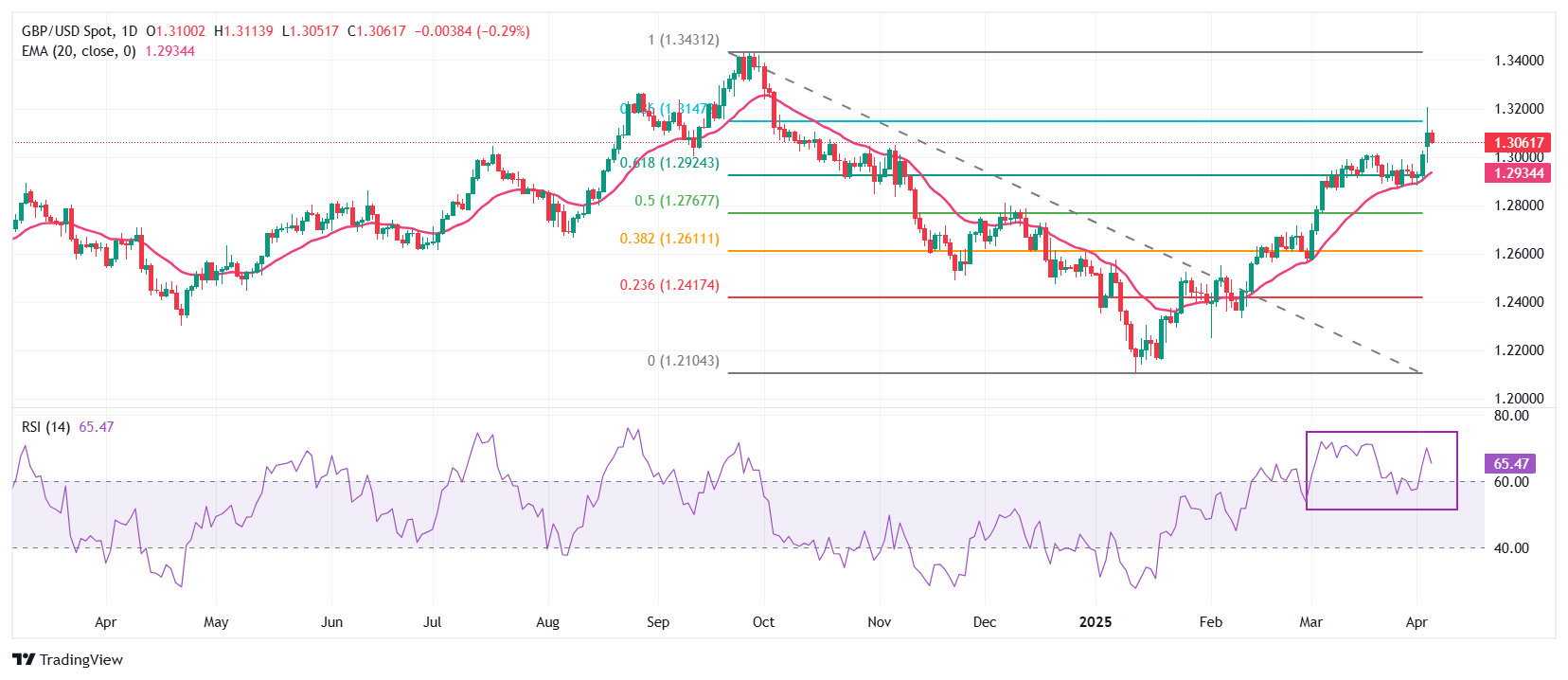
The Pound Sterling falls back below 1.3000 against the US Dollar on Friday after giving up gains made prior the day. The GBP/USD pair rallied on Thursday after building base around the 61.8% Fibonacci retracement, plotted from late-September high to mid-January low, near 1.2930. The upward-sloping 20-day Exponential Moving Average (EMA) near 1.2934 suggests that the near-term outlook is bullish.
The 14-day Relative Strength Index (RSI) holds above 60.00, indicating an active bullish momentum.
Looking down, the 61.8% Fibonacci retracement at 1.2930 will act as a key support zone for the pair. On the upside, the September 26 high of 1.3434 will act as a key resistance zone.
Economic Indicator
Nonfarm Payrolls
The Nonfarm Payrolls release presents the number of new jobs created in the US during the previous month in all non-agricultural businesses; it is released by the US Bureau of Labor Statistics (BLS). The monthly changes in payrolls can be extremely volatile. The number is also subject to strong reviews, which can also trigger volatility in the Forex board. Generally speaking, a high reading is seen as bullish for the US Dollar (USD), while a low reading is seen as bearish, although previous months' reviews and the Unemployment Rate are as relevant as the headline figure. The market's reaction, therefore, depends on how the market assesses all the data contained in the BLS report as a whole.
Read more.Last release: Fri Apr 04, 2025 12:30
Frequency: Monthly
Actual: 228K
Consensus: 135K
Previous: 151K
Source: US Bureau of Labor Statistics
America’s monthly jobs report is considered the most important economic indicator for forex traders. Released on the first Friday following the reported month, the change in the number of positions is closely correlated with the overall performance of the economy and is monitored by policymakers. Full employment is one of the Federal Reserve’s mandates and it considers developments in the labor market when setting its policies, thus impacting currencies. Despite several leading indicators shaping estimates, Nonfarm Payrolls tend to surprise markets and trigger substantial volatility. Actual figures beating the consensus tend to be USD bullish.
BRANDED CONTENT
Finding the right broker for your trading strategy is essential, especially when specific features make all the difference. Explore our selection of top brokers, each offering unique advantages to match your needs.
Author

Sagar Dua
FXStreet
Sagar Dua is associated with the financial markets from his college days. Along with pursuing post-graduation in Commerce in 2014, he started his markets training with chart analysis.