Pound Sterling rises on BoE's hawkish stance, lower US CPI revision
- Pound Sterling rebounds sharply as BoE Haskel, Mann maintain hawkish stance.
- The UK Employment and inflation data will provide fresh guidance on interest rates.
- Downwardly revised US monthly CPI for December weighs on the US Dollar.

The Pound Sterling (GBP) rebounds sharply in Friday's early New York session. The GBP/USD pair refreshes day high after Bank of England (BoE) policymaker Jonathan Hasker said signals of easing price pressures are encouraging but are insufficient to return to expansionary policy stance.
On Thursday, BoE Catherine Mann also maintained a hawkish stance as risks to inflation shocks have leaned on the upside due to the deepening Red Sea crisis. The Pound Sterling tends to attract higher foreign inflows if the BoE keeps interest rates restrictive for longer.
While Catherine Mann supports further policy tightening, other policymakers, such as Bank of England Chief Economist Huw Pill and Deputy Governor Sarah Breeden, discuss how long interest rates should be kept at their current level.
Amid an absence of precise guidance on interest rates by BoE policymakers, the United Kingdom’s labor market and inflation data will be keenly watched by the market participants scheduled for next week. Softening price pressures and easing labor market conditions could propel hopes of early rate cuts by the BoE, weighing on the Pound.
Meanwhile, the revised United States Consumer Price Index (CPI) figures by the Bureau of Labor Statistics (BLS) has impacted the US Dollar. The BLS showed that monthly headline inflation grew by 0.2% against the release of 0.3%. The agency believes that the addition of new seasonal adjusted factors will improve accuracy in reflecting how prices behaved over the year.
Daily Digest Market Movers: Pound Sterling revives while US Dollar falls on backfoot
- Pound Sterling refreshes the day's high at 1.2630 as Bank of England policymakers deliver hawkish guidance on interest rates.
- This week, BoE Chief Economist Huw Pill and Deputy Governor Sarah Breeden said fears of persistent inflation are well contained in the forecasted range.
- Contrary to them, BoE policymaker Catherine Mann remains worried about deepening supply chain disruptions due to the crisis in the Red Sea.
- On Thursday, Catherine Mann said trade-route issues between Asia and Europe could propel corporate pricing, which will result in a stubborn inflation outlook.
- Catherine Mann is one of two policymakers who voted for an interest rate hike by 25 basis points (bps) in the last monetary policy meeting. She said her hawkish vote was based on upside risks to inflationary pressures.
- Going forward, investors await economic data that could provide a fresh outlook on interest rates. Upbeat wage growth data out next week could push back expectations of early rate cuts by the
- Meanwhile, the US Dollar, measured by the DXY Index, surrendered its recovery and came back inside a three-day trading range.
- The US Dollar Index (DXY) remains lackluster in the past three trading sessions as no Federal Reserve policymakers provided a concrete time frame for rate cuts.
- Geopolitical uncertainty has led to a gloomy market mood, as Israeli Prime Minister Benjamin Netanyahu rejected a ceasefire proposal, citing truce terms proposed by Hamas as delusional.
- Meanwhile, investors await the United States inflation data for January, which is scheduled for Tuesday. The consumer price inflation data will provide a fresh outlook on interest rates.
Technical Analysis: Pound Sterling recaptures 1.2600
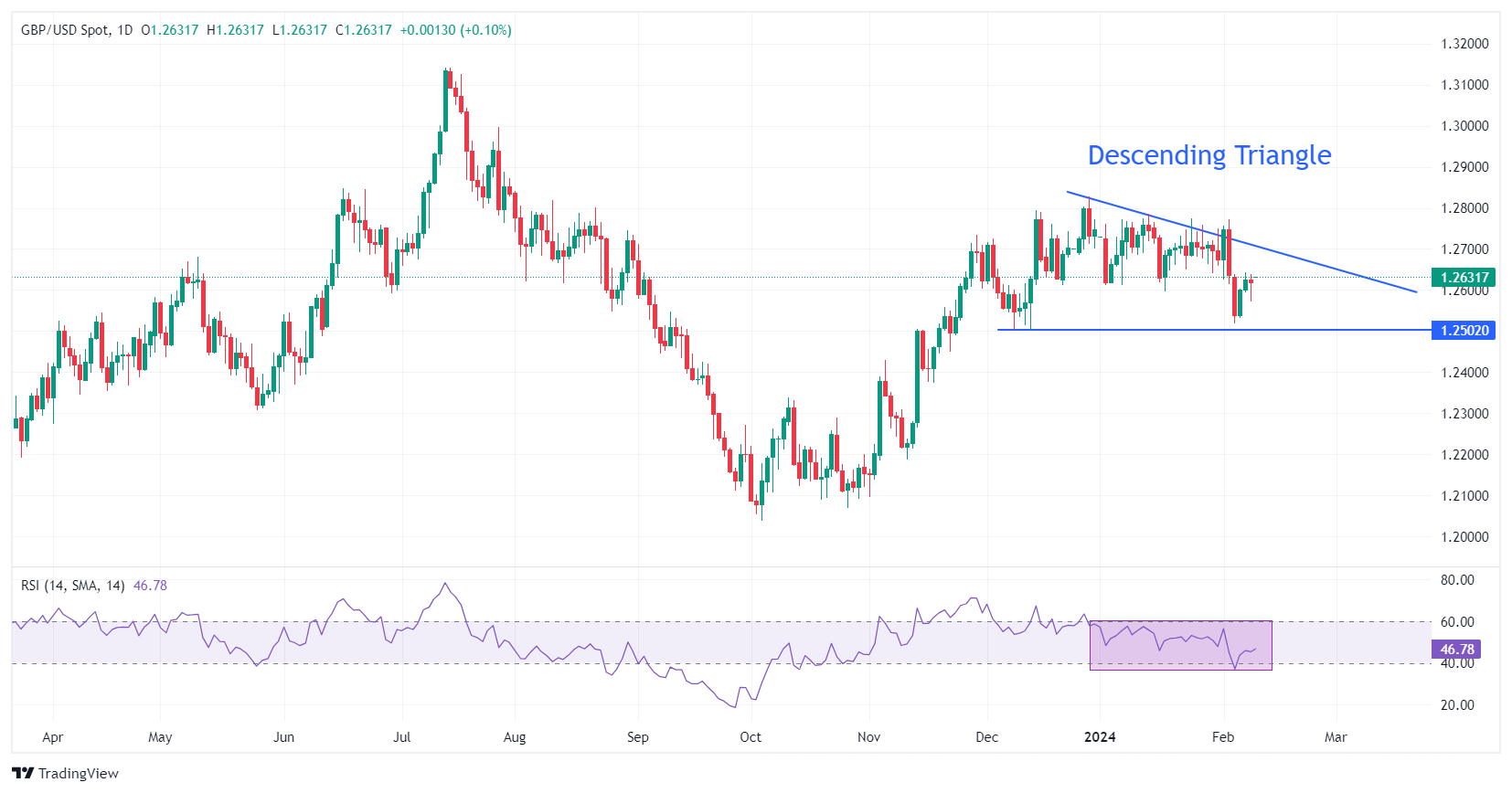
Pound Sterling oscillates in a tight range of 1.2580-1.2640 for the past three trading sessions amid uncertainty over the timing of rate cuts by the BoE and the Fed. The GBP/USD pair trades in a Descending Triangle chart pattern formed on a daily time frame, which indicates a volatility contraction but with a downside bias.
Downward-sloping trendline of the descending triangle formation is plotted from December 28 high at 1.2827 while the horizontal support is placed from December 13 low around 1.2500.
The 14-period Relative Strength Index (RSI) oscillates in the 40.00-60.00 range, indicating a probable consolidation ahead.
BoE FAQs
What does the Bank of England do and how does it impact the Pound?
The Bank of England (BoE) decides monetary policy for the United Kingdom. Its primary goal is to achieve ‘price stability’, or a steady inflation rate of 2%. Its tool for achieving this is via the adjustment of base lending rates. The BoE sets the rate at which it lends to commercial banks and banks lend to each other, determining the level of interest rates in the economy overall. This also impacts the value of the Pound Sterling (GBP).
How does the Bank of England’s monetary policy influence Sterling?
When inflation is above the Bank of England’s target it responds by raising interest rates, making it more expensive for people and businesses to access credit. This is positive for the Pound Sterling because higher interest rates make the UK a more attractive place for global investors to park their money. When inflation falls below target, it is a sign economic growth is slowing, and the BoE will consider lowering interest rates to cheapen credit in the hope businesses will borrow to invest in growth-generating projects – a negative for the Pound Sterling.
What is Quantitative Easing (QE) and how does it affect the Pound?
In extreme situations, the Bank of England can enact a policy called Quantitative Easing (QE). QE is the process by which the BoE substantially increases the flow of credit in a stuck financial system. QE is a last resort policy when lowering interest rates will not achieve the necessary result. The process of QE involves the BoE printing money to buy assets – usually government or AAA-rated corporate bonds – from banks and other financial institutions. QE usually results in a weaker Pound Sterling.
What is Quantitative tightening (QT) and how does it affect the Pound Sterling?
Quantitative tightening (QT) is the reverse of QE, enacted when the economy is strengthening and inflation starts rising. Whilst in QE the Bank of England (BoE) purchases government and corporate bonds from financial institutions to encourage them to lend; in QT, the BoE stops buying more bonds, and stops reinvesting the principal maturing on the bonds it already holds. It is usually positive for the Pound Sterling.
Author

Sagar Dua
FXStreet
Sagar Dua is associated with the financial markets from his college days. Along with pursuing post-graduation in Commerce in 2014, he started his markets training with chart analysis.

















