Pound Sterling outperforms on key UK data, US NFP eyed
- The Pound Sterling rebounds against its major peers after the release of the UK employment data.
- UK’s wage growth grew faster than projected, while labor demand remained weak in the three months ending October.
- Investors await the US NFP data for fresh cues on the Fed interest rate outlook.

The Pound Sterling (GBP) extend its intraday upside move against its major currency peers on Tuesday, following the release of the United Kingdom (UK) preliminary S&P Global Purchasing Managers' Index (PMI) data for December, and the labour market data for the three months ending in October.
The UK Composite PMI comes in at 52.1, higher from estimates of 51.4 and the November's reading of 51.2. The Composite PMI expanded sharply due to improvement in both manufacturing and the services sector activity. The Services and the Manufacturing PMI jumps to 52.1 and 51.2, respectively.
The Pound Sterling was already outperforming its peers, earlier in the day, following the release of the employment data. The report showed that Average Earnings Excluding Bonuses, a key measure of wage growth, rose at an annualized pace of 4.6%, faster than estimates of 4.5%. Additionally, the reading of the three-months ending September has been revised higher to 4.7% from 4.6%.
Average Earnings Including Bonuses grew at a faster pace of 4.7%, compared to expectations of 4.4%, but slower than the prior release of 4.9%, revised higher from 4.8%.
However, the upside reaction could falter as the labor demand has deteriorated further, with the ILO Unemployment Rate rising to 5.1%, as expected, from the prior reading of 5%. In addition, the UK labor force has witnessed lay-offs again. The UK economy shed 17K jobs in the three-months ending October, but lower than the prior reading of 22K lay-offs.
Signs of higher-than-projected wage growth and weak labor demand are expected to force Bank of England (BoE) officials to perform a delicate balancing act in the monetary policy meeting on Thursday. According to market expectations, the BoE is expected to cut interest rates by 25 basis points to 3.75%.
Before the monetary policy announcement, investors will also focus on the UK Consumer Price Index (CPI) data for November, which will be released on Wednesday.
Pound Sterling Price Today
The table below shows the percentage change of British Pound (GBP) against listed major currencies today. British Pound was the strongest against the Canadian Dollar.
| USD | EUR | GBP | JPY | CAD | AUD | NZD | CHF | |
|---|---|---|---|---|---|---|---|---|
| USD | -0.08% | -0.36% | -0.25% | 0.04% | 0.03% | 0.01% | -0.07% | |
| EUR | 0.08% | -0.30% | -0.16% | 0.10% | 0.09% | 0.10% | -0.01% | |
| GBP | 0.36% | 0.30% | 0.12% | 0.40% | 0.40% | 0.38% | 0.29% | |
| JPY | 0.25% | 0.16% | -0.12% | 0.28% | 0.28% | 0.25% | 0.17% | |
| CAD | -0.04% | -0.10% | -0.40% | -0.28% | 0.00% | -0.01% | -0.10% | |
| AUD | -0.03% | -0.09% | -0.40% | -0.28% | 0.00% | -0.02% | -0.10% | |
| NZD | -0.01% | -0.10% | -0.38% | -0.25% | 0.01% | 0.02% | -0.09% | |
| CHF | 0.07% | 0.00% | -0.29% | -0.17% | 0.10% | 0.10% | 0.09% |
The heat map shows percentage changes of major currencies against each other. The base currency is picked from the left column, while the quote currency is picked from the top row. For example, if you pick the British Pound from the left column and move along the horizontal line to the US Dollar, the percentage change displayed in the box will represent GBP (base)/USD (quote).
Daily digest market movers: Pound Sterling jumps higher against US Dollar
- The Pound Sterling moves higher to near 1.3425 against the US Dollar (USD) during the European trading hours on Tuesday. The GBP/USD pair strengthens, following key UK data. Investors brace for more action in the Cable as the United States (US) Nonfarm Payrolls (NFP) data for October and November is scheduled to be published at 13:30 GMT.
- During the press time, the US Dollar Index (DXY), which tracks the Greenback’s value against six major currencies, trades weakly near its eight-month low around 98.15.
- Investors will closely monitor the US NFP to get cues on the current labor market status. The US NFP report is expected to show that the economy created 40K fresh jobs in November. Meanwhile, the Unemployment Rate is seen remaining steady at 4.4%.
- The employment data will significantly influence market expectations for the Federal Reserve’s (Fed) monetary policy outlook.
- Broadly, the DXY is underperforming its major peers as traders are increasingly confident that the Fed will deliver more interest rate cuts than projected in last week's policy announcement.
- According to the CME FedWatch tool, there is a 74% chance that the Fed will cut interest rates at least two times by the end of 2026. Meanwhile, the Fed’s dot plot in the Summary of Economic Projections showed that policymakers see the Federal Fund Rate falling to 3.4% by 2026, indicating only one more interest rate cut from current levels of 3.50%-3.75%.
- In Tuesday’s session, investors will also focus on the US Retail Sales data for October and the flash S&P Global Purchasing Managers’ Index (PMI) data for December.
Technical Analysis: GBP/USD extends advance above 1.3400
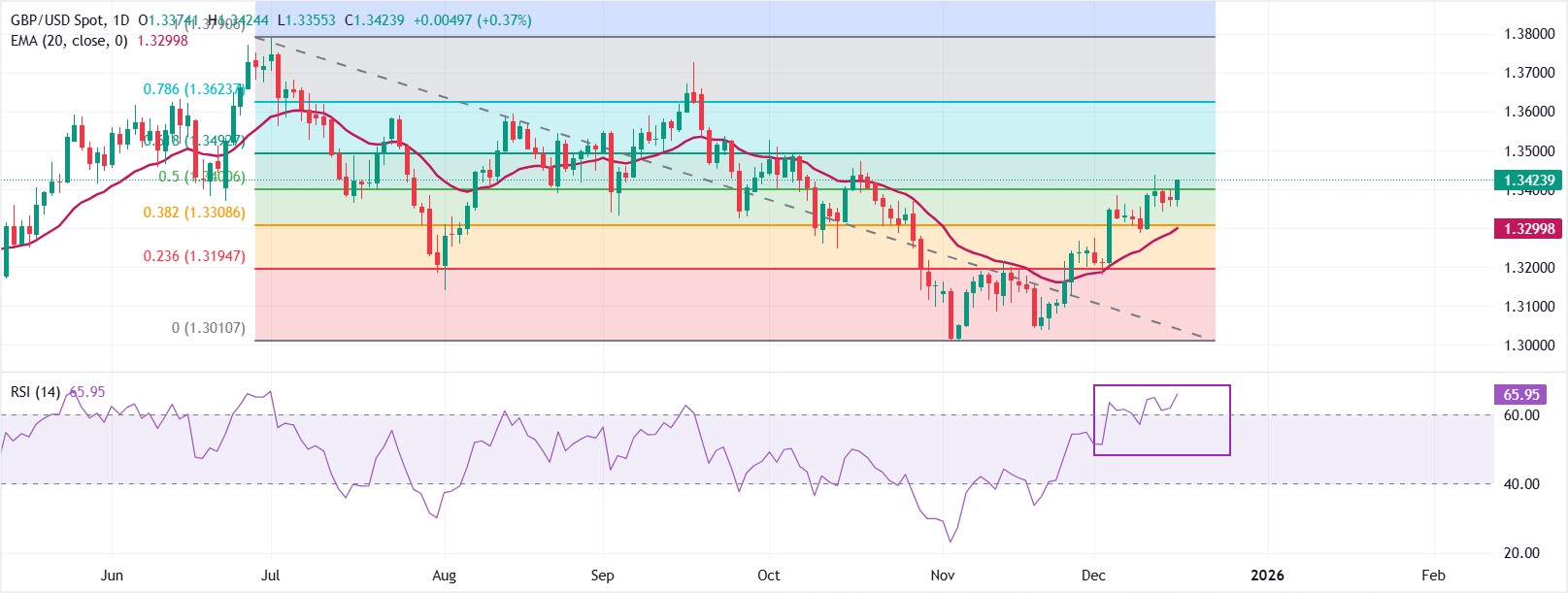
GBP/USD jumps to near 1.3420 as of writing. The pair holds above a rising 20-day Exponential Moving Average (EMA), currently near 1.3300, keeping the near-term bias pointed higher.
The 14-day Relative Strength Index (RSI) near 66.00 reflects positive momentum without overbought conditions.
Measured from the 1.3783 high to the 1.3008 low, the pair attempts to clear 50% Fibonacci retracement at 1.3395, underpinning the bullish tone, and a break higher would extend the rebound towards the 61.8% Fibo retracement at 1.3488. Failure to top the 50% Fibo retracement could see consolidation back toward the moving average.
The trend remains supported while price sustains above the ascending 20-day EMA, though a drop beneath 1.3286 would open the door for further downside towards the December low of 1.3180.
(The technical analysis of this story was written with the help of an AI tool.)
Economic Indicator
ILO Unemployment Rate (3M)
The ILO Unemployment Rate released by the UK Office for National Statistics is the number of unemployed workers divided by the total civilian labor force. It is a leading indicator for the UK Economy. If the rate goes up, it indicates a lack of expansion within the UK labor market. As a result, a rise leads to a weakening of the UK economy. Generally, a decrease of the figure is seen as bullish for the Pound Sterling (GBP), while an increase is seen as bearish.
Read more.Last release: Tue Dec 16, 2025 07:00
Frequency: Monthly
Actual: 5.1%
Consensus: 5.1%
Previous: 5%
Source: Office for National Statistics
The Unemployment Rate is the broadest indicator of Britain’s labor market. The figure is highlighted by the broad media, beyond the financial sector, giving the publication a more significant impact despite its late publication. It is released around six weeks after the month ends. While the Bank of England is tasked with maintaining price stability, there is a substantial inverse correlation between unemployment and inflation. A higher than expected figure tends to be GBP-bearish.
Author

Sagar Dua
FXStreet
Sagar Dua is associated with the financial markets from his college days. Along with pursuing post-graduation in Commerce in 2014, he started his markets training with chart analysis.

















