Political risk and Forex: Why traders can’t ignore the political landscape

The foreign exchange market, also known as Forex, is the world's largest financial market, with several trillion dollars traded daily. Unlike Equity markets, which are influenced by corporate results, Forex is particularly sensitive to political decisions and institutional stability.
Elections, geopolitical tensions, trade policies and central bank decisions directly shape currency values.
In a world where politics and economics are intertwined, understanding this link becomes essential for investors, companies and individuals exposed to currency variations.
Central banks at the heart of the link between policy and currencies
Central banks, such as the US Federal Reserve (Fed) and the European Central Bank (ECB), play a decisive role in currency trends.
Their interest rate and liquidity decisions immediately influence currency values. And while these institutions are supposed to be independent, they are never totally cut off from political pressures.
In the United States, the President appoints the members of the Fed's Board of Governors. US President Donald Trump, for example, has often publicly criticized Fed Chair Jerome Powell when he believed that monetary policy was not sufficiently supportive of growth.
In Europe, the ECB faces a complex equation, defending price stability while taking into account the political tensions between countries in the north and south of the Eurozone.
A signal of monetary loosening is perceived as downward pressure on the currency concerned, while a tightening of interest rates tends to reinforce it.
Political decisions influencing the trajectory of central banks are, therefore, becoming a key factor for Forex traders.
Elections and changes in leadership: Uncertainty as a driver of volatility
Election periods are highly volatile times for currencies. Uncertainty over the future government's economic program, or the stability of its institutions, pushes investors to quickly adjust their positions.
In the United States, since his return to the White House in 2025, Donald Trump has reintroduced an aggressive protectionist trade policy, massively raising tariffs on many imported products.
Far from supporting the US Dollar (USD), these measures have, on the contrary, weighed on the Greenback, as investors fear the impact of new trade wars. Growing uncertainty thus undermined confidence in the US currency, despite its traditional status as a safe-haven asset.
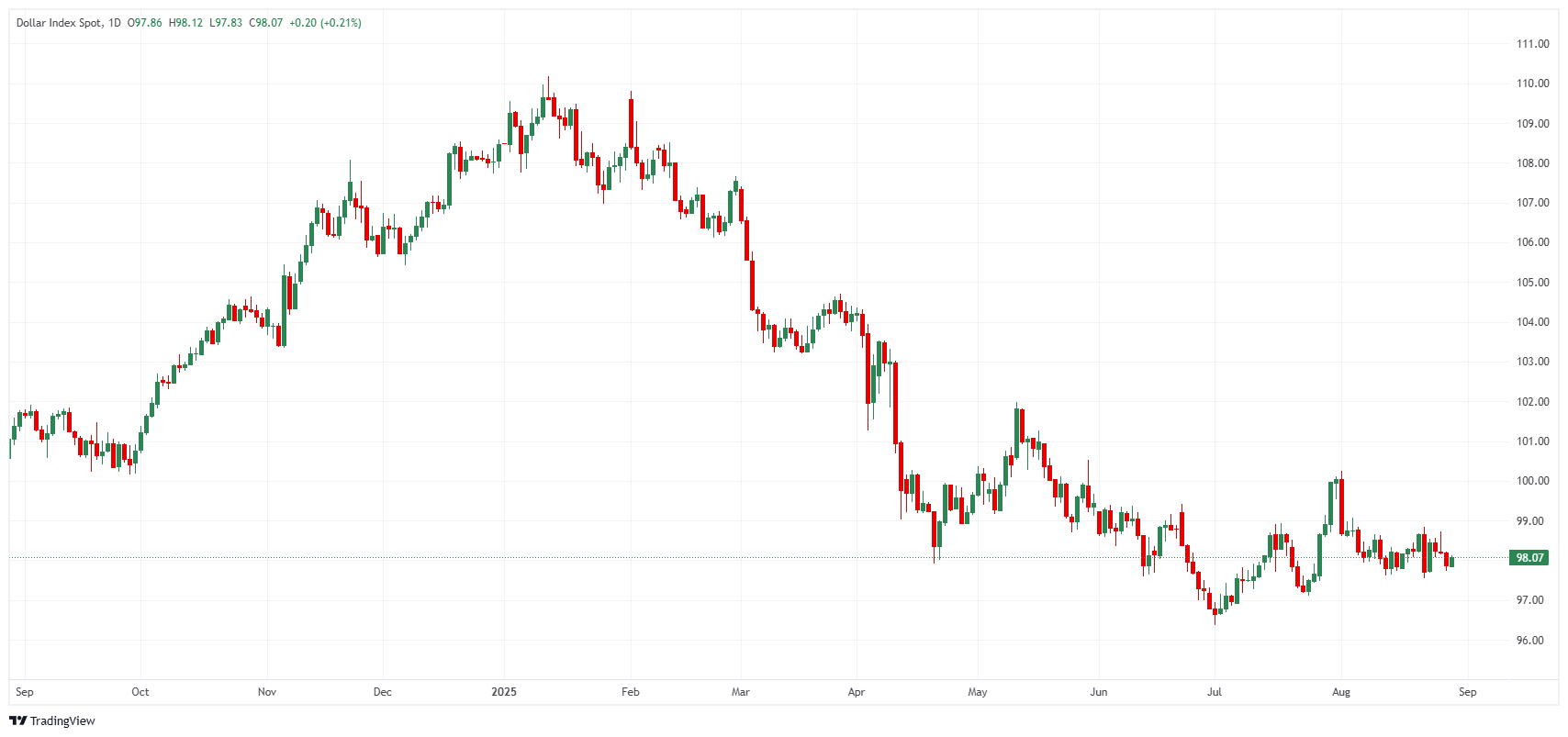
US Dollar Index daily chart. Source: FXStreet.
In Europe, national elections in countries such as Germany, France, Italy and Spain often weighed on the Euro, especially when populist or Eurosceptic parties were in a strong position.
Brexit is the most striking example of this. The announcement of the referendum in 2016 had plunged the Pound (GBP) to historic lows, and its price remains sensitive to British political developments to this day.
More recently, the multiple political crises in France have also regularly had a negative impact on the Euro, due to growing uncertainty.
Geopolitical tensions and the role of sanctions
Economic sanctions have become a political tool that immediately impacts currencies. Russia, hit by sanctions after its invasion of Ukraine, saw its Ruble (RUB) collapse before rebounding thanks to capital controls.
Iran, Venezuela and Turkey also suffered massive currency depreciations as a result of Western measures.
Geopolitical conflicts, for their part, direct flows towards "safe-haven currencies" such as the Swiss Franc (CHF), the Japanese Yen (JPY) or the US Dollar, accentuating market movements.
Populism, nationalism and the political use of currencies
The rise of populist and nationalist parties in many parts of the world is also having a lasting impact on Forex. These governments tend to favor protectionist policies and direct currency intervention.
Some economies do not hesitate to practice competitive devaluation to boost their exports, as China has often been accused of doing with the Yuan (CNY).
Turkey illustrates another scenario. President Recep Tayyip Erdoğan's determination to impose low interest rates despite galloping inflation has caused the Turkish Lira (TRY) to plummet, eroding international confidence in the country's monetary policy.
How investors can navigate this landscape
For foreign exchange traders, politics is an inescapable risk factor. There are several strategies for dealing with this volatility:
- Follow political news in real time: A speech by the Fed, a statement by US President Donald Trump or an unexpected vote in the European Parliament can trigger instantaneous movements on Forex.
- Diversify positions to avoid dependence on a single geographic zone.
- Turn to safe-haven assets such as the US Dollar, Japanese Yen, Swiss Franc or Gold during periods of great uncertainty.
- Use hedging instruments, such as options or futures, to protect against sudden movements.
The Forex market is a reflection of global political tensions. The decisions of leaders, whether Donald Trump in the United States, European institutions such as the ECB, or nationalist parties in Europe or Latin America, directly shape currency values.
Against a backdrop of fragile globalization and heightened trade rivalries, politics is increasingly influencing capital flows and therefore currencies.
For traders and investors, keeping a close eye on political developments is not just an option; it's a prerequisite for anticipating trends and protecting positions.
Author

Ghiles Guezout
FXStreet
Ghiles Guezout is a Market Analyst with a strong background in stock market investments, trading, and cryptocurrencies. He combines fundamental and technical analysis skills to identify market opportunities.