Broadcom, CrowdStrike both sell-off afterhours on earnings beats
- Broadcom sells off 5% despite reporting 48% YoY revenue growth.
- CrowdStrike issued a slim beat for Q1 with EPS and revenue both beating consensus by about 2%.
- AVGO stock sinks despite raising Q3 guidance.
- CrowdStrike announces a 4-for-1 stock split.

Broadcom (AVGO), the $2 trillion semiconductor powerhouse, shed weight afterhours on Wednesday after delivering a solid earnings report that bested Wall Street Consensus. In a similar fashion, cybersecurity major CrowdStrike (CRWD) lost more than 9% despite reporting above the top and bottom line analyst projection.
Broadcom stock sold off more than 5% despite reporting revenue growth of 48% YoY in its fiscal second quarter. The connectivity and infrastructure software firm reported adjusted earnings per share (EPS) of $2.44, $0.04 ahead of consensus, on $22.19 billion in revenue, $70 million above consensus. Those beats appear to have been too slim for investors.
Of Broadcom's full revenue in the quarter, $15.01 billion came from its semiconductors business, up 79% YoY, while software infrastructure revenue rose 9% to $7.18 billion. For fiscal Q3, the company said to expect $29.4 billion in revenue, more than $1 billion ahead of analyst consensus.
CrowdStrike reported adjusted EPS of $1.10, $0.03 better than consensus, on $1.39 billion in revenue, $30 million better than Wall Street expected. The company saw net new annual recurring revenue rise 32% YoY to $256 million in Q1. Management raised its full-year guidance slightly and announced a 4-for-1 stock split.
The stock market's reaction to the earnings releases was in line with many other AI-adjacent stocks during this earnings season. Earlier this week, both Credo Technology Group (CRDO) and Palo Alto Networks (PANW) turned in terrific quarters only to face a cascade of selling by shareholders. Earlier in earnings season, Microsoft (MSFT) and Meta Platforms (META) demonstrated that beating the Street's estimates wasn't enough to forestall a sell-off.
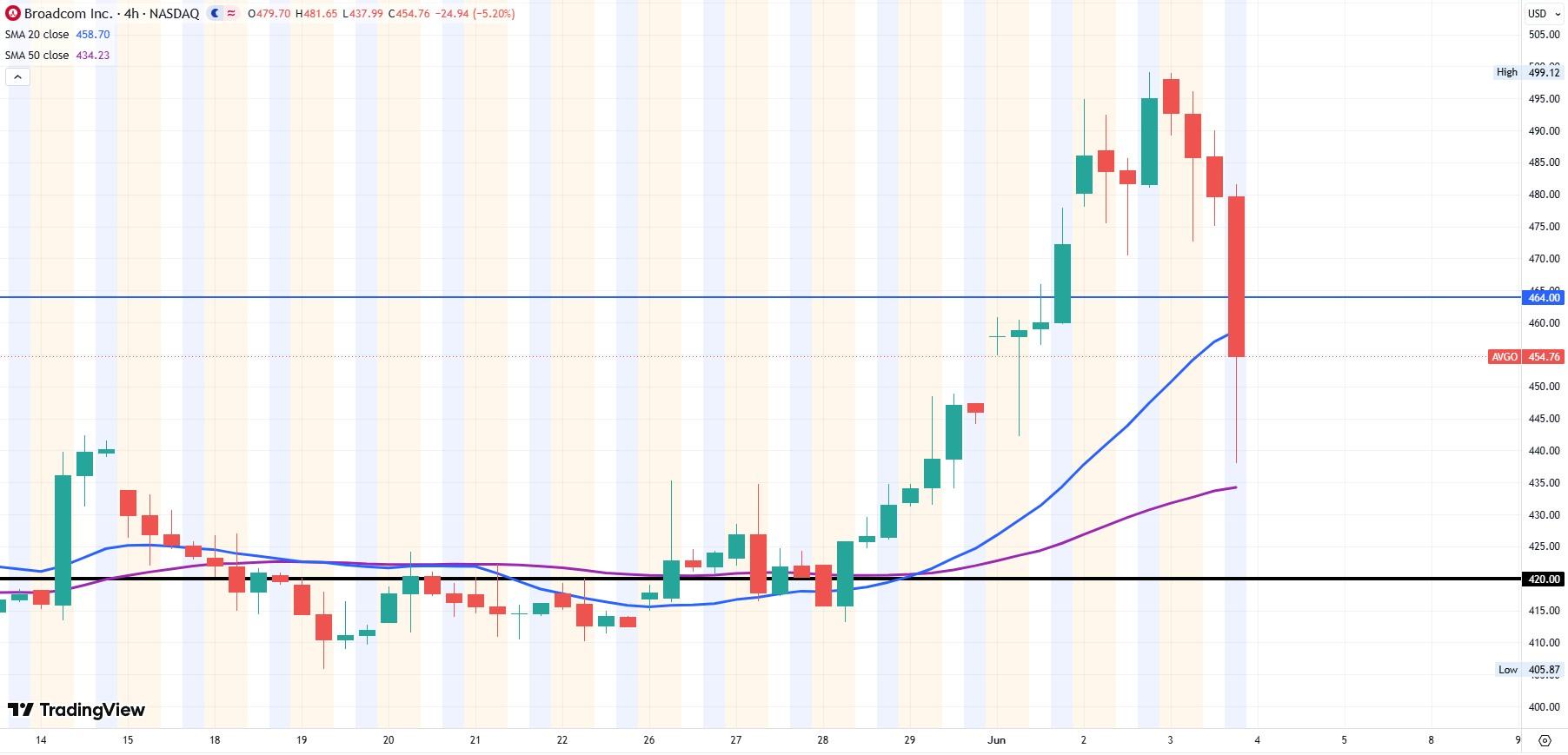
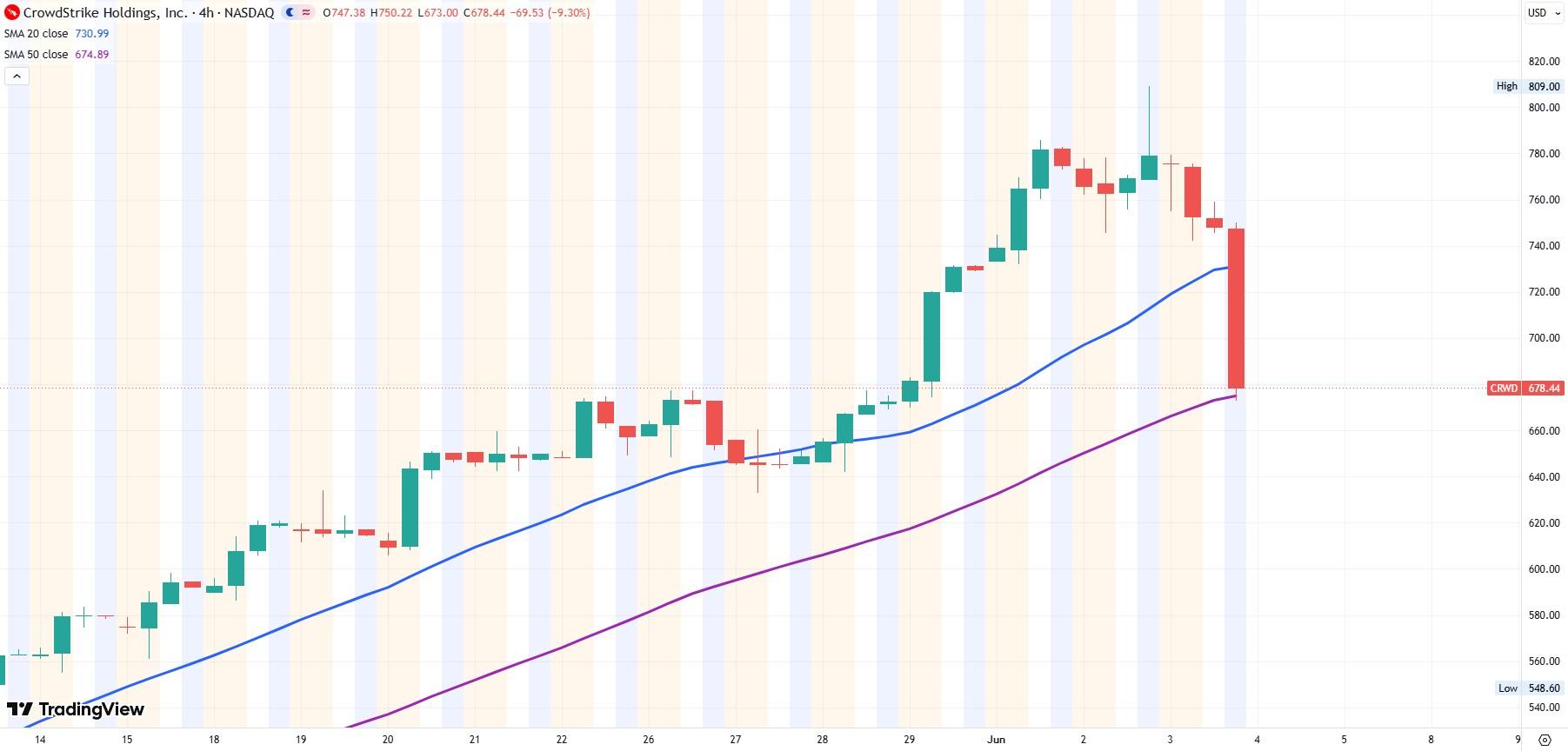
Broadcom and CrowdStrike stock charts
Broadcom stock broke below the 20-period Simple Moving Average (SMA) on its 4-hour chart. That tells us the bearish instinct is real and could lead the share price to move toward the 50-period SMA in short order. The 50-period SMA sits near $434 for the moment.
A break below the 50-period SMA should mean that bears retest the $420 price level. A volume zone sits between $405 and $420, which would make it ideal for bulls to re-enter the trade. Bulls won't regain the advantage until the share price moves back above the 20-period SMA and then the small shelf near $460.
CrowdStrike fell right through its own 20-period SMA to find support at its 50-period average. That means it's in a worse setup than Broadcom. The 50-period SMA coincides with the resistance from May 22 through 26. Below there lies minimal support at $645 and $620.
Author

Clay Webster
FXStreet
Clay Webster grew up in the US outside Buffalo, New York and Lancaster, Pennsylvania. He began investing after college following the 2008 financial crisis.














