|

Platinum Price Analysis: XPT/USD rebound remains elusive below $1,060

  • Platinum prices remain positive for the second consecutive day inside rising wedge bearish formation.
  • Convergence of 100-SMA, 200-SMA appears tough nut to crack for bulls.
  • Downside break of $1,020 will challenge the yearly low.

Platinum (XPT/USD) extends the previous day’s rebound from a weekly low, up 0.54% intraday around $1,030 heading into Friday’s European session.

Despite rising for the second day in a line, the precious metal portrays a one-week-old rising wedge bearish chart pattern, which in turn tests the upside momentum around $1,051.

Even if the commodity prices rally beyond $1,051, a convergence of the 100 and 200 SMAs will join the 38.2% Fibonacci retracement (Fibo.) of early March downturn to highlight the $1,061 as a crucial resistance.

It’s worth noting that the MACD conditions signal that the buyers don’t have control, which in turn suggests the pullback moves.

However, the quote’s run-up beyond $1,061 won’t hesitate to challenge the March 10 swing high near $1,105.

Meanwhile, pullback moves remain less important until staying above the stated wedge’s lower line, at $1,020 by the press time.

Following that, a south-run towards the $1,000 psychological magnet and then to the yearly bottom surrounding $922 can’t be ruled out.

Platinum: Four-hour chart
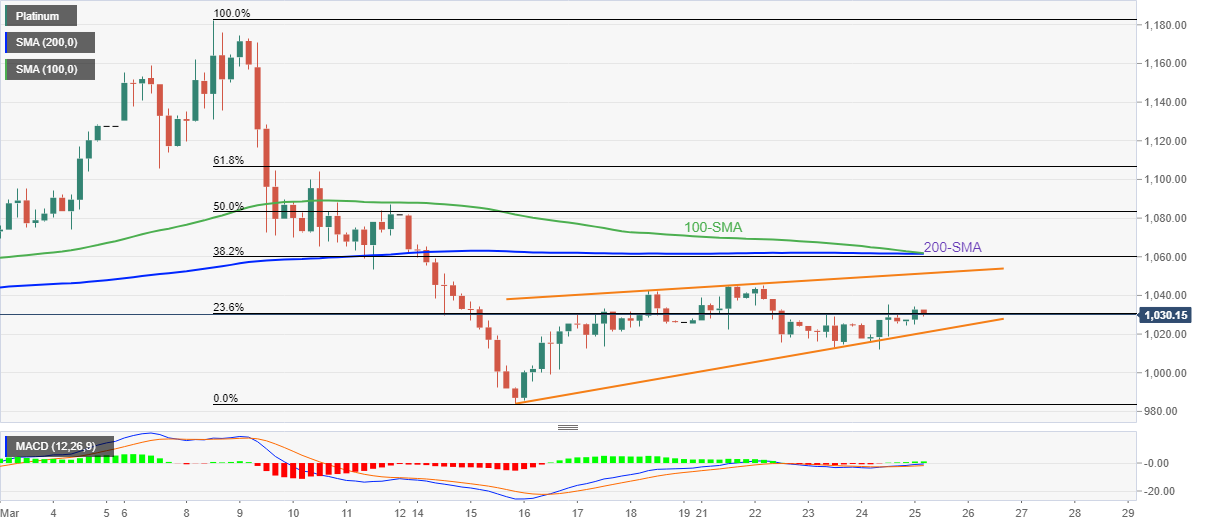
Trend: Pullback expected

Additional important levels

Overview
Today last price1030.46
Today Daily Change5.68
Today Daily Change %0.55%
Today daily open1024.78
 
Trends
Daily SMA201062.69
Daily SMA501052.09
Daily SMA1001008.73
Daily SMA2001008.97
 
Levels
Previous Daily High1035.31
Previous Daily Low1012.25
Previous Weekly High1081.91
Previous Weekly Low984.35
Previous Monthly High1129.06
Previous Monthly Low1008.03
Daily Fibonacci 38.2%1026.5
Daily Fibonacci 61.8%1021.06
Daily Pivot Point S11012.92
Daily Pivot Point S21001.05
Daily Pivot Point S3989.86
Daily Pivot Point R11035.98
Daily Pivot Point R21047.17
Daily Pivot Point R31059.04

Author

Anil Panchal

Anil Panchal

FXStreet

Anil Panchal has nearly 15 years of experience in tracking financial markets. With a keen interest in macroeconomics, Anil aptly tracks global news/updates and stays well-informed about the global financial moves and their implications.


More from Anil Panchal
Share:

Editor's Picks

AUD/USD bulls regain control above 0.6950 amid USD retreat

AUD/USD regains traction and extends the previous day's bounce from the weekly low, aiming for 0.7000 in Asia on Friday. The overnight pullback in US bond yields keeps the US Dollar below an 18-month high, which in turn offers some support to the pair. Meanwhile, hawkish RBA expectations also keep the major underpinned.

USD/JPY holds gains near 158.00 after Japan's weak Household Spending data

USD/JPY clings to gains around 158.00 after data showed on Friday that Japan's Household Spending fell for the ninth straight month, undermining the Japanese Yen. Meanwhile, the US Dollar remains depressed as the overnight fall in US bond yields counters a hawkish Fed and geopolitical uncertainties, could cap any downside in the pair.

Gold remains range-bound below $4,200

Gold has given up some ground after an initial bullish attempt to reach weekly highs, returning to below the $4,200 mark per troy ounce on Friday. The US Dollar’s strong upside momentum, combined with rising US Treasury yields across the curve, seems to keep further gains in the yellow metal under scrutiny.

Has Bitcoin really escaped the macro forces it was built to fight?
Over 17 years ago, Satoshi Nakamoto designed Bitcoin (BTC) on the back of a global financial crisis as an alternative to the global monetary system outside the control of central banks, governments and traditional intermediaries. This raises a key question: has Bitcoin really become independent of the macroeconomic forces it was built to challenge?
The Euro is not the sick man of Europe. France's bond market is
EUR/USD remains under pressure, near the 17-month low of 1.1161 reached on Monday. The pair has lost more than 7% since its yearly peak, as concerns over France's public finances increasingly weigh on the single currency. But behind the weakness of the Euro (EUR), the problem does not necessarily lie with the European economy as a whole.
Has Bitcoin really escaped the macro forces it was built to fight?
Over 17 years ago, Satoshi Nakamoto designed Bitcoin (BTC) on the back of a global financial crisis as an alternative to the global monetary system outside the control of central banks, governments and traditional intermediaries. This raises a key question: has Bitcoin really become independent of the macroeconomic forces it was built to challenge?














