|

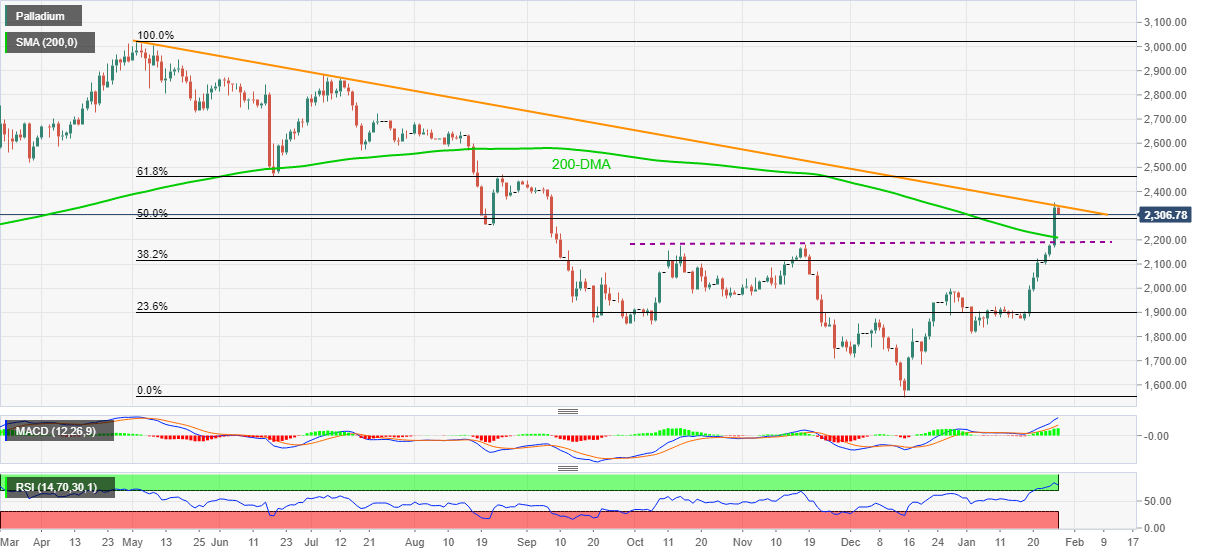
Palladium Price Analysis: XPD/USD eases from nine-month-old resistance to $2,300

  • Palladium snaps seven-day uptrend near the highest levels since September 2021.
  • Overbought RSI, failures to cross the key resistance line signals further weakness.
  • 200-DMA, three-month-old horizontal support lures short-term sellers while bulls have a bumpy road to the north.

Palladium (XPD/USD) takes offers around $2,304, down 1.26% intraday, as the market’s risk-off mood drown commodities heading into Thursday’s European session.

In doing so, the bullion prices take a U-turn from a descending trend line from May 2021. Given the overbought RSI conditions, the latest declines are likely to last longer.

The same highlights the 200-DMA and a horizontal resistance-turned-support area from October 2021, respectively around $2,210 and $2,185, for XPD/USD sellers.

In a case where palladium prices drop below $2,185, the $2,000 psychological magnet and December 2021 top near $1,997, should return to the chart.

Alternatively, the metal’s run-up beyond the stated resistance line, near $2,340 by the press time, will aim for the 61.8% Fibonacci retracement of May-December 2021 downside, close to $2,460.

Following that, the XPD/USD bulls will have a free hand to aim for the $3,000 round figure with tops marked in July around $1,720 and $2,880 likely acting as buffers.

Palladium: Daily chart
Trend: Pullback expected

Additional important levels

Overview
Today last price2306.19
Today Daily Change-27.56
Today Daily Change %-1.18%
Today daily open2333.75
 
Trends
Daily SMA201974.38
Daily SMA501883.51
Daily SMA1001941.09
Daily SMA2002211.83
 
Levels
Previous Daily High2353.87
Previous Daily Low2166.72
Previous Weekly High2123.91
Previous Weekly Low1868.1
Previous Monthly High1997.88
Previous Monthly Low1549.8
Daily Fibonacci 38.2%2282.38
Daily Fibonacci 61.8%2238.21
Daily Pivot Point S12215.69
Daily Pivot Point S22097.63
Daily Pivot Point S32028.54
Daily Pivot Point R12402.84
Daily Pivot Point R22471.93
Daily Pivot Point R32589.99

Author

Anil Panchal

Anil Panchal

FXStreet

Anil Panchal has nearly 15 years of experience in tracking financial markets. With a keen interest in macroeconomics, Anil aptly tracks global news/updates and stays well-informed about the global financial moves and their implications.


More from Anil Panchal
Share:

Editor's Picks

AUD/USD bulls regain control above 0.6950 amid USD retreat

AUD/USD regains traction and extends the previous day's bounce from the weekly low, aiming for 0.7000 in Asia on Friday. The overnight pullback in US bond yields keeps the US Dollar below an 18-month high, which in turn offers some support to the pair. Meanwhile, hawkish RBA expectations also keep the major underpinned.

USD/JPY holds gains near 158.00 after Japan's weak Household Spending data

USD/JPY clings to gains around 158.00 after data showed on Friday that Japan's Household Spending fell for the ninth straight month, undermining the Japanese Yen. Meanwhile, the US Dollar remains depressed as the overnight fall in US bond yields counters a hawkish Fed and geopolitical uncertainties, could cap any downside in the pair.

Gold remains range-bound below $4,200

Gold has given up some ground after an initial bullish attempt to reach weekly highs, returning to below the $4,200 mark per troy ounce on Friday. The US Dollar’s strong upside momentum, combined with rising US Treasury yields across the curve, seems to keep further gains in the yellow metal under scrutiny.

Has Bitcoin really escaped the macro forces it was built to fight?
Over 17 years ago, Satoshi Nakamoto designed Bitcoin (BTC) on the back of a global financial crisis as an alternative to the global monetary system outside the control of central banks, governments and traditional intermediaries. This raises a key question: has Bitcoin really become independent of the macroeconomic forces it was built to challenge?
The Euro is not the sick man of Europe. France's bond market is
EUR/USD remains under pressure, near the 17-month low of 1.1161 reached on Monday. The pair has lost more than 7% since its yearly peak, as concerns over France's public finances increasingly weigh on the single currency. But behind the weakness of the Euro (EUR), the problem does not necessarily lie with the European economy as a whole.
Has Bitcoin really escaped the macro forces it was built to fight?
Over 17 years ago, Satoshi Nakamoto designed Bitcoin (BTC) on the back of a global financial crisis as an alternative to the global monetary system outside the control of central banks, governments and traditional intermediaries. This raises a key question: has Bitcoin really become independent of the macroeconomic forces it was built to challenge?














