Palantir Stock Forecast: PLTR gains on Friday open heading into Jackson Hole event
- Palantir stock lost 7.6% on Thursday.
- PLTR has traded lower on Friday ahead of Powell’s Jackson Hole speech.
- Key executives have been shedding stock-based compensation en masse this week.
- A large break to $10.25 support is likely at this juncture.

Palantir (PLTR) stock gained 1.3% at the open on Friday despite trending lower in the premarket. The NASDAQ Composite, Dow Jones and S&P 500 index all rotated higher between 0.25% and 0.5%. Palantir, a leading data analytics company, witnessed its share price dive on Thursday. PLTR stock dropped 7.6% to close at $14.14.
There is general uncertainty in the leadup to Friday’s keynote speech from Fed Chair Jerome Powell at the Jackson Hole economic forum. Adding to fears though are a string of Palantir executives selling partial stakes in the artificial intelligence-based software provider.
Palantir stock news: Powell speech follows insider selling
At 14:00 GMT (10:00 EST), Jerome Powell will provide Jackson Hole with the three-day forum’s primary event. The market expects Powell to continue touting his sermon on keeping interest rates elevated until the Federal Reserve is certain that core inflation is under control. The fed funds rate is in a range from 5.25% to 5.5% following the July hike, and the market largely thinks the terminal rate has been achieved.
Any hint to the contrary should lead most tech stocks like Palantir much lower as growth stocks perform much better during low interest rate environments. The NASDAQ 100 index sold off 2.19% on Thursday as investors positioned for bad news out of Jackson Hole.
If an upside surprise were to occur, it would likely come from Powell announcing interest rate cuts sooner rather than later. The Fed Chair has not provided color thus far as to when rates will decrease. Goldman Sach released a note this month predicting that rates won’t drop until May 2024.
Adding to the unease in the market is this week’s string of insider selling filings. Of course, tech companies like Palantir provide executives with a good deal of stock-based compensation, so insider selling is not necessarily a major sign that the C-suite sees storm clouds on the horizon. Most often, executives just need to diversify their portfolios, pay off debt or make a major purchase like a home.
However, five important insiders filed sales documents with the Securities & Exchange Commission (SEC) this week, so it’s not surprising that the influx of supply has dented the share price of Palantir.
- CEO and co-founder Alex Karp sold 325,000 shares on Wednesday at an average price of $15.40 – or about $5 million in total. He still owns over 6.4 million common stock shares.
- Chief Revenue Officer Ryan Taylor sold 30,049 shares on Thursday after selling 147,827 PLTR shares on Monday.
- Chief Financial Officer David Glazer sold 376,90 Palantir shares between Monday and Wednesday, cutting his share count from 658K to about 380K.
- Chief Accounting Officer Heather Planishek sold nearly 23K PLTR shares this week but still owns just under 800K.
- Chief Technology Officer Sankar Shyam sold 650,330 PLTR shares from Monday through Wednesday. Due to several new allotments of stock-based compensation, however, Shyam still owns more than 750K shares.
Nasdaq FAQs
What is the Nasdaq?
The Nasdaq is a stock exchange based in the US that started out life as an electronic stock quotation machine. At first, the Nasdaq only provided quotations for over-the-counter (OTC) stocks but later it became an exchange too. By 1991, the Nasdaq had grown to account for 46% of the entire US securities’ market. In 1998, it became the first stock exchange in the US to provide online trading. The Nasdaq also produces several indices, the most comprehensive of which is the Nasdaq Composite representing all 2,500-plus stocks on the Nasdaq, and the Nasdaq 100.
What is the Nasdaq 100?
The Nasdaq 100 is a large-cap index made up of 100 non-financial companies from the Nasdaq stock exchange. Although it only includes a fraction of the thousands of stocks in the Nasdaq, it accounts for over 90% of the movement. The influence of each company on the index is market-cap weighted. The Nasdaq 100 includes companies with a significant focus on technology although it also encompasses companies from other industries and from outside the US. The average annual return of the Nasdaq 100 has been 17.23% since 1986.
How can I trade the Nasdaq 100?
There are a number of ways to trade the Nasdaq 100. Most retail brokers and spread betting platforms offer bets using Contracts for Difference (CFD). For longer-term investors, Exchange-Traded Funds (ETFs) trade like shares that mimic the movement of the index without the investor needing to buy all 100 constituent companies. An example ETF is the Invesco QQQ Trust (QQQ). Nasdaq 100 futures contracts allow traders to speculate on the future direction of the index. Options provide the right, but not the obligation, to buy or sell the Nasdaq 100 at a specific price (strike price) in the future.
What Factors Drive the Nasdaq 100
Many different factors drive the Nasdaq 100 but mainly it is the aggregate performance of the component companies revealed in their quarterly and annual company earnings reports. US and global macroeconomic data also contributes as it impacts on investor sentiment, which if positive drives gains. The level of interest rates, set by the Federal Reserve (Fed), also influences the Nasdaq 100 as it affects the cost of credit, on which many corporations are heavily reliant. As such the level of inflation can be a major driver too as well as other metrics which impact on the decisions of the Fed.
Palantir stock forecast
It’s been more than two weeks since Palantir stock broke below the $17 support-turned-resistance level. With the 9-day Simple Moving Average (SMA) breaking below the 21-day SMA, PLTR stock is clearly in at least a short-term downtrend. In fact, Palantir stock is already down about 30% since topping out on August first near $20.
If PLTR breaks below $13.56, and I think this is likely, then expect a swift move toward the bespoke support at $10.25. The Moving Average Convergence Divergence (MACD) indicator has fallen below the zero threshold, which often means a more drawn-out downtrend is in the cards.
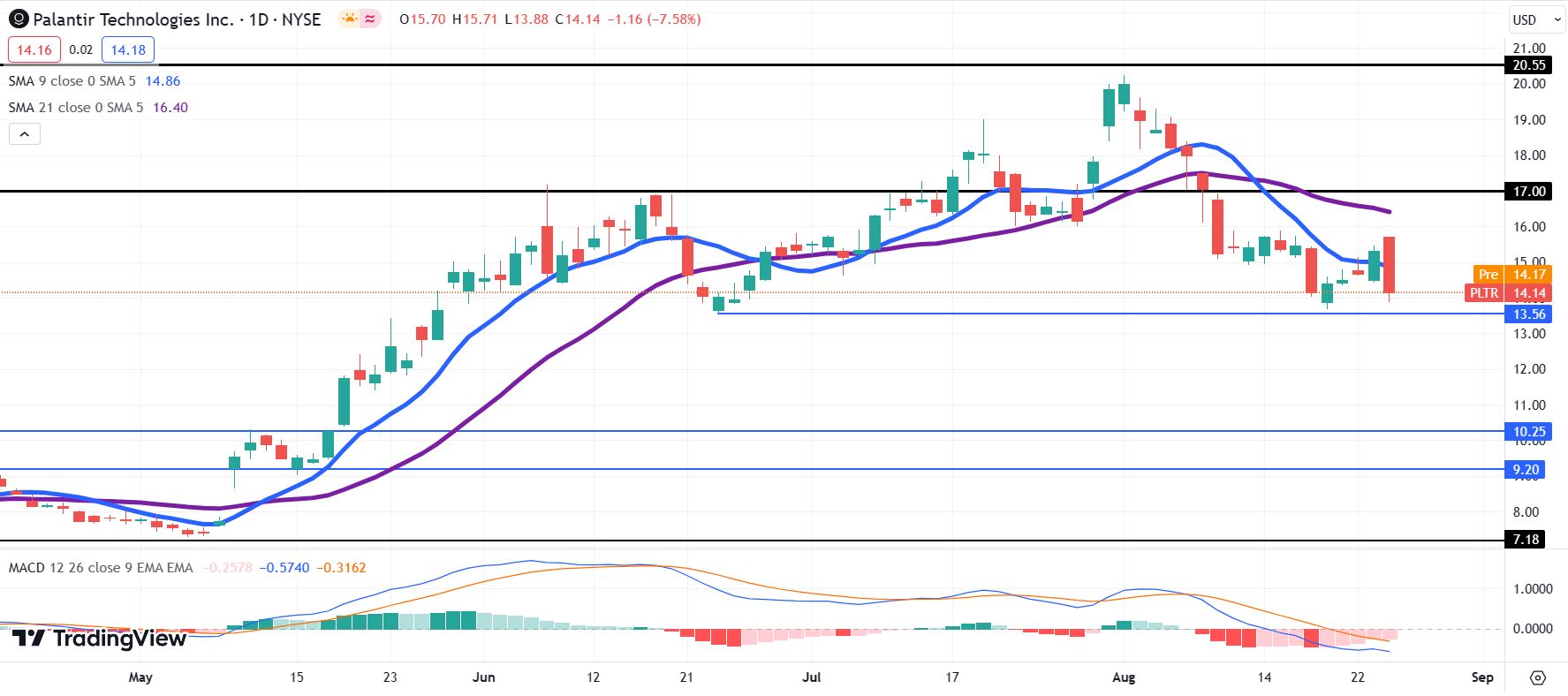
PLTR daily chart
Author

Clay Webster
FXStreet
Clay Webster grew up in the US outside Buffalo, New York and Lancaster, Pennsylvania. He began investing after college following the 2008 financial crisis.