OLB stock’s trendline rejection sends a clear message

The OLB Group, Inc. ($OLB) — a fintech company providing payment processing and merchant services solutions — just handed traders one of the cleaner technical signals we've seen on this chart in some time. On February 17th, price staged a dramatic spike that brought it all the way up to test a descending trendline that has been in control since early 2024. The result? A sharp, decisive rejection. And right now, $OLB is trading back near $0.83, roughly 50% below where that test occurred.
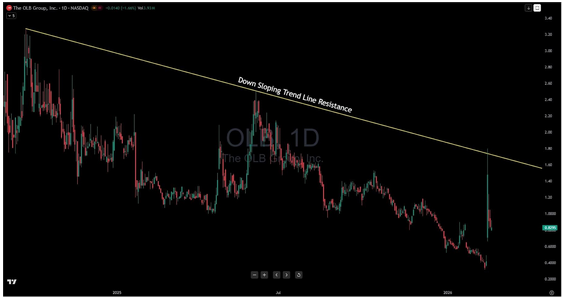
That's not a subtle signal. That's the trendline making its point.
Let's put this in context. The yellow descending trendline stretching from the $3.20–$3.40 highs of early 2024 down to current levels has been the defining feature of this chart for over a year. Every meaningful rally attempt has eventually faded beneath it, and the February 17th test was no different. Price surged into that resistance zone — likely fueled by short-covering or a news catalyst — touched the underside of the trendline, and immediately rolled over. The sellers showed up exactly where you'd expect them to.
What strikes me here is the velocity of the rejection. When price gives back 50% of a move that quickly, it tells you the buying pressure behind that spike was thin. There wasn't genuine accumulation driving it — more likely a sharp, momentum-driven burst that ran straight into overhead supply and exhausted itself.
So where does that leave traders? The path of least resistance remains downward as long as this trendline holds. The $0.40 area, which marked the recent lows before the February spike, becomes the first reference point worth watching on the downside. A stabilization and base-building around those levels would be the minimum requirement before any bullish case becomes worth entertaining.
For the trendline narrative to change, $OLB would need to reclaim and hold above that descending structure on meaningful volume. Until that happens, every bounce is just a potential shorting opportunity for technically-minded traders — and the February 17th rejection is Exhibit A.
Author

Benjamin Pool
Verified Investing
A seasoned financial expert with a passion for empowering individuals to mastering smart money management.