NZD/USD tanks below 0.6200 amidst risk-on impulse, US Dollar strength, ahead of FOMC decision
- Wall Street sees partial recovery from Thursday’s losses due to disappointing tech company earnings, while a lack of US economic data keeps focus on the upcoming Federal Open Market Committee (FOMC) meeting.
- Expectations of a 25 bps hike by the Federal Reserve past the July meeting are increasing following a week of robust US labor market data.
- The Reserve Bank of New Zealand’s (RBNZ) decision to maintain current rates contributes to the NZD’s weekly losses of nearly 3%,

NZD/USD dives below the 0.6200 figure, extending its losses past the 200-day Exponential Moving Average (EMA) of 0.6226, with the pair extending its losses to six straight days on overall US Dollar strength. At the time of writing, the NZD/USD is exchanging hands at 0.6175 after dropping from a daily high of 0.6240.
NZD/USD extends losses for the sixth straight day, underpinned by robust US labor market data
Wall Street pares some of Thursday’s losses on disappointing earnings from megacap tech companies. The lack of economic data in the United States (US) keeps NZD/USD traders bracing for the next week’s Federal Open Market Committee (FOMC) monetary policy decision, with the Federal Reserve (Fed) expected to deliver a 25 bps increase to the Federal Funds Rate (FFR), toward the 5.25%-5.50% area.
That follows a week that witnessed solid US economic data, as unemployment claims fell below estimates portraying a strong labor market and sparking fears for further Fed tightening, even though US retail sales printed mixed results. Turning to house market data, Housing Starts, Building Permits, and Existing Home Sales witnessed a dip after printing solid figures in May.
According to data from the CME FedWatch Tool, market players have fully priced in the next week’s increase but revised their bets upward from last week’s 19.8% to 28.0%.
Elsewhere, the latest Reserve Bank of New Zealand (RBNZ) monetary policy keeping rates unchanged is weighing on the New Zealand Dollar (NZD), which extended its weekly losses for almost 3%. That, despite fears of a slower recovery in China, despite the People Bank of China’s (PboC) efforts to prod its economy and achieve its annual target, would keep the NZD pressured.
Given the backdrop, the NZD/USD is warranted to extend its losses, but it would depend on the Fed and its Chair Jerome Powell to sustain a hawkish posture to keep the downtrend in the near term. Otherwise, the NZD/USD could recover after the FOMC’s decision.
NZD/USD Price Analysis: Technical outlook
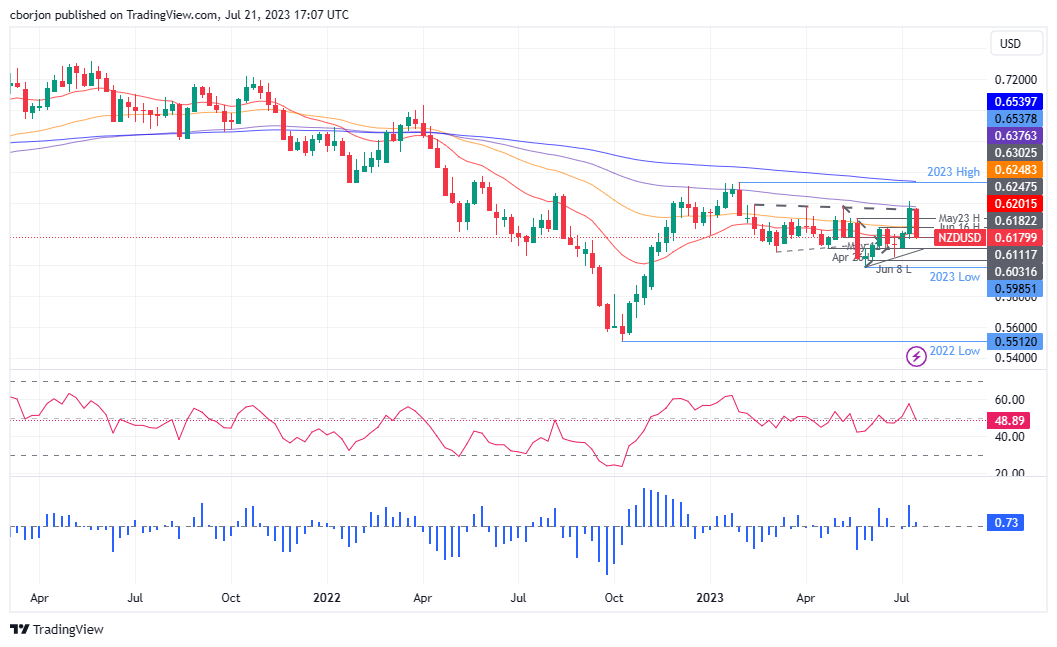
The NZD/USD shifted to a neutral bias once the major broke technical support level, like the 200, 20, 100, and 50-day EMAs on its way south, but its fall remains cushioned by the June 29 daily low of 0.6050. Once cleared, the NZD/USD could test the year-to-date (YTD) low of 0.5985. To keep their hopes of higher prices, buyers must reclaim the 0.6200 mark, but they need to clear the confluence of the 50 and 100-day EMAs at 0.6201/02 before testing the 20-day EMA at 0.6227.
With the Relative Strength Index (RSI) turning bearish and the three-day Rate of Change (RoC) suggesting sellers gather momentum, the NZD/USD might continue to trend lower.
Author

Christian Borjon Valencia
FXStreet
Markets analyst, news editor, and trading instructor with over 14 years of experience across FX, commodities, US equity indices, and global macro markets.