NZD/USD Price Forecast: Walks on thin rope near 0.5600
- NZD/USD faces selling pressure as the US Dollar performs strongly.
- The Fed is expected to follow a gradual policy-easing cycle as officials worry about a slowdown in the disinflation trend.
- China’s inflation grew at a slower pace in December, which weighs on the NZ Dollar.

The NZD/USD pair rises slightly after posting a fresh more-than-two-year low of 0.5570 in Thursday’s North American session but is still down quarter-to-a-percent. The outlook of the Kiwi pair remains bearish as the US Dollar (USD) performs strongly across the board on expectations that the Federal Reserve (Fed) will follow a gradual rate-cut approach this year.
Market speculation for a slower Fed policy-easing path is backed by commentary from officials that progress in the disinflation trend could stall by potential trade and immigration policies, as shown by the latest Federal Open Market Committee (FOMC) minutes.
Meanwhile, investors await the US Nonfarm Payrolls (NFP) data for December, which will be published on Friday. The US NFP report is expected to show that the economy added 154K workers in December, fewer than 227K additions in November. The Unemployment Rate is seen steady at 4.2%. Investors will pay close attention to the US labor market data as it will influence market expectations about when the Fed will deliver its first interest rate cut of this year.
The New Zealand Dollar (NZD) faces selling pressure as China’s inflation has slowed in December as expected. China’s annual Consumer Price Index (CPI) rose by 0.1%, slower than the former release of 0.2%. Being a proxy to China’s economy, the Kiwi dollar faces pressure on expectations of poor business outlook in the New Zealand (NZ) region.
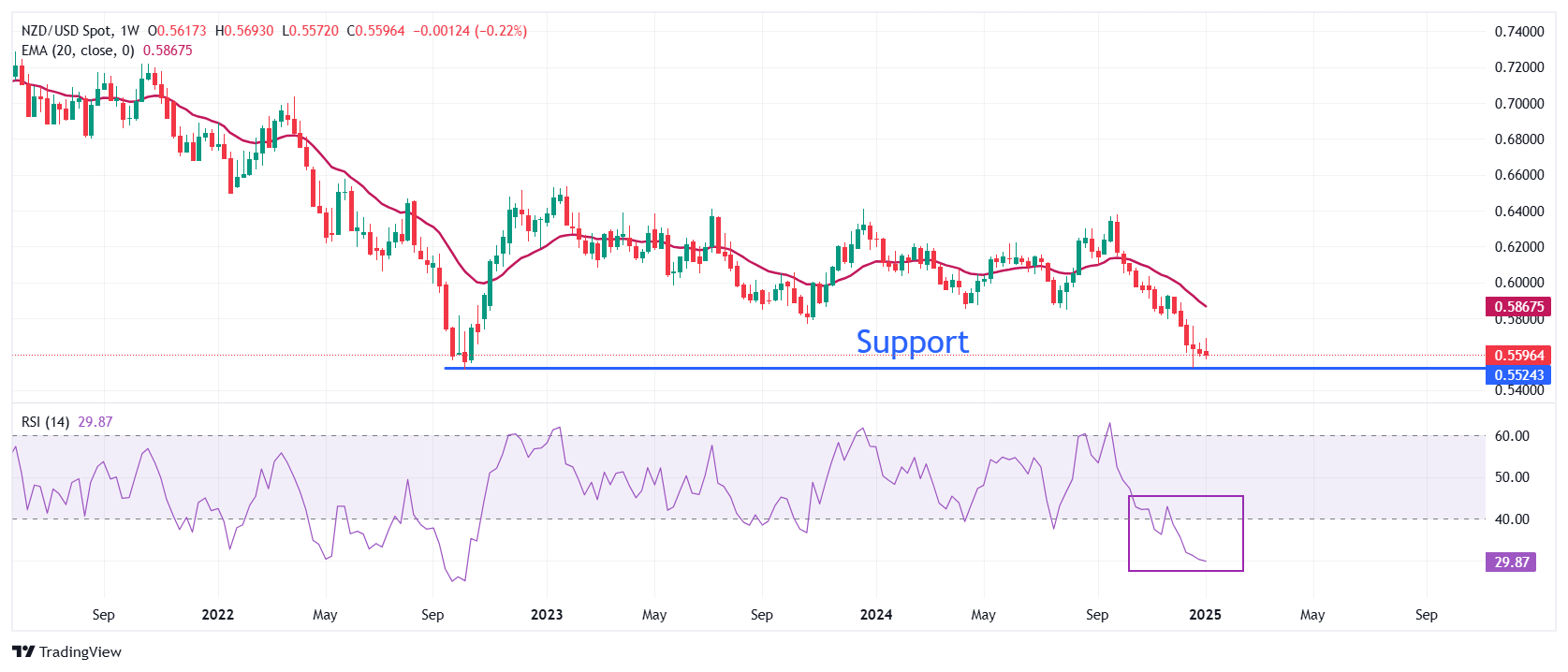
NZD/USD finds a temporary cushion near the two-year low of 0.5520 on a weekly timeframe. However, the outlook for the Kiwi pair remains bearish, as the 20-week Exponential Moving Average (EMA), which trades around 0.5867, is declining.
The 14-week Relative Strength Index (RSI) slides to near 30.00, suggesting a strong bearish momentum.
The Kiwi pair could decline to near the 13-year low of 0.5470 and the round-level support of 0.5400 if it breaks below the psychological support of 0.5500.
On the flip side, a decisive break above the November 29 high of 0.5930 could drive the pair to the November 15 high of 0.5970 and the psychological resistance of 0.6000.
NZD/USD weekly chart
New Zealand Dollar FAQs
The New Zealand Dollar (NZD), also known as the Kiwi, is a well-known traded currency among investors. Its value is broadly determined by the health of the New Zealand economy and the country’s central bank policy. Still, there are some unique particularities that also can make NZD move. The performance of the Chinese economy tends to move the Kiwi because China is New Zealand’s biggest trading partner. Bad news for the Chinese economy likely means less New Zealand exports to the country, hitting the economy and thus its currency. Another factor moving NZD is dairy prices as the dairy industry is New Zealand’s main export. High dairy prices boost export income, contributing positively to the economy and thus to the NZD.
The Reserve Bank of New Zealand (RBNZ) aims to achieve and maintain an inflation rate between 1% and 3% over the medium term, with a focus to keep it near the 2% mid-point. To this end, the bank sets an appropriate level of interest rates. When inflation is too high, the RBNZ will increase interest rates to cool the economy, but the move will also make bond yields higher, increasing investors’ appeal to invest in the country and thus boosting NZD. On the contrary, lower interest rates tend to weaken NZD. The so-called rate differential, or how rates in New Zealand are or are expected to be compared to the ones set by the US Federal Reserve, can also play a key role in moving the NZD/USD pair.
Macroeconomic data releases in New Zealand are key to assess the state of the economy and can impact the New Zealand Dollar’s (NZD) valuation. A strong economy, based on high economic growth, low unemployment and high confidence is good for NZD. High economic growth attracts foreign investment and may encourage the Reserve Bank of New Zealand to increase interest rates, if this economic strength comes together with elevated inflation. Conversely, if economic data is weak, NZD is likely to depreciate.
The New Zealand Dollar (NZD) tends to strengthen during risk-on periods, or when investors perceive that broader market risks are low and are optimistic about growth. This tends to lead to a more favorable outlook for commodities and so-called ‘commodity currencies’ such as the Kiwi. Conversely, NZD tends to weaken at times of market turbulence or economic uncertainty as investors tend to sell higher-risk assets and flee to the more-stable safe havens.
Author

Sagar Dua
FXStreet
Sagar Dua is associated with the financial markets from his college days. Along with pursuing post-graduation in Commerce in 2014, he started his markets training with chart analysis.


![How Wall Street rigs the game [Video]](https://editorial.fxsstatic.com/images/i/market-chaos-01.jpg)