NZD/USD Price Forecast: Slumps below 0.5950 as antipodeans underperform
- NZD/USD falls sharply to near 0.5940 as antipodeans underperform their peers.
- Traders have become increasingly confident that the RBNZ could reduce interest rates in the policy meeting in August.
- Uncertainty surrounding trade talks between the US and its trading partners would keep the US Dollar on cliffhanger.

The NZD/USD pair trades almost 0.4% lower to near 0.5940 during the European trading session on Tuesday. The Kiwi pair declines as both antipodeans: the New Zealand Dollar (NZD) and the Australian Dollar (AUD) are underperforming their peers amid growing expectations that central banks from both economies will reduce interest rates in their August monetary policy meeting.
New Zealand Dollar PRICE Today
The table below shows the percentage change of New Zealand Dollar (NZD) against listed major currencies today. New Zealand Dollar was the weakest against the Swiss Franc.
| USD | EUR | GBP | JPY | CAD | AUD | NZD | CHF | |
|---|---|---|---|---|---|---|---|---|
| USD | 0.07% | 0.18% | 0.28% | 0.04% | 0.27% | 0.38% | -0.06% | |
| EUR | -0.07% | 0.13% | 0.24% | -0.01% | 0.18% | 0.39% | -0.11% | |
| GBP | -0.18% | -0.13% | 0.10% | -0.14% | 0.05% | 0.20% | -0.24% | |
| JPY | -0.28% | -0.24% | -0.10% | -0.22% | -0.03% | 0.17% | -0.40% | |
| CAD | -0.04% | 0.01% | 0.14% | 0.22% | 0.19% | 0.35% | -0.10% | |
| AUD | -0.27% | -0.18% | -0.05% | 0.03% | -0.19% | 0.17% | -0.34% | |
| NZD | -0.38% | -0.39% | -0.20% | -0.17% | -0.35% | -0.17% | -0.49% | |
| CHF | 0.06% | 0.11% | 0.24% | 0.40% | 0.10% | 0.34% | 0.49% |
The heat map shows percentage changes of major currencies against each other. The base currency is picked from the left column, while the quote currency is picked from the top row. For example, if you pick the New Zealand Dollar from the left column and move along the horizontal line to the US Dollar, the percentage change displayed in the box will represent NZD (base)/USD (quote).
Traders raise Reserve Bank of New Zealand (RBNZ) dovish bets as price pressures cooled down at a faster pace in the second quarter of the year. The data showed on Monday that the New Zealand (NZ) Q2 Consumer Price Index (CPI) grew moderately by 0.5%, compared to expectations of 0.6% and the prior release of 0.9%.
Theoretically, easing price pressures often lead to monetary policy easing by the central bank.
Markets now imply around an 80% probability the RBNZ will cut the 3.25% cash rate a quarter point at its meeting on August 20, Reuters reported.
Meanwhile, the US Dollar (USD) gains ground after a corrective move in the last two trading sessions. However, the outlook remains uncertain as the August 1 tariff deadline approaches and Washington has closed deals with a handful of its trading partners.
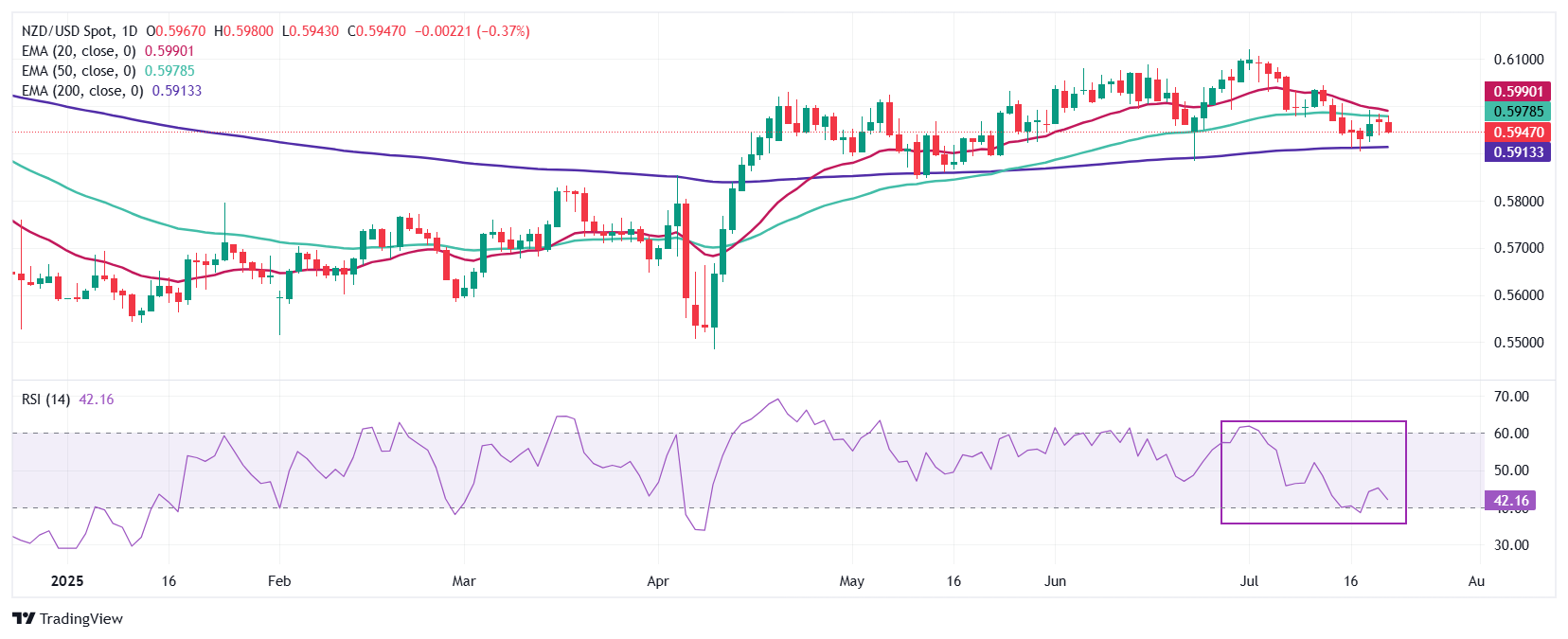
NZD/USD continues to hold the 200-day Exponential Moving Average (EMA), which is around 0.5910. However, the overall trend remains bearish as the 20- and 50-day EMAs slope downwards.
The 14-day Relative Strength Index (RSI) trades close to 40.00. A fresh bearish momentum would trigger if the RSI falls below that level.
Going forward, a downside move by the pair below the June 23 low of 0.5883 will expose it to the May 12 low of 0.5846, followed by the round-level support of 0.5800.
In an alternate scenario, the Kiwi pair would rise towards the June 19 high of 0.6040 and the September 11 low of 0.6100 if it manages to return above the psychological level of 0.6000.
NZD/USD daily chart
Economic Indicator
Consumer Price Index (QoQ)
The Consumer Price Index (CPI), released by Statistics New Zealand on a quarterly basis, measures changes in the price of goods and services bought by New Zealand households. The CPI is a key indicator to measure inflation and changes in purchasing trends. The QoQ reading compares prices in the reference quarter to the previous quarter. A high reading is seen as bullish for the New Zealand Dollar (NZD), while a low reading is seen as bearish.
Read more.Last release: Sun Jul 20, 2025 22:45
Frequency: Quarterly
Actual: 0.5%
Consensus: 0.6%
Previous: 0.9%
Source: Stats NZ
With the Reserve Bank of New Zealand's (RBNZ) inflation target being around the midpoint of 2%, Statistics New Zealand’s quarterly Consumer Price Index (CPI) publication is of high significance. The trend in consumer prices tends to influence RBNZ’s interest rates decision, which in turn, heavily impacts the NZD valuation. Acceleration in inflation could lead to faster tightening of the rates by the RBNZ and vice-versa. Actual figures beating forecasts render NZD bullish.
Author

Sagar Dua
FXStreet
Sagar Dua is associated with the financial markets from his college days. Along with pursuing post-graduation in Commerce in 2014, he started his markets training with chart analysis.


![How Wall Street rigs the game [Video]](https://editorial.fxsstatic.com/images/i/market-chaos-01.jpg)