|

NZD/USD Price Analysis: Dip challenges support at the 20-day SMA

  • NZD/USD eases on Thursday, hovering near 0.5610 in a cautious market mood.
  • MACD histogram shows rising green bars, hinting at subdued but ongoing buyer interest.
  • RSI sits at 45, slipping slightly yet staying within a mild negative zone.

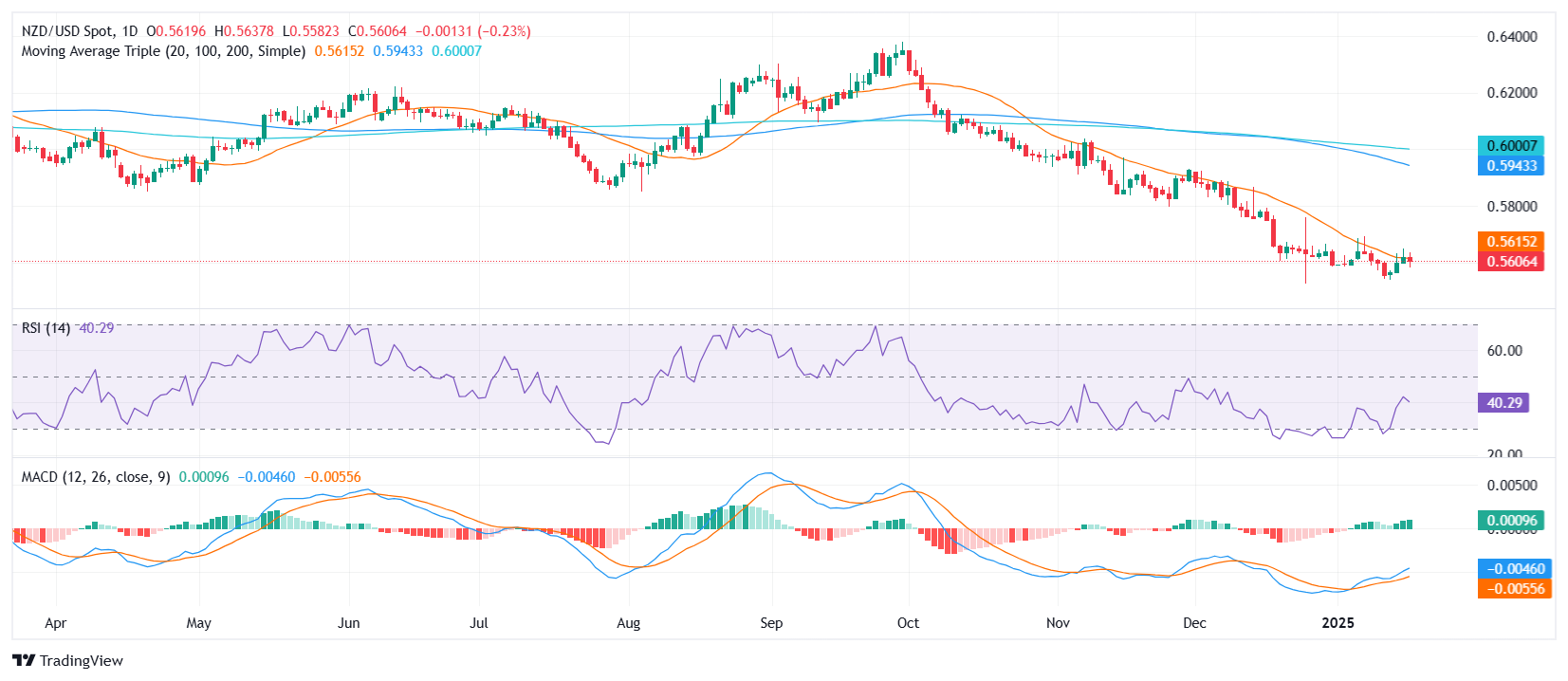
The NZD/USD pair encountered modest pressure on Thursday, drifting 0.16% lower to roughly 0.5610. Despite this pullback, the exchange rate has managed to hold close to its 20-day Simple Moving Average (SMA), a signal that buyers could be attempting to build a floor under recent price action. While momentum remains tepid, the pair’s resilience at this critical threshold indicates a measured appetite for higher levels.

Technically, the Moving Average Convergence Divergence (MACD) histogram continues to print rising green bars, suggesting that, although not overwhelming, there is a degree of underlying demand. Meanwhile, the Relative Strength Index (RSI) has edged down to 45, reflecting a slight decline in bullish conviction without totally ceding ground to sellers. This delicate balance between optimism and caution leaves NZD/USD in a precarious spot.

Going forward, a sustained hold above the 20-day SMA near 0.5600 would underline the possibility of further gains, potentially guiding the pair toward the 0.5650 region. Conversely, a break beneath the immediate support could target 0.5580, with a deeper slide exposing 0.5550 if sentiment takes another negative turn.

NZD/USD daily chart
Author

Patricio Martín

Patricio is an economist from Argentina passionate about global finance and understanding the daily movements of the markets.


More from Patricio Martín
Share:

Editor's Picks

AUD/USD stuck as the RBA talks tough into a slowdown

The Australian Dollar is going nowhere in a hurry, and the contradiction at its core explains why. The Reserve Bank of Australia keeps dangling the prospect of another hike, yet the economy it governs just expanded 0.3% in the first quarter, a clear step down from the prior pace. A central bank threatening to tighten into a visible slowdown is not a recipe for conviction in either direction, and the tape shows it.

USD/JPY: Japanese Yen coiled at the line, leaning on everyone but Japan

The Yen is doing very little, and that stasis is the whole story. USD/JPY sits glued near 160.00 not because Japan has found new strength, but because two outside forces are fighting to a draw over it: a US rate complex that keeps the dollar bid, and a Ministry of Finance that refuses to let the line break.

Gold declines below $4,500 on stalled US-Iran ceasefire talks, US NFP data looms

Gold price edges lower to near $4,470 during the early Asian session on Friday. The precious metal remains volatile amid ongoing geopolitical turmoil. Traders will closely monitor the developments surrounding the US-Iran peace deal and the US May employment report later on Friday. 


Bitcoin falls below $64K as demand turns negative, short-term holders' selling intensifies

Bitcoin has fallen below $64,000 on Thursday amid weakening market demand and mounting selling pressure from short-term holders. The leading cryptocurrency slipped toward the $63,000 level amid a broader risk-off environment, with several key metrics signaling one of the most challenging periods of the current market cycle.

Nonfarm payrolls: Testing the limits of Fed policy patience

The upcoming nonfarm payrolls report for May will provide the final update on the US labor market before Kevin Warsh attends his first policy meeting as the new Fed Chair later this month.

Recession on paper: What really moves the Canadian Loonie now?

Statistics Canada handed the headline writers a gift and the analysts a headache. Real GDP shrank 0.1% on an annualized basis in the first quarter, and with the fourth quarter of 2025 revised down to a 1.0% contraction, that is two negative quarters in a row, the textbook definition of a technical recession and Canada's first since the pandemic.