|

NZD/USD Price Analysis: Bulls surge to back to highs since January, eyeing 100-day SMA retest

  • NZD/USD jumps to 0.5765 on Thursday, reaching its highest level since January.
  • The RSI climbs to 62, nearing overbought territory but still signaling room for further gains.
  • MACD histogram shows rising green bars, indicating sustained bullish momentum and potential for continued upside.

NZD/USD Price Analysis: Bulls surge to back to highs since January, eyeing 100-day SMA retest

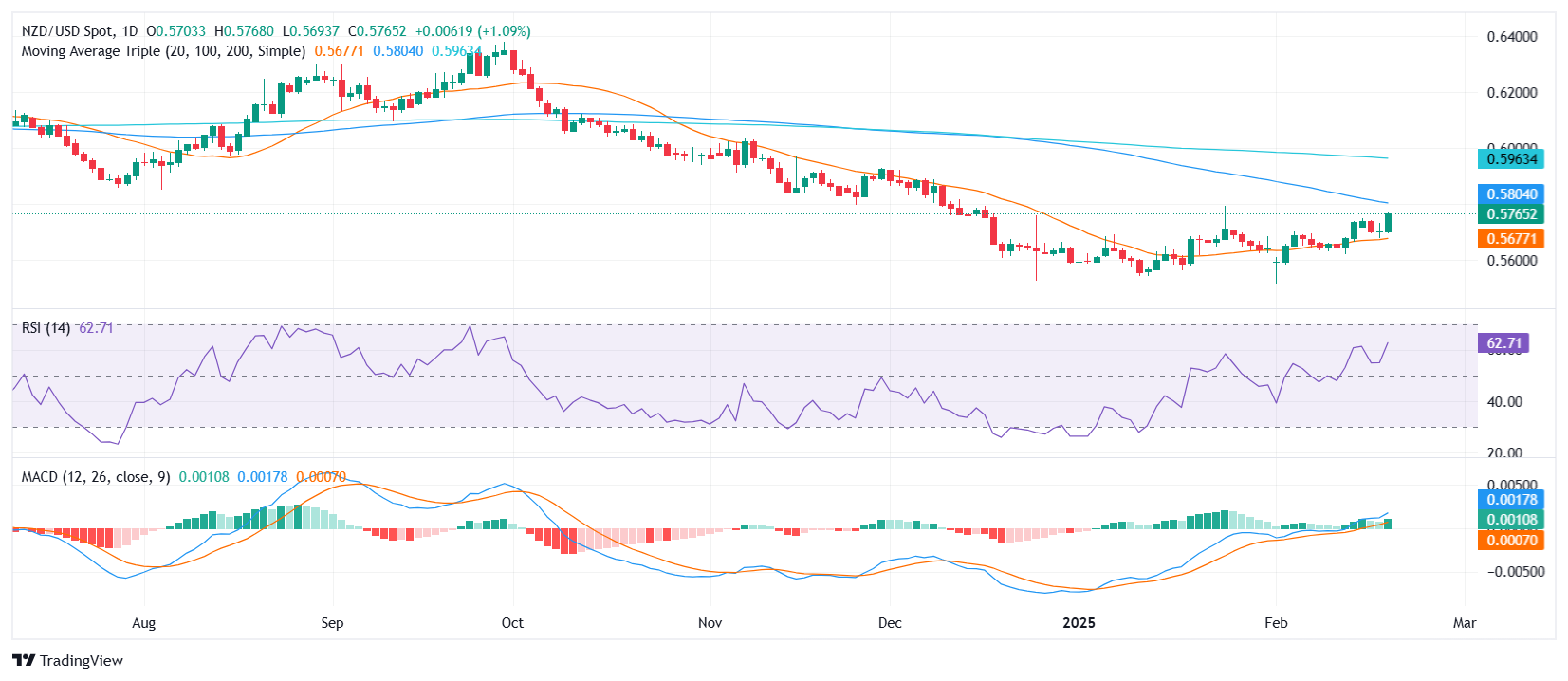
The NZD/USD pair staged an impressive rally on Thursday, climbing 1.03% to close at 0.5765, marking its highest point since January. Buyers regained control, building on recent momentum as the pair looks poised to retest the 100-day Simple Moving Average (SMA), which stands as the next major resistance level.

Technical indicators support the bullish outlook. The Relative Strength Index (RSI) surged to 65, edging closer to overbought territory but still offering room for additional upside before triggering exhaustion signals. Meanwhile, the Moving Average Convergence Divergence (MACD) histogram continues to print rising green bars, highlighting sustained buying pressure and strengthening momentum.

Looking forward, a successful break above the 100-day SMA, currently around 0.5805, could open the door for further gains, potentially extending the bullish trend. On the downside, immediate support is seen near 0.5700, with a drop below this level potentially triggering a deeper correction. However, with indicators still favoring buyers, the near-term bias remains tilted to the upside.

NZD/USD daily chart
Author

Patricio Martín

Patricio is an economist from Argentina passionate about global finance and understanding the daily movements of the markets.


More from Patricio Martín
Share:

Editor's Picks

AUD/USD tests 0.6650 on the recovery from YTD lows

AUD/USD kicks off the new week on a positive note and retakes 0.6650, snapping a three-day losing streak to the YTD low set Friday, though the upside seems limited. The US Dollar trades near April 2025 highs amid firming Fed rate-hike bets and geopolitical uncertainties. This, along with Australia’s dismal flash PMIs and the RBA’s dovish tilt, could cap the Aussie.

USD/JPY bounces to 159.00 amid BoJ uncertainty

USD/JPY attracts buyers at the start of the week and revisits 159.00, reversing part of Friday’s fall to an over one-week low as uncertainty over the pace of BoJ rate hikes undermines the Japanese Yen. Meanwhile, the US Dollar sits near April 2025 highs amid hawkish Fed bets and Middle East jitters, further supporting the pair, though intervention risks could cap gains.

Gold consolidates gains as US Dollar climbs to fresh 19-month high

Gold consolidates its gains during American trading hours on Monday after rebounding sharply from last week’s 9% slump, which dragged the metal to its lowest level since September 2025.

PI extends a V-shaped rebound from a record low
Pi Network (PI) bounces back above $0.0550 on Monday, extending gains from the last two consecutive days after a record low of $0.0473 set on Friday. Valour’s PI-focused Exchange Traded Product (ETP) struggles to attract institutional appeal, amid a Year-to-Date decline of more than 70%.
Dow Jones futures bounce up as investors pare back aggressive Fed tightening expectations
Wall Street Indexes are likely to open the week in a stronger tone, with fears about AI overfinancing easing, and with market expectations of a large Federal Reserve (Fed) rate hike in December ebbing. The Dow Jones Futures show a 1.44% advance at the European session opening times, trading at 48,909 at the time of writing.
Gold's 14-month low looks mild next to Silver's fall from $121 to $44
Gold has lost a third of its value since January as traders bet on more Federal Reserve rate increases. Silver has lost nearly two-thirds, because the buyers still holding Gold up have no equivalent in the Silver market. Gold is trading below $3,700 for the first time since September 2025, a little more than a third under the record near $5,600 it set in late January.















