|

NZD/USD faces headwinds amid souring market sentiment, hawkish Fed stance

  • NZD/USD is set to remain fragile amidst mixed market sentiment in the US.
  • Federal Reserve officials, led by Minnesota’s Fed President Neil Kashkari, maintain a hawkish stance, foreseeing potential rate hikes and a 60% probability of a soft landing.
  • Economic data in focus: NZ Business Confidence, while the US Docket would feature GDP Q2 revisions Fed speakers.

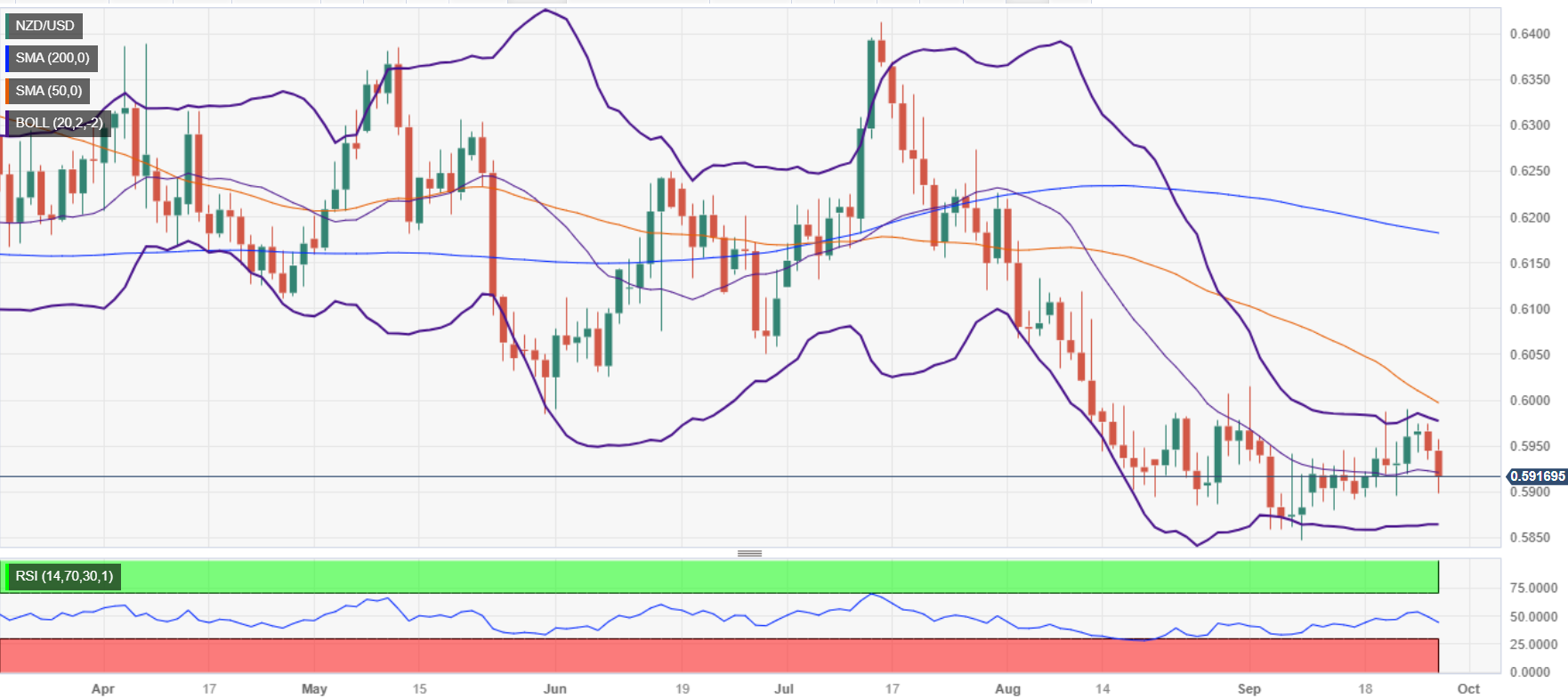
The New Zealand Dollar (NZD) lost ground versus the US Dollar (USD) late in the New York session after hitting a daily high of 0.5956 but erased those gains on sour market sentiment spurred by developments in the United States (US). Hence, the NZD/USD is trading at 0.5922, down by 0.37%.

New Zealand Dollar (NZD) struggles against the robust US Dollar (USD) as market participants weigh in on US economic developments and Federal Reserve signals

Market sentiment remains fragile, as investors jumped and lifted two of the three major equity indices in the United States (US), shifting mood mixed. Nevertheless, US Treasury bond yields remain near the year's highs, while the US Dollar Index (DXY) retreats from the year-to-date (YTD) high reached at 106.83 to 106.62, gains 0.42%.

Federal Reserve officials remain hawkish, with Minnesota’s Fed President Neil Kashkari continuing his parade on Wednesday. Summarizing what he has said, he remains hawkish, foresees at least one more rate hike, and sees a 60% probability of achieving a soft landing. Kashkari added that he expects the Fed to hold rates “steady” for 2024.

Before Wall Street opened, the US Department of Commerce revealed that August’s Durable Goods Orders rose more than expected, at 0.2% MoM, with estimates for a -0.2% plunge. Excluding Transports, the so-called core came at 0.4% MoM, above estimates and the previous month's 0.1% expansion.

In the meantime, the Kiwi (NZD) is taking some cues on the latest inflation figures from Australia, which, although coming as expected at 5.2%, failed to underpin the antipodeans. Therefore, sellers piled in and dragged prices towards the low of the week at 0.5899 before reversing its course, and hovering at around current exchange rates.

Ahead in the week, traders would take some clues on New Zealand’s (NZ) ANZ Business Confidence alongside Australia’s Retail Sales. On the US front, the final revision of Q2’s Gross Domestic Product (GDP), Pending Home Sales, Initial Jobless Claims, and Fed speakers. By Friday, the Fed’s preferred gauge for inflation, the Core PCE, would be announced.

NZD/USD Price Analysis: Technical outlook

After forming a bearish-engulfing candlestick pattern, the NZD/USD dropped to a new four-day low of 0.5899, but buyers stepping at the 0.5900 figure lifted the pair. Despite its bearish bias, the pair must reclaim the September 5 swing low of 0.5859, to register a new cycle low that could extend the downtrend and open the door to challenge the November 3, 2022, low of 0.5740. On the upside, the NZD/USD's first resistance would be 0.5950, followed by the 50-day moving average (DMA) at 0.5996.
NZD/USD

Overview
Today last price0.5925
Today Daily Change-0.0020
Today Daily Change %-0.34
Today daily open0.5945
 
Trends
Daily SMA200.5923
Daily SMA500.6004
Daily SMA1000.6089
Daily SMA2000.6184
 
Levels
Previous Daily High0.5974
Previous Daily Low0.5935
Previous Weekly High0.599
Previous Weekly Low0.5894
Previous Monthly High0.6219
Previous Monthly Low0.5885
Daily Fibonacci 38.2%0.595
Daily Fibonacci 61.8%0.5959
Daily Pivot Point S10.5929
Daily Pivot Point S20.5912
Daily Pivot Point S30.589
Daily Pivot Point R10.5968
Daily Pivot Point R20.599
Daily Pivot Point R30.6007

Author

Christian Borjon Valencia

Markets analyst, news editor, and trading instructor with over 14 years of experience across FX, commodities, US equity indices, and global macro markets.


More from Christian Borjon Valencia
Share:

Editor's Picks

AUD/USD consolidates above 0.7000/two-month low; bearish potential intact

The AUD/USD pair oscillates in a narrow range during the Asian session, and moves little following the release of mixed inflation figures from China. Spot prices currently trade around the 0.7025 region, nearly unchanged for the day, and remain within striking distance of a nearly two-month low set on Tuesday. Renewed hostilities between the US and Iran temper hopes for a deal to end the over three-month-old war.

Japanese Yen languishes despite wholesale inflation accelerates in May

USD/JPY flatlines after experiencing volatility, trading around 160.40 during the Asian hours on Wednesday. The pair continues to hold its ground, reflecting a struggling Japanese Yen that has failed to find support despite a massive acceleration in wholesale inflation. Driven by surging energy costs linked to the ongoing Middle East conflict, Japan’s Producer Price Index jumped 6.3% year-over-year in May. This hot printing comfortably outpaced April’s upwardly revised 5.3% figure and surpassed market consensus of 5.5%, marking the fastest pace of wholesale price growth in three years.

Gold plummets below $4,200 amid US‑Iran tensions ahead of US CPI

Gold extends the recent breakdown momentum below a technically significant 200-day Simple Moving Average (SMA) and drops to a fresh low since March 23, further below the $4,200 mark during the Asian session. Crude Oil prices rise amid renewed hostilities between the US and Iran, fueling inflation fears and bolstering bets for more hawkish central banks.

Bitcoin remains vulnerable, Ethereum weakens further, XRP signals more downside

Bitcoin, Ethereum, and Ripple remain under pressure mid-week, as the broader cryptocurrency market struggles to regain recovery momentum after last week’s massive correction. BTC struggles below $62,000, ETH continues to weaken below $1,650, while XRP’s momentum indicators remain biased toward further downside.

US CPI data set to show inflation at three-year high in May, backing Fed hawkish tilt

The US Bureau of Labor Statistics will publish the May Consumer Price Index (CPI) data on Wednesday. The report is expected to show another step up in consumer inflation, driven by the persistently high Oil prices due to the ongoing crisis in the Middle East.

The US economy defies the rules: 100 days into the Oil shock and the recession signal is still missing

More than three months after the start of the Iran war and the resulting disruption to global energy markets, the US economy continues to display remarkable resilience. The conflict has triggered a sharp rise in Oil prices, reignited inflationary pressures and fueled widespread concerns about a potential economic slowdown.