|

NZD/USD climbs amid mixed market mood, eyes on Powell’s Jackson Hole speech

  • US Existing Home Sales drop by -2.2% in July, with "inventory availability" and higher "mortgage rates" cited as reasons.
  • Richmond Fed's Manufacturing Index meets expectations with a drop of -7, while the Services Index surprises positively.
  • US bond yields show mixed dynamics, but the Greenback continues its ascent with the DXY at 103.588.

NZD/USD recovers some ground though exchanges hands off the highs of the day of 0.5972, trading at 0.5941, amidst a mixed market mood spurred by fears about recent developments in China and uncertainty about the outcome of US Federal Reserve Chair Jerome Powell’s speech at Jackson Hole.

The Kiwi recovers slightly but remains under pressure due to concerns over China and US economic data

US equities dwindle as market sentiment remains fragile. The National Association of Realtors (NAR) revealed that Existing Home Sales plunged -2.2% in July but improved compared to June’s -3.3% figures. According to the report, “inventory availability” and higher “mortgage rates” are the drivers behind the latest report drop, revealed NAR Chief Economist Lawrence Yun.

In other data revealed by the Richmond Fed, the Manufacturing Index plummeted -7 as expected in August, though its Services Index exceeded estimates of a -4 contraction, came at 4.

US bond yields are mixed as the short-end of the curve continues to bull-steepen, while the 10s, 20s, and 30s drop between 0.18 and 0.47 percent. However, the Greenback (USD) continues to rise, with the US Dollar Index (DXY), a measure of the buck’s value vs. six currencies, advancing 0.26%, at 103.588.

Meanwhile, Richmond Fed President Thomas Barkin emphasized that reaching the 2% target is crucial to Fed’s credibility. Later on the day, further, Fed policymakers will cross the wires, with Bowman and Golsbee up next.

On the New Zealand (NZ) front, the lack of economic data keeps traders seeking direction on China’s latest developments and market sentiment. Nevertheless, Retail Sales for the Second Quarter will be revealed on Wednesday, estimated to exceed the prior’s quarter yearly figures, while quarter-on-quarter (QoQ) is foreseen to disappoint investors. Hence, further NZD/USD could be expected.

On the US front, the economic docket would feature Fed speakers, S&P Global PMIs, Durable Good Orders, and New Home Sales.

NZD/USD Price Analysis: Technical outlook

The NZDUSD remains downward biased even though it bounced off year-to-date (YTD) lows of 0.5896. If NZD/USD buyers want to shift the trend to neutral, they must reclaim May 31 daily low turned resistance at 0.5985, followed by the 0.6031 June 8 daily low. Nevertheless, the NZD/USD’s path of least resistance is downwards, and it could test the November 10 daily low of 0.5840, followed by the November 3 swing low of 0.5741.

NZD/USD Daily chart
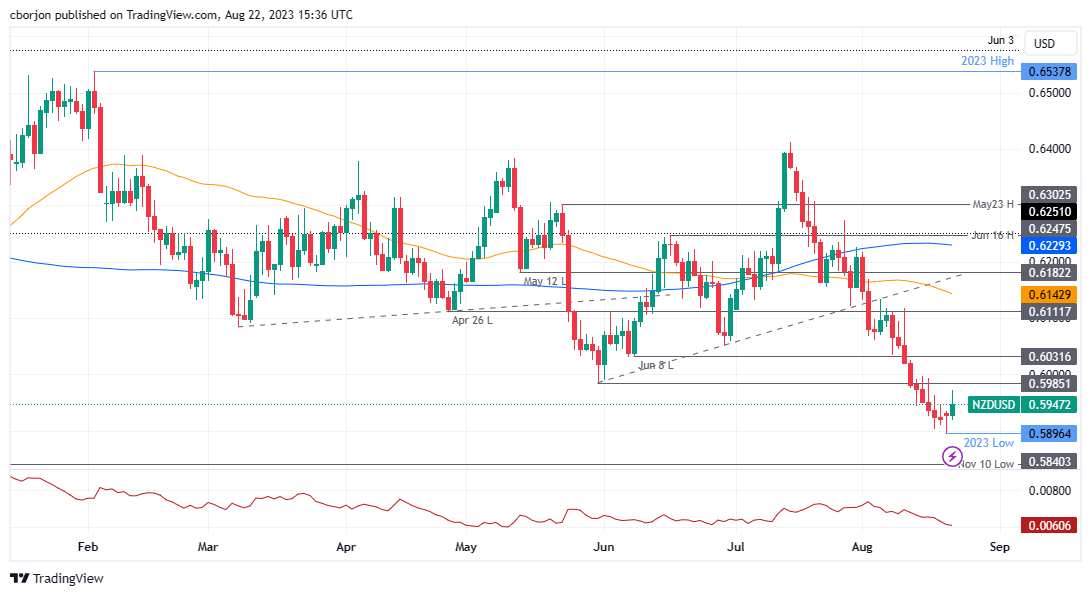
NZD/USD Daily chart

NZD/USD

Overview
Today last price0.5945
Today Daily Change0.0016
Today Daily Change %0.27
Today daily open0.5929
 
Trends
Daily SMA200.6062
Daily SMA500.6146
Daily SMA1000.6166
Daily SMA2000.6231
 
Levels
Previous Daily High0.5936
Previous Daily Low0.5895
Previous Weekly High0.5997
Previous Weekly Low0.5903
Previous Monthly High0.6413
Previous Monthly Low0.612
Daily Fibonacci 38.2%0.591
Daily Fibonacci 61.8%0.592
Daily Pivot Point S10.5904
Daily Pivot Point S20.5879
Daily Pivot Point S30.5864
Daily Pivot Point R10.5945
Daily Pivot Point R20.596
Daily Pivot Point R30.5985

Author

Christian Borjon Valencia

Markets analyst, news editor, and trading instructor with over 14 years of experience across FX, commodities, US equity indices, and global macro markets.


More from Christian Borjon Valencia
Share:

Editor's Picks

AUD/USD remains depressed near 0.6950 after RBA minutes

AUD/USD attracts follow-through selling during Tuesday’s Asian session, looking to extend the overnight rejection slide from 0.7000, or a two-week top, following the release of RBA meeting Minutes. The US Dollar retains a bullish undertone near its highest level since April 2025 as energy-driven inflation risks keep December Fed rate hike bets firmly on the table. Adding to this, geopolitical risks further underpin the safe-haven USD.

USD/JPY extends retreat below 158.50 as intervention risks loom

USD/JPY is dropping below 158.50 in the Asian session on Tuesday, snapping a two-day winning streak and pulling back from an over two-week top touched the previous day, despite Japan's soft PPI inflation print. Bulls turn cautious amid speculation that authorities will step in to prop up the Japanese Yen, which, in turn, weighs on the pair.

Gold advances to $4,200 amid retreating USD; Fed hike bets to cap further gains

Gold builds on its modest intraday move up and hits a fresh daily high around the $4,200 neighborhood during the Asian session. The US Dollar retreats from its highest level since April 2025 amid some profit-taking, offering support to the commodity. However, the US Federal Reserve's hawkish stance and escalating Middle East conflicts could limit deeper losses for the safe-haven buck.

Cardano: Retail support wanes as ADA tests a make-or-break level

Cardano price is up nearly 2% at press time on Tuesday, holding above its 50-day Exponential Moving Average (EMA) at $0.2302 and a near-term rising support trendline at $0.2264. ADA is losing retail demand in the derivatives market as its futures Open Interest declines and funding rates flip negative.

Indian Rupee gains further on RBI’s fresh measures to lower US Dollar’s demand

The Indian Rupee extends the Monday’s advance against the US Dollar on Tuesday, driven by the announcement of fresh Reserve Bank of India’s US Dollar-related measures to shore up the domestic currency. In the opening session, the USD/INR pair tumbles 0.6% to near 95.00, the lowest level seen in over a month.

Has Bitcoin really escaped the macro forces it was built to fight?
Over 17 years ago, Satoshi Nakamoto designed Bitcoin (BTC) on the back of a global financial crisis as an alternative to the global monetary system outside the control of central banks, governments and traditional intermediaries. This raises a key question: has Bitcoin really become independent of the macroeconomic forces it was built to challenge?















