NZD/USD bounces back on improved sentiment, soft US Dollar
- NZD/USD rebounds from a daily low of 0.5919 to 0.5977, driven by improved risk appetite and a softer US Dollar.
- Mixed US economic data and hawkish yet cautious remarks from Fed officials fail to bolster the Greenback, with the DXY slightly up at 105.47.
- Upcoming economic indicators, including Consumer Confidence and Core PCE in the US, and Business and Consumer Confidence in NZ, are in focus for the next week.

The New Zealand Dollar (NZD) stages a recovery against the US Dollar (USD) ahead of the weekend as investors' sentiment improved, while the Greenback is trading soft, undermined by a fall in US Treasury bond yields. The NZD/USD is trading at 0.5977 after bouncing from a daily low of 0.5919.
Kiwi recovers to 0.5977 as US Dollar weakens amid falling Treasury yields and mixed PMIs
Wall Street is trading in the green due to improved risk appetite. A report from S&P Global showed that business activity in the United States (US) was almost unchanged in September. The S&P Global Manufacturing PMI improved to 48.9 from 47.9 a month earlier, exceeding estimates but remained in contractionary territory, while the Services PMI dipped to 50.2 from 50.5 in July, below forecasts. The Composite reading, which offers a general view of business activity, was aligned with estimates at 50.1 but trailed August’s 50.2
Aside from this, US central bank officials had been unleashed, with Boston Fed President Susan Collins saying that further tightening is possible, though “patience” is required. Echoing some of her comments was Fed’s Governor Michell Bowman, who was more determined, saying that more rate hikes are needed to control inflation.
Although Fed officials' comments were hawkish, the Greenback failed to gain traction. The US Dollar Index (DXY), which measures the buck’s value against its peers, climbs just 0.09%, at 105.47, after dropping from 10578 high. US Treasury bond yields continued to weaken across the short and long end of the curve.
On the New Zealand (NZ) front, data revealed on Friday’s session that consumer confidence weakened in the third quarter regarding the economic outlook, with the index falling to 80.2 from 83.1. The agenda revealed the Trade Balance showed an improvement in the annual trade deficit to $15.54B for August $-1588B from prior figures.
For the next week, the economic agenda in the US would feature the Conference Board (CB) Consumer Confidence, Durable Good Orders, Initial Jobless Claims, and the Fed’s preferred gauge for inflation, the Core PCE. The docket would feature the Business and Consumer Confidence on the NZ front.
NZD/USD Price Analysis: Technical outlook
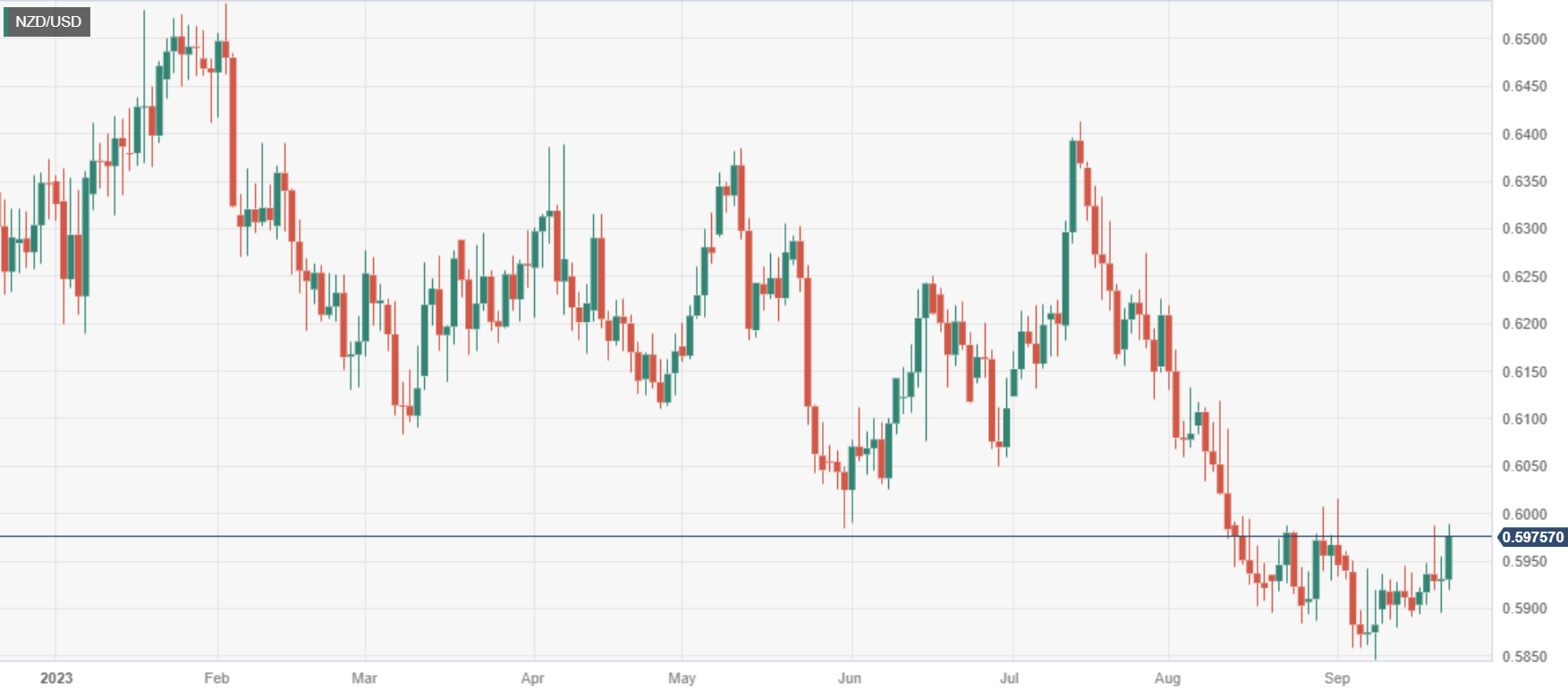
The pair bottomed out at around 0.5859, and since then, the NZD/USD has staged a comeback despite recent US Dollar strength. During the last three days, the currency pair has remained volatile, unable to get a clear direction, though it remains slightly tilted to the downside. However, further upside is expected if buyers lift the exchange rate past the September 1 swing high at 0.6015. Conversely, sellers must reclaim the September 21 low of 0.5895.
Author

Christian Borjon Valencia
FXStreet
Markets analyst, news editor, and trading instructor with over 14 years of experience across FX, commodities, US equity indices, and global macro markets.
















