NZ CPI: 1.4% YoY 0.5% QoQ, beats expectations, NZD/USD bid


Kiwi is bid to 0.7220 on the back of the New Zealand Consumer Price Index that has been released as follows:
- New Zealand inflation for Q4 2020: CPI 0.5% QoQ vs expected 0%, prior 0.7%).
- YoY 1.4% vs 1% expected and 1.4% prior.
Quarterly change
''In the December 2020 quarter compared with the September 2020 quarter, the CPI rose 0.5 percent (0.6 with seasonal adjustment).
Transport rose 2.3 percent, influenced by higher prices for purchase of vehicles (up 3.0 percent) and passenger transport services (up 7.9 percent).
Recreation and culture rose 2.6 percent, influenced by higher prices for accommodation services (up 11 percent).
Housing and household utilities rose 0.5 percent, influenced by higher prices for purchase of housing (up 1.3 percent).
Food fell 1.7 percent, influenced by lower prices for fruit and vegetables (down 12 percent).''
Annual change
From the December 2019 quarter to the December 2020 quarter, the CPI inflation rate was 1.4 percent.
Housing and household utilities increased 2.6 percent, with rentals for housing up 2.9 percent.
Food prices increased 2.5 percent, with fruit and vegetables up 8.6 percent.
Alcoholic beverages and tobacco increased 6.0 percent with cigarettes and tobacco up 11 percent.
Transport prices decreased 3.7 percent with private transport supplies and services down 8.1 percent.
NZD/USD reaction
NZD/USD was testing below 0.7200 in the run-up to the data but has spiked to 0.72199 on the release.
NZD/USD technical analysis
NZD/USD had completed a 38.2% Fibonacci retracement on the 4-hour time frame and can be projected to extend to 0.7235:
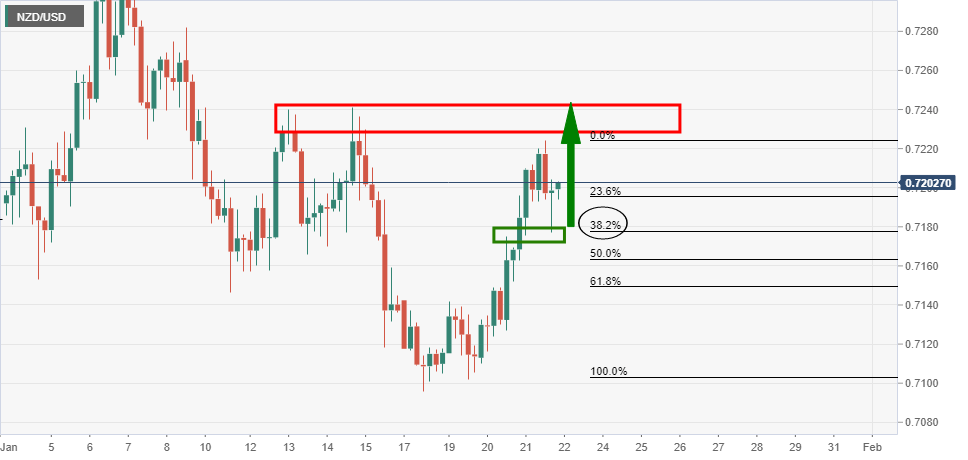
Meanwhile, the market is bearish below 0.7170.
Description of the Consumer Price Index
Consumer Price Index released by the Statistics New Zealand is a measure of price movements by the comparison between the retail prices of a representative shopping basket of goods and services.
The purchasing power of NZD is dragged down by inflation.
The CPI is a key indicator to measure inflation and changes in purchasing trends.
A high reading is seen as positive (or bullish) for the NZD, while a low reading is seen as negative.
Author
Ross J Burland
FXStreet
Ross J Burland, born in England, UK, is a sportsman at heart. He played Rugby and Judo for his county, Kent and the South East of England Rugby team.