Nvidia plunges 10% as Tuesday selling picks up steam on China chip curbs
- NVDA stock lost as much as 10% on Wednesday, sinking near $100.
- The company said late Tuesday that the Trump administration would be curbing its export of H20 AI chips to China.
- Nvidia says it will take a $5.5 billion charge due to the rule change.
- Nvidia built the H20 chip in order to comply with Biden-era export rules.
Nvidia (NVDA) began the Wednesday session down on bad news regarding its H20 chip, and the sell-off has only gained energy as the session progressed. About one hour out from the close, NVDA stock gave up more than 10% to trade near $100.45.
The NASDAQ has collapsed in unison, trading down 4.2% to 16,115. The Dow Jones Industrial Average, which also includes NVDA, lost 2.1%, while the S&P 500 is circling a 3% loss.
The market was not swayed by a quite positive US Retail Sales reading of 1.4% growth MoM in March, which was above the consensus for 1.3%.
Nvidia stock news
Nvidia announced late Tuesday that the Trump administration has issued a notice on April 9 that its H20 chips would now require an export license. This news had been rumored earlier in the year, but some reporting last week suggested that the White House was also pausing that process alongside its tariff exemption for chips and pharmaceuticals.
The H20 chip was originally designed to give Chinese companies an AI semiconductor with less optimization than the H100 chip made by Nvidia in order to circumvent the US’ AI Diffusion Rule that banned the H100 from export to China. Begun by the Biden administration, the AI Diffusion Rule limited what AI tech China and certain other countries could buy from US companies.
Nvidia claims that it will take a $5.5 billion charge due to high inventories of the H20 chip that are unlikely to be sold. Technically, Nvidia could request to ship the H20 chip to certain Chinese corporations, but the general perception is that the Trump administration will ban the export of this chip to all Chinese entities.
At the beginning of the year, ByteDance, which owns TikTok, and Tencent ordered more than $16 billion in H20 chips in an attempt to front-run the coming export ban.
In a press release, Nvidia said, “The [US government] indicated that the license requirement addresses the risk that the covered products may be used in, or diverted to, a supercomputer in China. On April 14, 2025, [they] informed the Company that the license requirement will be in effect for the indefinite future.”
US President Donald Trump announced on Tuesday that Nvidia had agreed to invest $500 billion in building supercomputers in the United States, which is similar to Apple’s (AAPL) plan to invest in manufacturing and other capabilities over the next four years.
Nvidia stock forecast
Nvidia stock has lost its perch above support at $105. This means the mega cap could be headed for another run-in with the $92 price level that held up during the crash on August 5, 2024. Although, traders will notice that NVDA shares fell briefly below $87 on April 7.
Owing to the Death Cross pattern, wherein the 50-day Simple Moving Average (SMA) travels below the 200-day SMA, Nvidia is simply in a down cycle. With the administration's present focus on tariffs and its trade war with China, more and more traders will take the hint and begin shorting this market.
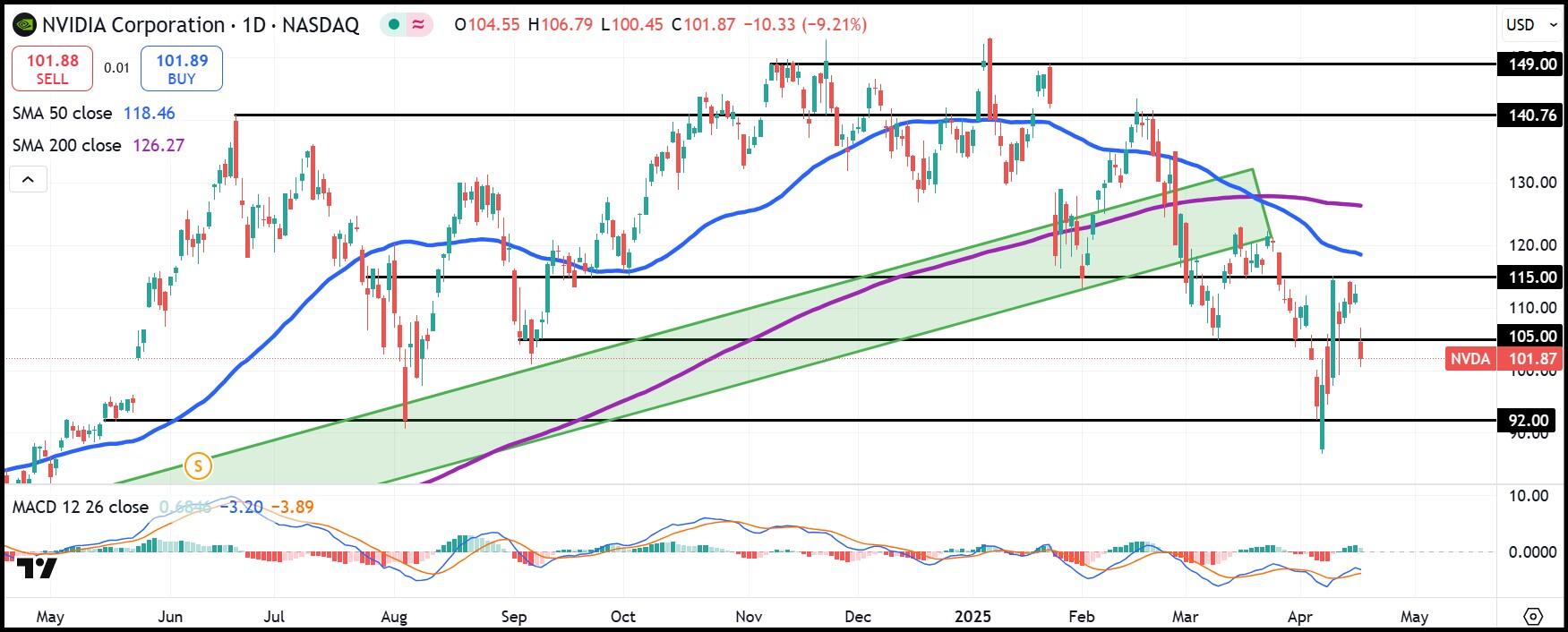
NVDA daily stock chart
Author

Clay Webster
FXStreet
Clay Webster grew up in the US outside Buffalo, New York and Lancaster, Pennsylvania. He began investing after college following the 2008 financial crisis.