Nvidia–Intel deal: What it means for the AI ecosystem

Key points:
- A new alliance reshapes AI computing: Nvidia’s $5B investment in Intel is not just financial support—it puts Intel back at the center of the AI ecosystem by making its CPUs a core part of Nvidia’s GPU platforms.
- Winners and losers emerge: Intel gains credibility, Nvidia expands its reach, and supply chain players like TSMC, SK Hynix, Micron, ASML, Synopsys, and Japan’s Tokyo Electron benefit from rising complexity. On the other hand, AMD and Arm risk losing share as Intel’s CPUs get tightly integrated with Nvidia.
- Strategic implications go beyond business: The deal reflects a broader U.S. effort to consolidate semiconductor leadership against China, while also planting seeds for Intel Foundry to become a long-term alternative to TSMC.
Nvidia’s $5 billion investment in Intel and their plan to co-develop custom chips is one of the most consequential alliances in U.S. technology in recent years. It comes just weeks after the U.S. government took a direct stake in Intel, underscoring how strategic semiconductors have become in the U.S.–China rivalry.
For investors, the deal reshapes the AI computing landscape, with implications stretching from Nvidia and Intel themselves to the entire global supply chain.
What the deal means
Nvidia will acquire Intel shares at $23.28 each and the two companies will collaborate on custom data-center and PC chips. These products will combine Intel’s x86 CPUs with Nvidia’s graphics and interconnect technologies, such as NVLink and RTX GPU chiplets.
In simple terms:
- For AI servers: Intel will design custom CPUs that fit perfectly with NVIDIA’s GPUs.
- For PCs: They’ll build new “AI PC” chips that combine Intel’s processors with NVIDIA’s RTX graphics.
Importantly, NVIDIA is not moving its chip manufacturing to Intel yet. This is more about design and partnership than production. But geopolitically, it signals a stronger U.S. push to consolidate domestic semiconductor leadership.
Impact on Intel
For years, Intel’s processors were treated as basic connectors between GPUs and the rest of the system. With Nvidia now co-developing CPUs that plug directly into its GPUs, Intel’s chips move from a supporting role to a core driver of performance.
If you control the world’s most entrenched ecosystem—Windows and x86—and suddenly those chips plug directly into Nvidia’s GPU mesh, you are no longer on the sidelines. Intel, long dismissed as lagging in the AI race, has been pulled back into the center of the conversation.
If you control the entrenched Windows and x86 ecosystem and can now integrate seamlessly into Nvidia’s GPU clusters, you are back in the game in a very real way. In the short run, this gives Intel fresh credibility with customers. Longer term, it plants seeds for Nvidia to eventually use Intel’s foundry as a second manufacturing source if TSMC capacity becomes strained or geopolitics intervene.
Intel’s execution challenges remain, however. Its foundry division still has to prove it can scale efficiently.
Impact on Nvidia
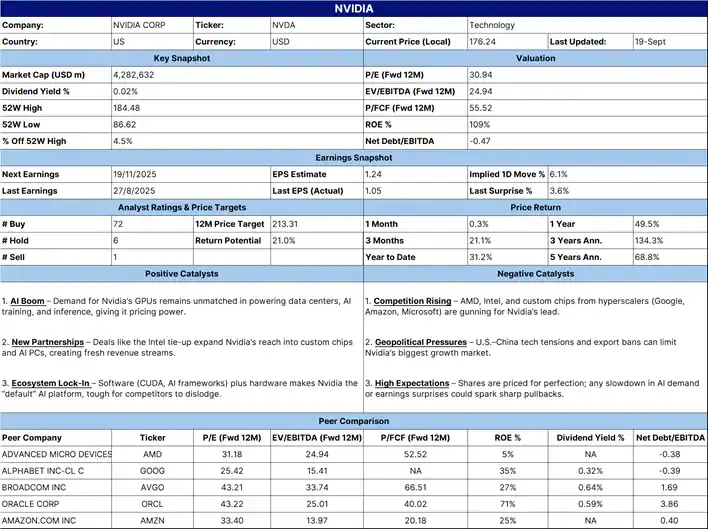
For Nvidia, the partnership provides flexibility and reach. The company already has ARM-based Grace CPUs, but adding Intel’s x86 architecture broadens its appeal to enterprises that prefer to stick with familiar systems. This strengthens Nvidia’s grip on AI data centers and opens the door to new categories of AI PCs.
The deal also helps Nvidia entrench NVLink as the standard interconnect, making its platform harder to dislodge. Political goodwill is another side benefit, as Nvidia shows alignment with U.S. industrial policy.
Still, risks remain. Nvidia must balance the Intel tie-up with its own CPU roadmap, and the deal does not resolve bottlenecks in advanced manufacturing or memory. It will remain heavily dependent on TSMC for leading-edge production and on SK Hynix and Micron for scarce high-bandwidth memory.
Implications for U.S. tech
The bigger picture is that this partnership represents a form of U.S. technology consolidation. Intel, Nvidia, and the government are aligned in reinforcing domestic leadership at a time when China is rapidly developing its own AI chips.
It is unlikely to stop at Intel, and other U.S. chipmakers could also be drawn into similar public–private partnerships as Washington deepens its commitment to securing semiconductor supply chains.
Supply chain beneficiaries
The deal’s impact extends far beyond Nvidia and Intel.
- Foundries: TSMC remains essential for Nvidia’s flagship GPUs and interconnect chips, but its dominance looks marginally less secure as Intel Foundry gains a potential future role.
- Memory suppliers: SK Hynix, Micron, and Samsung stand to benefit from rising demand for HBM, which remains the bottleneck in AI server performance.
- Chip design tools: Companies like ASML, Synopsys and Japan’s Lasertec stand to benefit, as as more complex chip designs drive demand for advanced tools.
- Server and PC makers: Companies such as Super Micro Computer in the U.S. should see increased demand for AI-optimized systems. PC makers including Dell, HP, and Lenovo could also benefit if AI PCs gain traction.
- Networking: Broadcom and Marvell will remain integral to scaling data-center networks, even as Nvidia pushes its proprietary NVLink technology.
- Japan and Taiwan equipment/materials: Tokyo Electron, Shin-Etsu Chemical, and Taiwanese packaging firms could see upside from capacity expansion.
On the other side, AMD could lose relative share in CPUs and PC chips as Intel leverages Nvidia’s ecosystem. Smaller challengers without clear integration into the Nvidia–Intel world may also find it harder to compete.
Arm also loses momentum. Cloud providers had been tempted by Arm’s efficiency pitch and the potential of Nvidia’s Grace CPUs. But with x86 systems now offering direct NVLink bandwidth and maintaining enterprise software compatibility, the incentive to shift workloads to Arm has weakened considerably.
Risks for investors
As with any large partnership, execution risk is significant. New CPUs and PC systems must be delivered on time and at competitive efficiency levels. Supply bottlenecks in HBM and advanced packaging remain tight, which could limit upside. Finally, the geopolitical backdrop is volatile: U.S. stakes in Intel and export restrictions on China mean regulatory or political developments could quickly affect sentiment.
Investor takeaways
This deal reshuffles the AI competitive landscape. Nvidia now extends its dominance into the CPU layer, Intel reclaims a meaningful seat at the AI table, AMD and Arm face strategic headwinds, and toolmakers like ASML, Synopsys, and Lasertec become even more indispensable.
In summary,
- Short term: Intel enjoys a credibility boost, Nvidia consolidates ecosystem power.
- Medium term: Supply chain beneficiaries—TSMC, HBM suppliers, ASML, Synopsys, and Lasertec—are well positioned as complexity and capacity rise.
- Long term: Intel Foundry becomes the wildcard. If execution improves, it could emerge as Nvidia’s insurance policy against TSMC dependence.
The bottom line: Nvidia and Intel have redrawn the AI map. Investors should balance exposure between U.S. technology leaders and Asian supply chain enablers, with a tilt toward companies that profit regardless of who wins the CPU–GPU rivalry.
Read the original article here: Nvidia–Intel deal: What it means for the AI ecosystem
Author
Saxo Research Team
Saxo Bank
Saxo is an award-winning investment firm trusted by 1,200,000+ clients worldwide. Saxo provides the leading online trading platform connecting investors and traders to global financial markets.