No, it isn’t time to sell IBM stock

Key points
-
IBM’s results failed to impress the analysts, but they aren’t bad, and cash flow is robust.
-
The stock’s 5% dividend yield is enough to get investor attention and the distribution is growing.
-
The institutions are buying this stock and helping to put a bottom in place.
-
5 stocks we like better than International Business Machines.
IBM’s (NYSE: IBM) share price is struggling to hold gains inspired by the Q1 earnings report, and they may move lower but don’t take this as a signal to sell. The results failed to sustain a rally, but they aren’t bad. The results are mixed; IBM isn’t growing fast, but who cares?
This isn’t a growth name anymore; it is a blue-chip tech stock that pays a 5% dividend and significantly outperforms the bottom-line consensus. That’s what investors should care about. Income investors, anyway.
The 5% dividend yield might be a red flag, the payout ratio is near 70% of the 2023 consensus for earnings, but the payout is safe. The company’s cash flow and FCF are sufficient and expected to grow. One of the significant takeaways from the Q1 report is that margin was much wider than expected, resulting in earnings nearly double the Marketbeat.com consensus estimate.
Add nearly 30 years of annual increases to the equation, and future distribution increases are expected.
“In the quarter, we remained focused on the fundamentals of our business, increasing productivity and generating operating leverage,” said James Kavanaugh, IBM senior vice president and chief financial officer.
“As a result, we again expanded our gross profit margin, improved our underlying profit performance and increased our cash generation. We are well-positioned to continue investing for growth and returning value to shareholders through dividends.”
IBM widens margin, shares surge
IBM posted a decent quarter with revenue of $14.3 billion, growing by 0.7% compared to last year. The gain was driven by growth in the Software and Consulting segments, offset by a decline in Infrastructure products.
The takeaway is that operating efficiency leveraged the growth and resulted in widening gross and operating margins. Wider margins resulted in a double-digit increase in cash flow and a high-single-digit increase in free cash flow.
The company’s net cash from operations grew by 15% and FCF by 8%, although the GAAP earnings of $1.36 are down slightly compared to last year but still $0.69 better than the expected $0.67.
Despite the stunning bottom-line beat, the analysts were less than impressed with the results. In their view, some questions need to be answered and shifting business trends could impact results later in the year. Marketbeat is tracking 4 new commentaries so far, including price target reductions.
The upshot is that 3 of the 4 new targets are above the consensus estimate, about 9% above the current market action.
The institutions are more bullish on the stock. They’ve been buyers on balance for the last 9 consecutive quarters, and their activity spiked in Q1. The institutions netted about $3.7 billion worth of stock, about 3.2% of the company. They own about 56% of the company, and their holdings are growing in Q2. Not surprising given the company’s history with artificial intelligence.
The technical outlook: Downtrend coming to an end
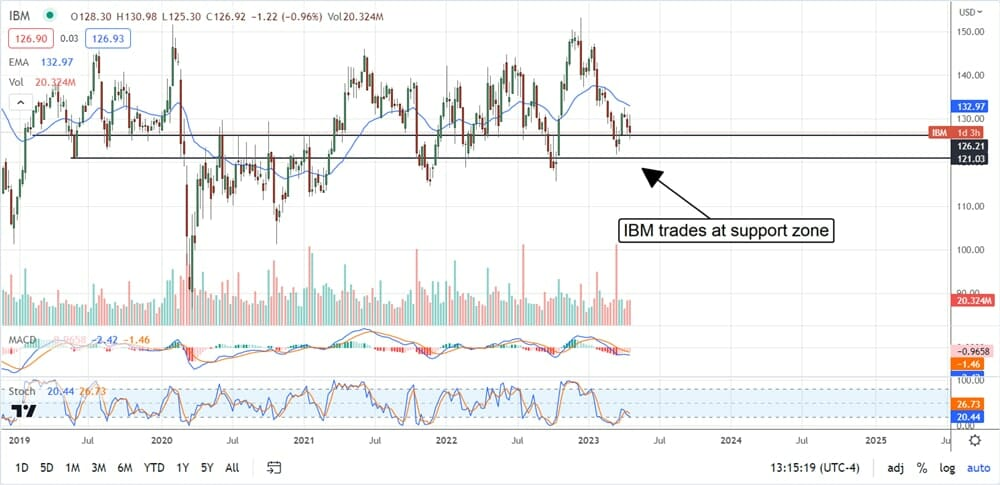
The downtrend in IBM shares may not be over, but the bottom is close. The market shows signs of support above critical levels predating the pandemic. Assuming the market supports the price at this level, this stock should complete a bottom and prepare for a rally that may begin later in the year. If not, this stock could fall to the $115 level, which tends to produce a strong bounce.
Author

Jacob Wolinsky
ValueWalk
Jacob Wolinsky is the founder of ValueWalk, a popular investment site. Prior to founding ValueWalk, Jacob worked as an equity analyst for value research firm and as a freelance writer. He lives in Passaic New Jersey with his wife and four children.