Nio Stock Forecast: A bad sign as NIO shares react poorly to good news
- Nio unveils Onvo L60, a more mainstream model with a 620-mile range.
- JPMorgan analyst places $5.40 price target on NIO stock.
- NIO shares drop 7.9% on Wednesday despite upgrade.
- Lighter US inflation, Retail Sales boost NASDAQ.


Nio (NIO) has unveiled a new brand called Onvo that it thinks will better compete for the average vehicle customer compared to its current name brand, Nio, that focuses on an appeal to luxury.
After introducing the newest model from Onvo at an event on Wednesday, NIO shares slumped nearly 8% despite a positive note from a respected analyst.
Nio moved further behind in Wednesday’s session as the broader market triumphed on a report that showed inflation trending lower, as well as flat Retail Sales. This news was taken as a sign that the Federal Reserve (Fed) would trim interest rates sooner rather than later, and NASDAQ sailed to an impressive 1.4% gain.
Nio stock news: JPMorgan upgrade follows release of Onvo L60
Executives at Nio unveiled the Onvo L60 on Wednesday, which should be available to buyers in the third quarter of the year. The mid-market SUV is supposed to compete with the Tesla (TSLA) model Y and will retail for just $30,500.
The L60 sports a long-range option that will allow drivers to last as much as 620 miles without needing a new charge. Additionally, drivers can use the company’s patented “three-minute” battery swap at any of over 1,300 Nio stations.
The news may have taken some Nio investors by surprise as it would seem like Nio is spreading its workers thin in order to launch a separate in-house brand. Also, the market likely sees the cheaper Onvo vehicles as a scourge to Nio’s gross margins.
JPMorgan does not seem to see it that way. Analyst Nick Lai wrote a note this week that changed his tune on NIO stock. First, Lai wrote that Nio’s battery as a service model would begin reaping a harvest soon enough by creating a lower entry price for vehicles. Then Lai said that the electric automaker should benefit from new government policies to boost EV demand.
Nio has already seen a measured return to growth so far in 2024 despite an earlier period of flat demand. Nick Lai changed his rating on NIO from Underweight to Neutral but placed a conservative price target on the shares of $5.40.
Lai said that monthly vehicle sales should rise from 15K in the second quarter to 23K in the fourth quarter, followed by a rise to a 12% gross margin.
EV stocks FAQs
Electric vehicles or EVs are automobiles that use rechargable batteries and electric motors to accelerate rather than internal combustion engines (ICEs). They have been around for more that 100 years, but battery technology research & development was meager for much of the 20th century. Lithium-ion battery technology became advanced enough to produce EVs at scale in the late 1990s and 2000s, and sales have been steadily increasing since then Tesla’s Roadster was unveiled in 2008. EVs are viewed as a means of reducing carbon emissions since battery electric vehicles (BEVs) themselves produce zero emissions. Other vehicles called plug-in hybrid electric vehicles (PHEVs) utilize both battery electric power and ICEs as a backup.
EVs are growing from a small base, but they rose from 9% of global new auto sales in 2021 to 14% of the total in 2022. This was a 65% YoY growth rate, and the industry delivered 10.2 million EVs worldwide in 2022. Projections show this number climbing above 16 million in 2023. Across the world, market shares differ greatly among nations. Nearly 88% of Norwegian new car sales in 2022 were EVs. On the other hand, the United States, where much of the modern innovation in EVs was forged, had less than 8% of new vehicle sales go to EVs in 2022. The largest EV market in the world, China, saw 30% of the market go to EVs that year.
We know you’re thinking Elon Musk, but he’s probably more like the father of the mass-market, contemporary EV. All the way back in 1827, a Hungarian priest named Anyos Jedlik invented the electric motor and used it the following year to power a vehicle of sorts. French scientist Gaston Planté invented the lead-acid battery in 1859, and German engineer Andreas Flocken built the first true electric car for the public in 1888. EVs made up about 38% of all vehicles sold in the US around 1900. They began losing market share rapidly after 1910 when gasoline-powered vehicles grew much more affordable. They largely died off until new research programs in the 1990s led to gradual private sector investment in the 2000s.
China’s BYD is by far the largest manufacturer of EVs in the world. In 2022 it sold 1.8 million EVs and in the second half of the year made up 20% of the global market. The asterisk given to BYD is that the vast majority of these vehicles are hybrids. Tesla’s 12% market share is often treated as more significant than BYD, because it only sells BEVs and is the most famous EV brand in the world. Volkswagen, BMW and Wuling then round out the top five. As a new sector with heavy investment though, many startups have flooded the market. These include China’s Nio, Li Auto and Xpeng; a Swedish-Chinese manufacturer called Polestar; and Lucid and Rivian from the US.
Nio stock forecast
Nio stock needs to cling to the $5.30 level, which held up most of the time in February and March. Otherwise, a break of that level would send shares reeling back below $4.00. The close on Wednesday at $5.33 really leaves shareholders in the lurch. Will $5.30 hold once again?
The focus for bulls is whether or not they can blast through the $6.00 to $6.30 range. Two chances this month fell flat. From there it's a straight shot to the $7.00 to $7.30 zone that worked as support during Q4 2023.
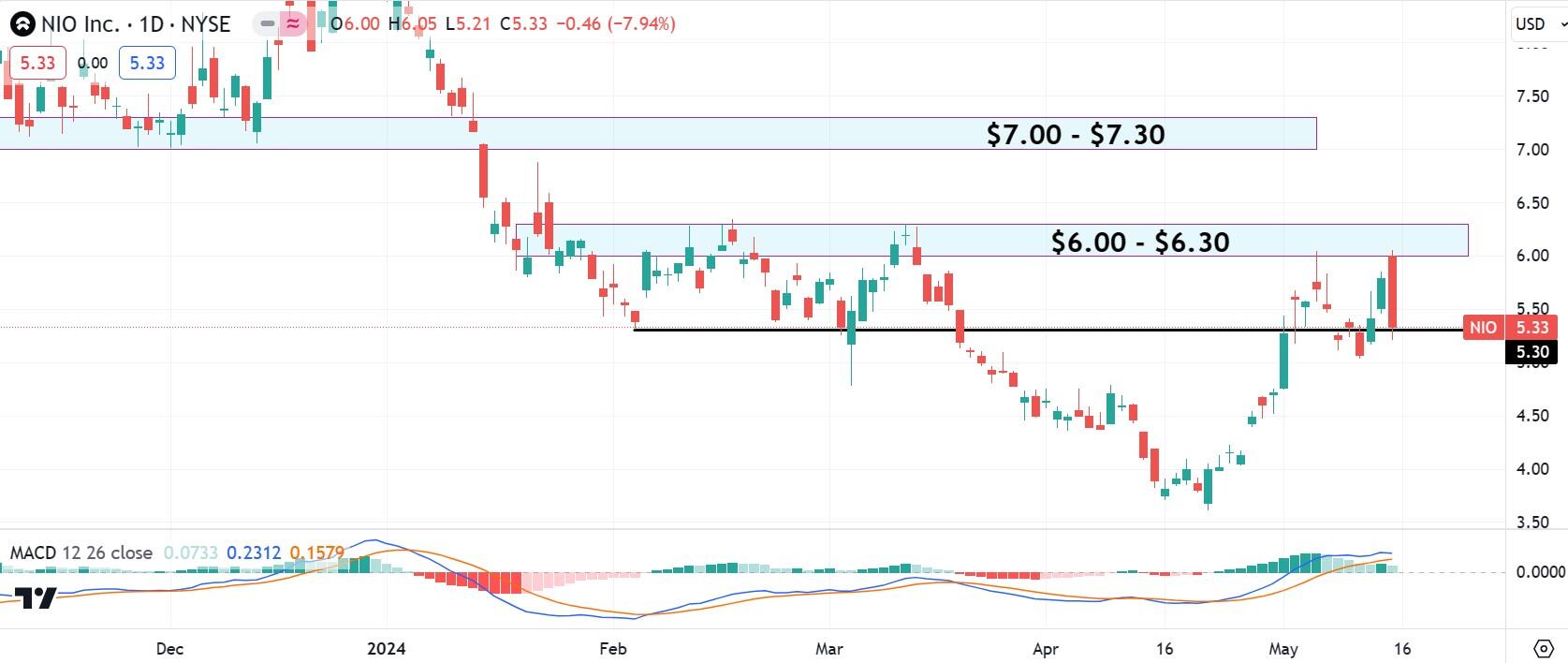
NIO daily stock chart
Premium
You have reached your limit of 3 free articles for this month.
Start your subscription and get access to all our original articles.
Author
Clay Webster
FXStreet
Clay Webster grew up in the US outside Buffalo, New York and Lancaster, Pennsylvania. He began investing after college following the 2008 financial crisis.

















