Natural Gas jumps near 2% with European gas concerns at hand
- Natural Gas prices are jumping higher on Monday in both US and European trading.
- Traders are picking up Gas contracts with gas prices in Spain pointing to shortage.
- The US Dollar Index sees ample support towards 105.00 despite its downbeat performance last week.

Natural Gas (XNG/USD) reverses from its earlier thoughts this Monday that a global recession could be showing up. Biggest element for this turnaround comes out of Spain where local gas prices are trading above the benchmark European prices. Spain has a just-in-time gas network with little storage facilities compared to France or Germany, and is very much dependant from inflows from other countries.
The DXY US Dollar Index meanwhile sees further upticks this Monday after the positive undertone from the US Jobs Report on Friday, which smashed all expectations with a stellar performance of 303,000 against 200,000 expected. US yields increased by over 20 basis points in the US 10-year benchmark rate last week, which means expectations for that first rate cut are starting to reverse substantially.
Natural Gas is trading at $1.94 per MMBtu at the time of writing.
Natural Gas news and market movers: Spain has issues
- Spillover risk lingers between the Carbon Emission market and the Gas market. Traders are cutting their Carbon exposure, which could point to a potential recession risk in the energy sector. Energy-consuming companies buy Carbon Emission rights to be able to burn Gas or consume other energy resources for their business. A decline in Carbon buying could mean a slowdown ahead in industrial production.
- The ban on new US Gas exports from US President Joe Biden is starting to bite on a state level. Pennsylvania governor Josh Shapiro (Democrat) urged Joe Biden to reverse the policy with risk of losing the swing state in the 2024 Presidential Election, according to Bloomberg.
- Dow Jones reports that TotalEnergies will expand its gas production in Texas after it acquired a 20% stake in Lewis Energy Group, which holds leases to mine Gas in Dorado.
- Bloomberg reports a drop in Natural Gas supplies with biggest factor being Egypt, which is set to halt gas exports over the summer, to redirect the gas feed inland in order to meet with the energy demand during the need for cooling.
Natural Gas Technical Analysis: Short term squeeze
Natural Gas prices are facing issues again, with the rising US yields as the biggest threat on the horizon. US rates soared over 20 basis points in the US 10-year benchmark rate last week, while other major economies are seeing their central banks on the way to cut or have cut already. This rate differential weighs on the US against the rest of the world, and it could mean a slowdown is taking place: Even if the US economy is outperforming, higher rates will start to cut growth and this means less demand for Natural Gas.
On the upside, the key $1.97 level needs to be regained before challenging last week’s peak at $2.00. The next key mark is the historic pivotal point at $2.13. Should Gas prices pop up in that region, a broad area opens up with the first cap at the red descending trend line near $2.21.
On the downside, multi-year lows at $1.60 are still nearby, with $1.65 as the first line in the sand. In case of a breakdown below these levels, traders should look at $1.53 as the next supportive area.
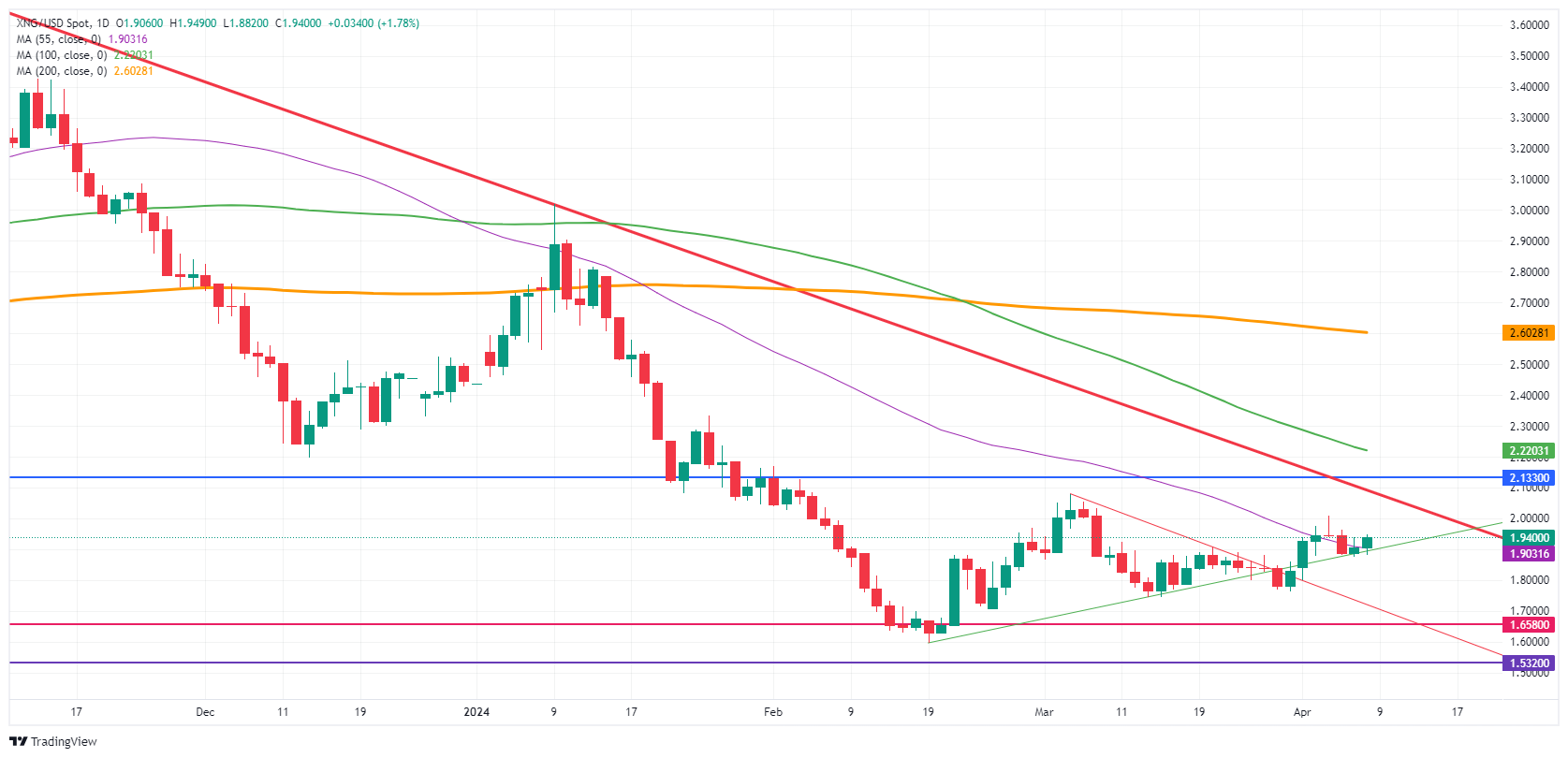
Natural Gas: Daily Chart
Natural Gas FAQs
Supply and demand dynamics are a key factor influencing Natural Gas prices, and are themselves influenced by global economic growth, industrial activity, population growth, production levels, and inventories. The weather impacts Natural Gas prices because more Gas is used during cold winters and hot summers for heating and cooling. Competition from other energy sources impacts prices as consumers may switch to cheaper sources. Geopolitical events are factors as exemplified by the war in Ukraine. Government policies relating to extraction, transportation, and environmental issues also impact prices.
The main economic release influencing Natural Gas prices is the weekly inventory bulletin from the Energy Information Administration (EIA), a US government agency that produces US gas market data. The EIA Gas bulletin usually comes out on Thursday at 14:30 GMT, a day after the EIA publishes its weekly Oil bulletin. Economic data from large consumers of Natural Gas can impact supply and demand, the largest of which include China, Germany and Japan. Natural Gas is primarily priced and traded in US Dollars, thus economic releases impacting the US Dollar are also factors.
The US Dollar is the world’s reserve currency and most commodities, including Natural Gas are priced and traded on international markets in US Dollars. As such, the value of the US Dollar is a factor in the price of Natural Gas, because if the Dollar strengthens it means less Dollars are required to buy the same volume of Gas (the price falls), and vice versa if USD strengthens.
Author

Filip Lagaart
FXStreet
Filip Lagaart is a former sales/trader with over 15 years of financial markets expertise under its belt.

















