|

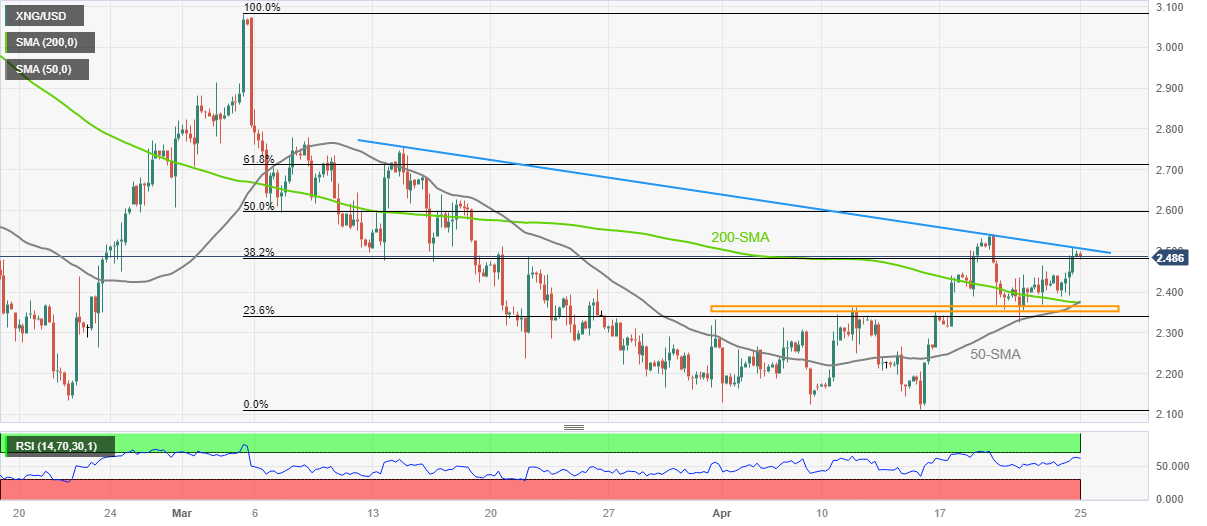
Natural Gas Price Analysis: XNG/USD retreat appears elusive amid impending Golden Cross near $2.50

  • Natural Gas price snaps three-day winning streak as bulls take a breather at one-week high.
  • 50-SMA pierces 200-SMA from below, suggesting strength of short-term bullish bias.
  • 1.5-month-old descending resistance line challenges immediate XNG/USD upside.
  • Key SMAs, fortnight-long horizontal support prod Natural Gas sellers amid upbeat RSI (14).

Natural Gas Price (XNG/USD) prints the first intraday loss, so far, in four as the quote eases from a one-week high to $2.48 amid early Tuesday. In doing so, the XNG/USD takes a U-turn from a six-week-old descending resistance line.

However, the energy instrument’s sustained trading beyond the 200-SMA and 50-SMA, as well as the previous horizontal resistance, now the key support zone, keeps the Natural Gas buyers hopeful. Adding strength to the upside bias is the firmer conditions of the RSI (14) line, not overbought.

That said, the quote’s latest weakness also appears elusive as the 50-SMA crosses the 200-SMA from below and portrays a “Golden Cross” bullish signal for the XNG/USD price.

Even if the quote slips beneath the looming bullish moving average crossover, around $2.37 by the press time, a horizontal area comprising multiple levels marked since April 11, close to $2.36-35, appears a tough nut to crack for the XNG/USD bears.

Meanwhile, the Natural Gas price run-up beyond the aforementioned resistance line from early March, close to $2.51 by the press time, needs validation from the monthly high of $2.54 to convince the XNG/USD bulls.

Following that, a run-up toward the mid-March swing high of around $2.74 can’t be ruled out.

Natural Gas Price: Four-hour chart
Trend: Recovery expected

Author

Anil Panchal

Anil Panchal

FXStreet

Anil Panchal has nearly 15 years of experience in tracking financial markets. With a keen interest in macroeconomics, Anil aptly tracks global news/updates and stays well-informed about the global financial moves and their implications.


More from Anil Panchal
Share:

Editor's Picks

GBP/USD pops to three-week highs above 1.3400

GBP/USD accelerates its advance and surpasses the key 1.3400 barrier on Wednesday. That said, Cable clinches new multi-week tops on the back of the resurgence of the selling interest in the Greenback despite persistent tensions in the Middle East.

EUR/USD reverses losses, targets 1.1450

EUR/USD trades with decent gains north of the 1.1400 hurdle in the latter part of Wednesday’s NA session. The fresh offered stance in the US Dollar allowed the pair to revert the initial drop and refocus on the upside despite the hawkish tone from the FOMC Minutes and persistent geopolitical tensions.

Gold trims losses, looks at $4,100

Gold manages to regain some composure and bounce off earlier lows on Wednesday. The precious metal now shifts its focus to the $4,100 mark per troy ounce amid decent losses in the US Dollar and steady geopolitical jitters.

Dogecoin Forecast: DOGE risks sliding below $0.07 despite returning retail interest
Dogecoin (DOGE) edges lower toward support at $0.07 at the time of writing on Wednesday. The meme coin reflects a broader sell-off in the crypto market, primarily attributed to uncertainty over tensions in the Middle East. Iran launched attacks on American military bases in the Middle East on Wednesday in retaliation for attacks by the United States (US) on several places in Iran.
2.50%: Why the Kiwi's first hike in three years is a wager on a number nobody can see
The Reserve Bank of New Zealand (RBNZ) raised the Official Cash Rate (OCR) by 25 basis points to 2.50% at 02:00 GMT on Wednesday, its first hike in three years and the moment the bank that cut deeper than any G10 peer last cycle turned to face the other way.
Bye, forward guidance: How to trade when central banks choose silence

Central banks have spent years telling markets what might come next. Now, traders face the possibility that they say a lot less. From the Federal Reserve to the European Central Bank and the Bank of England, policymakers are pushing back against forward guidance.