|

Natural Gas Price Analysis: XNG/USD bounces off key support to reclaim $2.60 ahead of Fed inflation

  • Natural Gas Price picks up bids to recover from weekly low, snaps two-day losing streak.
  • Two-month-old rising support line prods XNG/USD bears as US Dollar stabilizes ahead of Core PCE Price Index data.
  • 50-DMA, steady RSI also favor Natural Gas recovery as market awaits Fed’s preferred inflation gauge.
  • Five-month-old horizontal resistance, descending trend line from March appear strong challenges for the XNG/USD bulls.

Natural Gas Price (XNG/USD) clings to mild gains around $2.63 during the mid-Asian session on Friday. In doing so, the XNG/USD prints the first daily gains in three while bouncing off the weekly low.

That said, the energy instrument dropped the most in more than a fortnight the previous day amid the broad US Dollar strength.

The XNG/USD downside, however, failed to conquer an upward-sloping support line from late May, around $2.58 by the press time.

It should be noted that the steady RSI (14) and the 50-DMA challenge the Natural Gas sellers unless the quote provides a daily closing beneath the $2.56 level.

Following that the 38.2% Fibonacci retracement of the March-April downside, near $2.48, will be in the spotlight before directing the XNG/USD bears toward the previous monthly low surrounding $2.17.

On the contrary, the 61.8% Fibonacci retracement level of $2.71 guards the immediate upside of the Natural Gas price ahead of a five-month-old horizontal resistance surrounding $2.78.

Even if the XNG/USD crosses the $2.78 hurdle, a downward-sloping resistance line from March, close to $2.89 by the press time, will act as the last defense of the bears.

Natural Gas Price: Daily chart
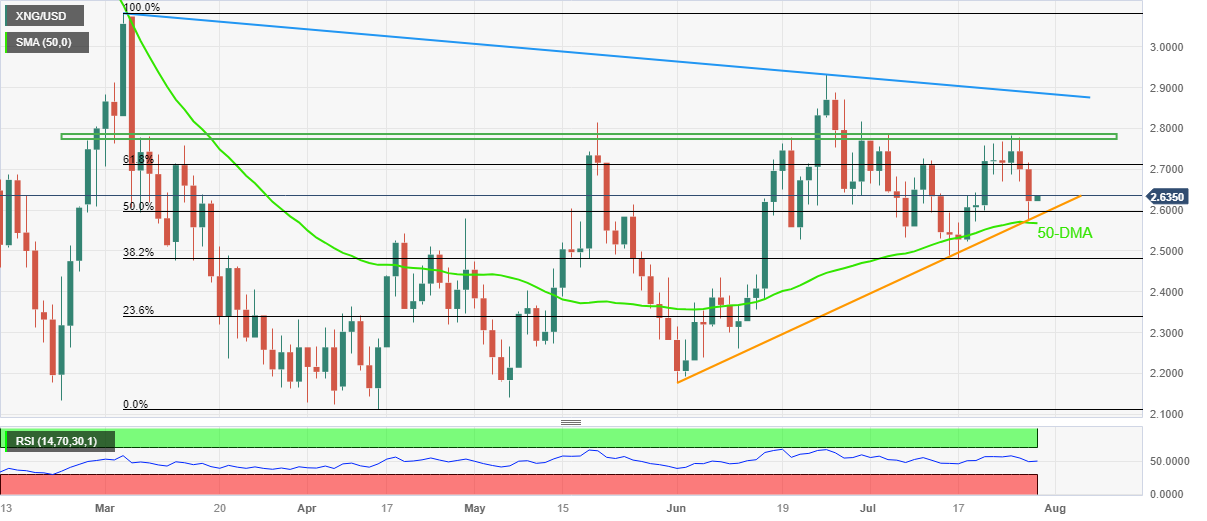
Trend: Limited recovery expected

Author

Anil Panchal

Anil Panchal

FXStreet

Anil Panchal has nearly 15 years of experience in tracking financial markets. With a keen interest in macroeconomics, Anil aptly tracks global news/updates and stays well-informed about the global financial moves and their implications.


More from Anil Panchal
Share:

Editor's Picks

AUD/USD stabilizes above two-week low/0.6950 as traders await US election results

AUD/USD edges higher in the Asian session on Wednesday, recovering slightly from a two-week low touched on a less hawkish RBA reaction the previous day. Hopes for Iran diplomacy undermine the safe-haven US Dollar and support the currency pair, though the upside remains capped as traders await US midterm election results.

USD/JPY retreats from three-week top, slips below 158.50 amid intervention risks and softer USD

USD/JPY slides below 158.50 in the Asian session on Wednesday, snapping a two-day winning streak to hit a near three-week high the previous day, as intervention risks support the Japanese Yen. Meanwhile, the US Dollar remains on the back foot amid hopes for Iran diplomacy, further weighing on the currency pair as traders brace for some volatility surrounding US midterm election results.


Gold consolidates below $3,950 as Fed hike bets counter softer USD ahead of US election results

Gold struggles to capitalize on the previous day's bounce from sub-$3,900 levels, oscillating in a range during the Asian session on Wednesday as traders brace for short-term market volatility surrounding US midterm election results. Meanwhile, hopes for Iran diplomacy weigh on the safe-haven US Dollar and support bullion, though upside remains capped amid Fed rate hike bets.

Ethereum: US-led selling keeps ETH below $2,309 realized price
Ethereum (ETH) faces pressure near $2,300 on Tuesday as it struggles to recover its realized price. The top altcoin fell below its realized price, or investors' average on-chain cost basis, at $2,309 following the $6.3 billion Binance hack last Thursday.
US Midterms: Can Wall Street rally despite AI debt and credit risks?
Political uncertainty may be coming to an end, but the real question for investors is whether the technology sector can sustain its enormous spending commitments. The US midterm elections are arriving at an interesting moment for financial markets.
The 2% inflation target came from a throwaway remark. It now moves trillions
The Federal Reserve's 2% inflation goal grew out of an off-the-cuff remark by a New Zealand politician in 1988. Bond investors still price long-term US debt as if 2% holds, so a change in how the Fed measures inflation would move markets.