|

Natural Gas Price Analysis: 100-EMA prods XNG/USD rebound near $2.75

  • Natural Gas Price struggles to defend corrective bounce off the lowest level in a fortnight.
  • Steady RSI suggests further recovery but one-week-old resistance line adds to the upside filters.
  • Rising trend line from June appears key support for XNG/USD bears to watch.

Natural Gas Price (XNG/USD) clings to mild gains around $2.75 amid early Friday morning in Europe. In doing so, the energy instrument justifies the market’s indecision amid a light calendar and mixed fundamentals about the energy market, as well as a pullback in the US Dollar and the Treasury bond yields.

With this, the XNG/USD pares the weekly losses while poking the 100-day Exponential Moving Average (EMA) level of around $2.76. Not only the market’s consolidation due to the pullback in the US Treasury bond yields but a steady RSI (14) line also favor the intraday buyers of the Natural Gas Price.

Amid this plays, the XNG/USD is likely to extend the latest rebound towards crossing the 100-EMA hurdle surrounding $2.76. However, a downward-sloping resistance line from August 10, around $2.82 by the press time, restricts the further advances of the Natural Gas Price.

In a case where the XNG/USD remains firmer past $2,.82, the odds of witnessing another attept to cross the 5.5-month-old horizontal resistance surrounding $3.06-08 can’t be ruled out.

Meanwhile, a pullback in the Natural Gas Price will challenge an ascending support line from June 01, around $2.60.

However, a daily closing below $2.60 will make the XNG/USD vulnerable to declining toward July’s low of $2.48.

Overall, Natural Gas price pare weekly losses but the buyers have a long way to ride before retaking control.

Natural Gas Price: Daily chart
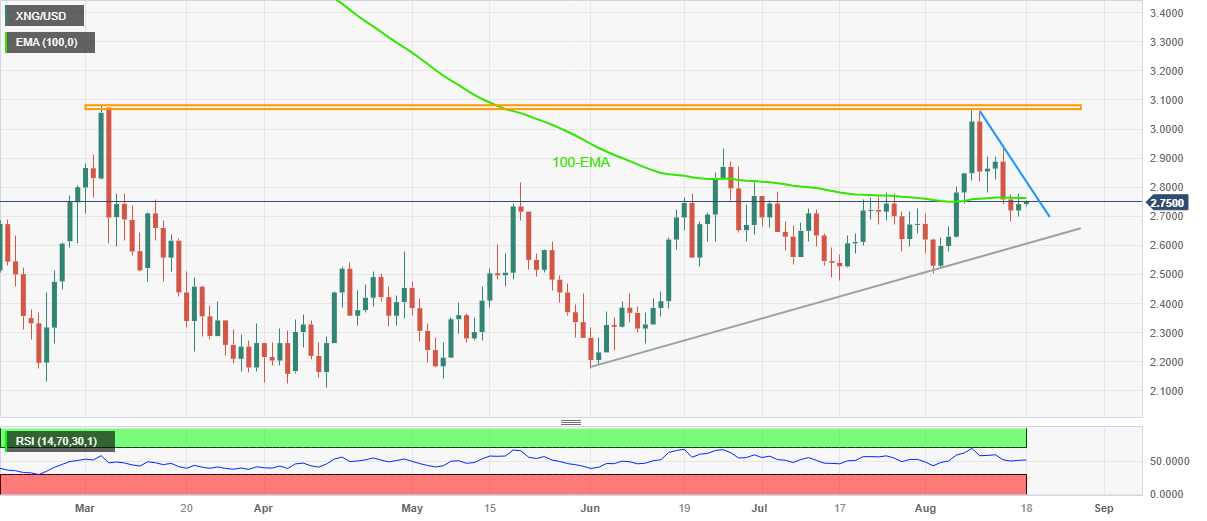
Trend: Limited recovery expected

Author

Anil Panchal

Anil Panchal

FXStreet

Anil Panchal has nearly 15 years of experience in tracking financial markets. With a keen interest in macroeconomics, Anil aptly tracks global news/updates and stays well-informed about the global financial moves and their implications.


More from Anil Panchal
Share:

Editor's Picks

AUD/USD edges higher as hot CPI inflation and hawkish RBA lift rate hike bets

The AUD/USD pair gathers strength to near 0.7035 during the Asian trading hours on Friday. The Australian Dollar edges higher against the US Dollar as hotter Australian CPI inflation data has bolstered expectations of Reserve Bank of Australia rate hikes.

USD/JPY meets support near 157.00

USD/JPY retreats for the third consecutive day on Friday, revisiting the 157.00 region before attempting some recovery as investors continue to assess the latest BoJ meeting, where the central bank left rates unchanged, as widely anticipated.

Gold sinks to fresh yearly lows despite risk-off mood as Fed rate hike bets weigh

Gold slips to fresh year-to-date lows on Friday. The metal struggles despite a risk-off mood across markets, as expectations of further Federal Reserve (Fed) interest rate hikes continue to dominate price action, leaving Gold on track to end the month in negative territory.


Ripple Price Forecast: XRP bulls defend $1.20 as sell-side pressure triggers liquidations
Ripple (XRP) trades around $1.25 on Friday, rising from a short-term support level established at $1.20. This minor upward correction follows a sharp sell-off, triggered amid reports of a hack attack on the Binance exchange that impacted approximately $6.3 billion. The attack drove the broader crypto market on edge, as Binance suspended both deposits and withdrawals to contain the situation.
BoJ recap: A pause for now... but Japan has entered a new inflation phase
The Bank of Japan left its short-term policy rate unchanged at 1.25% but delivered a distinctly hawkish message on the risk of an inflation overshoot. The decision passed by 8-1, with board member Takata dissenting in favour of an increase to 1.5%, while Governor Kazuo Ueda stressed that the Bank would continue adjusting policy as needed.
The 2% inflation target came from a throwaway remark. It now moves trillions
The Federal Reserve's 2% inflation goal grew out of an off-the-cuff remark by a New Zealand politician in 1988. Bond investors still price long-term US debt as if 2% holds, so a change in how the Fed measures inflation would move markets.















