Natural Gas faces headwinds with summer future contracts facing worst demand ever
- Natural Gas prices are nosediving over 1.50% ahead of the US opening bell.
- Summer gas contracts are trading substantially lower, pointing to even lower than expected demand out of Europe.
- The US Dollar Index trades around 104.00 ahead of Super Tuesday and US PMI numbers.

Natural Gas (XNG/USD) completely drops the ball and sinks in red numbers for this Tuesday. The premature winning streak ends quite quickly with traders selling near term contracts as further dated contracts are selling off even harder. Biggest reason is the abscence of European demand in the market where apparently demand to refuel the gas stockpiles is even more disappointing as first anticipated.
Meanwhile, the US Dollar (USD) is gearing up for the first of many eventful days this week. Today, the so-called Super Tuesday takes place in the presidential primary election. The second big event will take place on Thursday, with the European Central Bank (ECB) monetary policy decision as a litmus test for the US Federal Reserve meeting on March 20. Ahead of Super Tuesday Primaries results, traders will pay attention to the S&P Global Services Purchasing Managers Index (PMI) and the Institute for Supply Management (ISM) data release.
Natural Gas is trading at $1.97 per MMBtu at the time of writing.
Natural Gas market movers: European tepid demand puts bulls under pressure
- The near term selling pressure is taking over from the longer term speculation with firm selling pressure ahead of the US opening bell.
- According to a weekly Bloomberg report, global weekly LNG supply fell by 13% for the week of February 26 against the previous week.
- Temperatures are set to fall again in China and Europe, heading back below 10 degrees Celsius, which is below the 10-year average.
- European demand is not picking up, forcing several Gas cargoes to stay at sea. Roughly 3 million metric tons have been afloat at sea for more than 20 days, a very high number compared to normal standards.
- Russia is facing headwinds from fresh US sanctions issued two weeks ago. Russia had ordered icebreaker vessels for its Arctic LNG 2 exports at a South Korean shipbuilder. However, under the new sanctions, Hanwha Ocean (the South Korean shipbuilder) is forbidden to sell to Russia, which means Russia is unable to open its arctic installation for production and exports.
Natural Gas Technical Analysis: A rally comes not that easily
Natural Gas prices are facing more upside pressure with both Qatar and the US delivering less than 13% of the normal weekly volume. These chunky drawdowns in supply are moving the needle quite quickly, with Gas prices soaring for the second consecutive day and exceeding the $2 level again. Though, the current selling pressure seen specifically in the summer contracts, is spilling over into the near term contracts and is erasing the earlier tailwind for Natural Gas.
On the upside, Natural Gas is breaking that $1.99-$2.00 marker – the level which, when broken on the way down, saw an accelerated decline back at the beginning of February. After that, the green line at $2.13 comes into view, where the triple bottoms from 2023 are placed. If Natural Gas sees a sudden demand pickup, $2.40 could come into play.
On the downside, $1.64 and $1.53 (the low of 2020) are targets to look out for. Ahead of those levels, the recently created pivotal levels at $1.86 and $1.80 should be able to provide some support and slow down any downside moves.
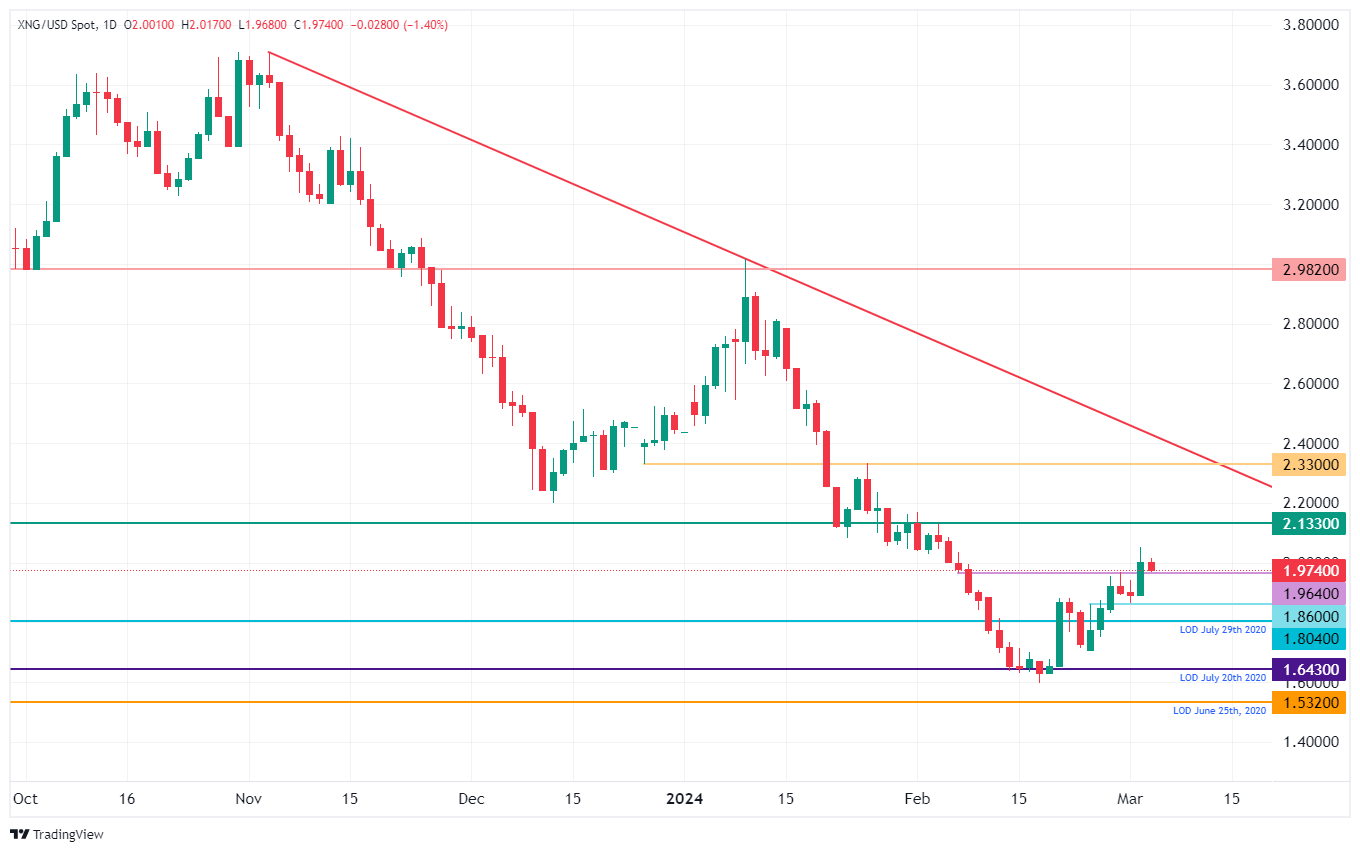
XNG/USD (Daily Chart)
Natural Gas FAQs
What fundamental factors drive the price of Natural Gas?
Supply and demand dynamics are a key factor influencing Natural Gas prices, and are themselves influenced by global economic growth, industrial activity, population growth, production levels, and inventories. The weather impacts Natural Gas prices because more Gas is used during cold winters and hot summers for heating and cooling. Competition from other energy sources impacts prices as consumers may switch to cheaper sources. Geopolitical events are factors as exemplified by the war in Ukraine. Government policies relating to extraction, transportation, and environmental issues also impact prices.
What are the main macroeconomic releases that impact on Natural Gas Prices?
The main economic release influencing Natural Gas prices is the weekly inventory bulletin from the Energy Information Administration (EIA), a US government agency that produces US gas market data. The EIA Gas bulletin usually comes out on Thursday at 14:30 GMT, a day after the EIA publishes its weekly Oil bulletin. Economic data from large consumers of Natural Gas can impact supply and demand, the largest of which include China, Germany and Japan. Natural Gas is primarily priced and traded in US Dollars, thus economic releases impacting the US Dollar are also factors.
How does the US Dollar influence Natural Gas prices?
The US Dollar is the world’s reserve currency and most commodities, including Natural Gas are priced and traded on international markets in US Dollars. As such, the value of the US Dollar is a factor in the price of Natural Gas, because if the Dollar strengthens it means less Dollars are required to buy the same volume of Gas (the price falls), and vice versa if USD strengthens.
Author

Filip Lagaart
FXStreet
Filip Lagaart is a former sales/trader with over 15 years of financial markets expertise under its belt.