|

NASDAQ spikes 10% after Trump pauses tariffs for 90 days

  • Trump pauses so-called "reciprocal" tariffs for 90 days.
  • NASDAQ Composite explodes 10% higher as Trump pauses severe bilateral tariffs.
  • Trump administration keeps 10% worldwide tariff in place.
  • S&P 500 and Dow Jones also spike above 7%.
In one the most volatile sessions in living memory, the NASDAQ Composite spiked as much as 10% on Wednesday after US President Trump surprised everyone with a sudden 90-day pause on US tariffs. The tech-heavy index shot up as much as 10% to 16,752 from an intraday low of 15,270.

Prior to the rally, the NASDAQ Composite had traded flat for part of the session. The Dow Jones Industrial Average (DJIA) and S&P 500 also spiked more than 7% on the news.

Trump halts US tariff policy for 90 days

In a certain sense, it would seem that the world beat Trump in round one of this trade war. US stock market indices sold off en masse in the three sessions following Trump's new tariff policy that was first announced last Wednesday. Wall Street denounced the policy broadly, and some of Trump's allies like Elon Musk disparaged his trade advisor Peter Navarro. It appears the gambit worked.

Trump relented on Wednesday after only a week. Under the new policy, the Trump administration will stick to its 10% broad-based tariff rate on all foreign imports but delay its much higher rates, such as 24% on Japan and 46% on Vietnam, for the time being.

However, Trump didn't budge on China, and instead, he announced a 125% tariff rate on Chinese goods due to that nation's response of announcing its own 34% additional tariff to US goods. The proposed base rate had been 104% on Chinese goods as of Tuesday, following several rounds of new tariffs.

On Wednesday morning, China announced that it would ditch its initial 34% added tariff rate on US goods and instead go with an 84% rate.
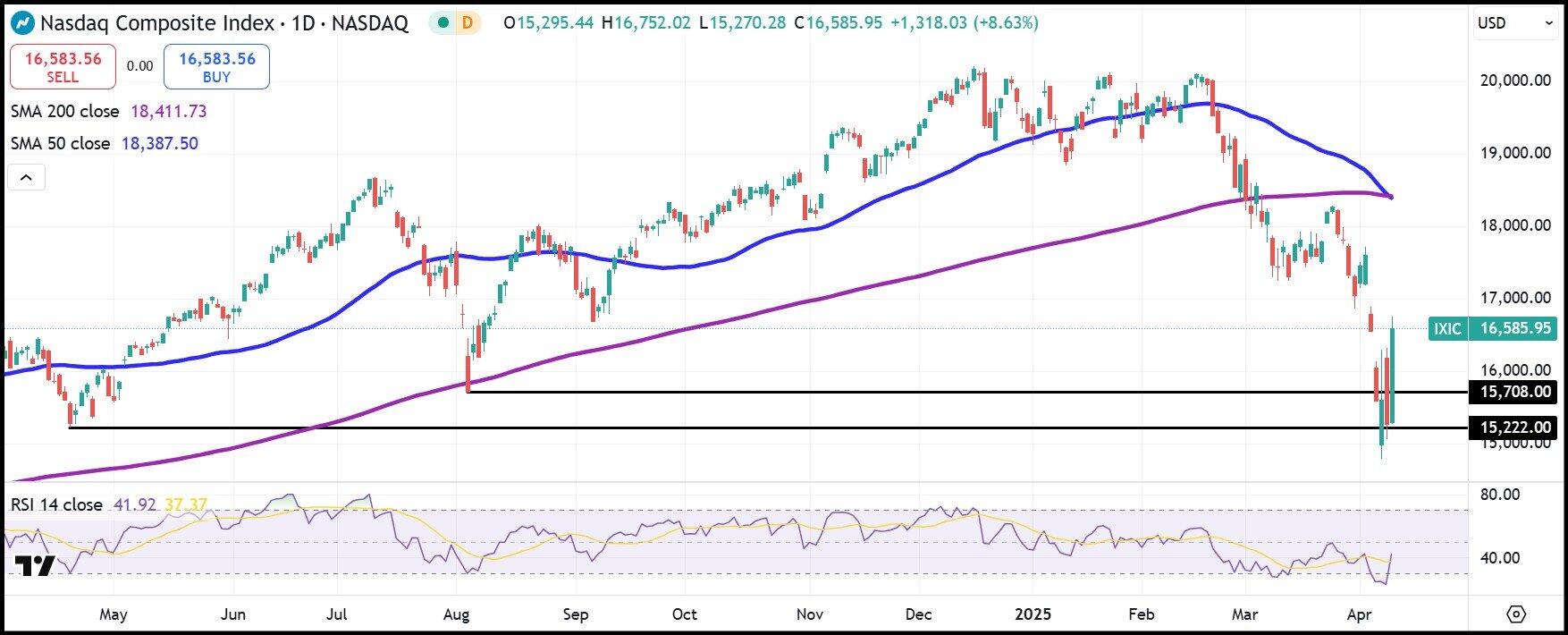
NASDAQ Composite daily index chart

NASDAQ Composite daily index chart

Author

Clay Webster

Clay Webster

FXStreet

Clay Webster grew up in the US outside Buffalo, New York and Lancaster, Pennsylvania. He began investing after college following the 2008 financial crisis.


More from Clay Webster
Share:

Editor's Picks

GBP/USD defends 1.3300 after strong UK PMI data

Following Thursday's sharp decline, GBP/USD clings to small gains above 1.3300 in the American session on Friday, supported by the upbeat UK Retail Sales and July PMI data. Nevertheless, the pair's upside remains capped as investors cling to a cautious stance amid a further escalation of tensions in the Middle East. The US July PMI data failed to trigger relevant price action.

EUR/USD remains below 1.1400 after mixed US PMIs

EUR/USD pressures daily lows below the 1.1400 mark in the American session on Friday. Mixed S&P Global PMIs, as manufacturing output contracted while services activity expanded in July, triggered no relevant market reaction. The focus remains in Middle East developments and inflation-related concerns.

Gold holds above $4,050 but momentum still missing

Gold builds on its modest intraday bounce and climbs above the $4,050 level on Friday, hitting a fresh daily high amid a modest US Dollar pullback. The fundamental backdrop, however, warrants some caution before confirming that the pullback from an over two-week high, touched on Wednesday, has run its course and positioning for any meaningful upside.

Ethereum: Derivatives interest in ETH improves, but signs of caution remain

Ethereum is hovering slightly below the $1,900 level, down 3% on Thursday following a slight expansion in derivatives interest. The top altcoin's open interest has increased to 14.60 million ETH, marking a 600K ETH increase over the past two days and its highest level since June 7.

XRP retreats as ETF interest cools
Ripple (XRP) slides toward the short-term $1.10 support on Friday, as broader crypto market sentiment weighs on crypto assets. The sell-off mainly stems from fears of inflation in the United States (US) amid the ongoing war in the Middle East and rising Oil prices.
US Dollar mid-year outlook: Exceptional currency, exceptional risks?
The US Dollar enters the second half of 2026 in a markedly different position from a year ago. The King currency has recovered, reflecting persistent US inflation, changing expectations for Fed policy, geopolitical tensions and renewed demand for defensive assets.