|

MULN Stock Forecast: Mullen Automotive slips as Tesla/Twitter deal drags down EV stocks

  • MULN fell by 3.7% during Wednesday’s trading session.
  • As Elon Musk moves in to acquire Twitter, Tesla stock sells off.
  • Ford is raising the price of its F-150 Lightning Truck for the second time. 

Mullen Automotive (MULN) traded lower on Tuesday as stocks cooled off following a red-hot start to the month of October. Shares of MULN slipped lower by 3.7% and closed the trading session at a price of $0.34. It was a volatile trading day as all three major averages closed the day lower after flipping from red to green during intraday trading. 10-year treasury bond yields rose sharply after retreating for the first two days of the week. Overall, the Dow Jones lost 42 basis points, the S&P 500 dropped by 0.2%, and the Nasdaq closed lower by 0.25%. 

Mullen Automotive stock price

Much of the focus in the electric vehicle industry remains on Tesla (TSLA) CEO Elon Musk’s impending acquisition of Twitter (TWTR). Tesla’s stock dropped again on Wednesday as investors began to weigh how much Musk’s involvement with Twitter will take away from his operations at Tesla. Musk has already revealed on Twitter that the acquisition brings him one step closer to being able to launch the X app, which is his vision to take on other super apps like Tencent’s (TCEHY) WeChat. Shares of TSLA and TWTR fell by 3.5% and 1.4%, respectively, during the session. 

In other EV news, legacy automaker Ford (F) is raising the price of its much anticipated F-150 Lightning truck by a further $5,000. It is the second such price hike for the truck in two months as Ford continues to battle rising costs and supply chain issues. Shares of Ford were up by 1.2% on Wednesday after Morgan Stanley raised its rating for the stock to Overweight. 
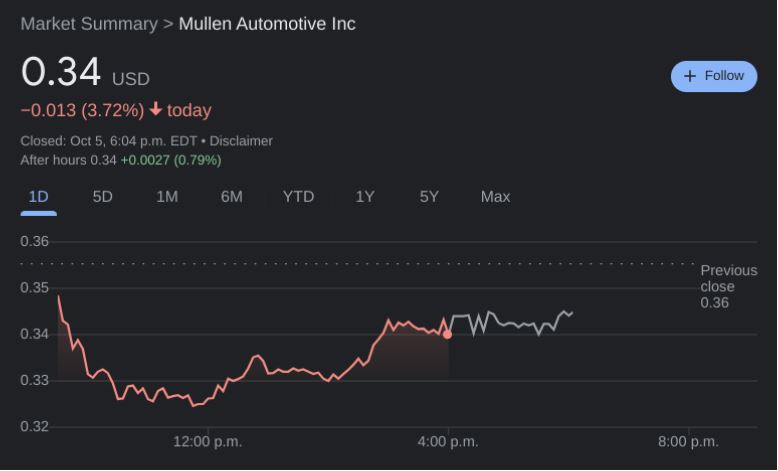
MULN stock performance 10/5/22

Author

More from Stocks Reporter
Share:

Editor's Picks

GBP/USD declines to near 1.3500 as US-Iran tensions rise

The GBP/USD pair declines to near 1.3500 during the early European trading hours on Wednesday. Ongoing tensions in the Middle East provide some support to a safe-haven currency such as the US Dollar against the British Pound. All eyes will be on the US August jobs report later on Friday.

EUR/USD falls to two-week low below 1.1600 on broad USD strength

EUR/USD remains under bearish pressure after closing in negative territory on Tuesday and trades at its lowest level in two weeks below 1.1600 on Wednesday. As tensions in the Middle East escalate further, the US Dollar gathers strength on risk-aversion and hawkish Fed repricing, forcing the pair to stay on the back foot. Later in the day, private sector employment data from the US will be watched closely by market participants.

Gold recovers above $4,300; upside seems capped as Fed bets support USD

Gold recovers early lost ground to a four-week low, and trades above $4,320 heading into the European session. A modest US Dollar pullback is seen as a key factor supporting the commodity, though any meaningful upside seems elusive amid hawkish US Federal Reserve expectations. The escalating Middle East conflict lifted crude oil prices to a fresh high since July 24, stoking inflation fears and reaffirming bets for a Fed rate hike in September.

WTI advances to mid-$90.00s, fresh high since July 24 amid escalating US-Iran tensions

West Texas Intermediate (WTI) – the benchmark US Crude Oil price – scales higher for the third straight day – also marking the fifth day of a positive move in the previous six – and climbs to a fresh high since July 24 during the Asian session on Wednesday.

BoC set to keep interest rates steady despite sticky inflation

The Bank of Canada is widely expected to keep its policy rate unchanged at 2.25% on Wednesday. This would be the seventh consecutive gathering with the central bank sitting on the fence. The BoC left its policy rate unchanged at 2.25% in July, as widely anticipated.

Diesel’s record $100 warning: The oil shock hiding in plain sight

The Oil market may look calmer than it did a few months ago, but diesel is sending a very different message. The US diesel crack spread, the premium of ultra-low sulphur diesel futures over WTI, recently surged above $100 per barrel for the first time, reaching an intraday record of just over $102.00.
















