Mullen Automotive Stock Forecast: MULN moves up 4% on Friday after dropping 15% on Thursday
- MULN stock lost 15.1% on Thursday.
- NASDAQ dropped 1.8% Thursday.
- Mullen Automotive reported Q1 results on Wednesday.
- MoM PPI inflation figure arrived nearly double the expectation.

Mullen Automotive (MULN) collapsed 15.1% on Thursday as a prominent reading of inflation came in hot and put in motion a risk-off reversal of sorts. The US Producer Price Index (PPI) arrived at a reading of 0.7% MoM, which was well above the 0.4% estimate from analysts. Possibly more importantly, investors reacted to Mullen's business updated, which announced that it has received approval to expand MULN common shares by nearly 3x.
The NASDAQ, known for its growth stock makeup, fell 1.8% on Thursday, and NASDAQ futures are off another 1% in Friday's premarket. The EV upstart is, however, seeing its MULN shares up more than 4% in Friday's premarket.
Mullen Automotive stock news: FQ1 results arrived Wednesday
Mullen Automotive stock closed at $0.2916 on Thursday after the US Producer Price Index surprised analysts expecting it to fall in line with the Consumer Price Index (CPI) from earlier in the week. The latter reading was in line with expectations for the most part but slightly higher, which made some equity bulls begin to question their surroundings. Now the hot PPI number has brought about a seachange in thought as the market realizes that prices are sticky and the road down to the Federal Reserve's 2% core inflation target will be rocky at best.
The NASDAQ suffered the worst of the three major US indices on Thursday, and Friday sees this most likely continuing. It sure looks likes the market is waking up hungover from January's frat party of a rally.
Mullen shared its financial results for the fiscal first quarter of 2023 on Wednesday. The company reported a per share loss of $0.28 for the quarter ending in December, which amounted to a net loss of $377 million. This was much higher than the $156 million loss in the quarter one year ago. The large loss was expected as Mullen finalized its acquisition of Electric Last Mile Solutions for $105 million, which gave it the company's factory in Mishawaka, Indiana, that has the capacity to build 50,000 vehicles per year. Mullen still has another $100 million on its balance sheet and expects a further $90 million influx by April.
Mullen announced in its business update that it still expects to begin production of the Mullen FIVE crossover vehicle by the fourth quarter of 2024 or the first quarter of 2025. Additionally, it plans to begin production of its Bollinger B4 semi-truck by the first quarter of 2024. This would make it a competitor of the Tesla (TSLA) Semi being built in Nevada.
At its recent shareholder meeting, Mullen managment won approval to increase MULN common shares from 1.75 billion to 5 billion. Additionally, if the share price does not reach $1 by September 6, 2023, then the company will approve a reverse-stock split to ensure that happens.
Mullen Automotive stock forecast
Mullen stock broke below the $0.33 support level and now will likely steadily move lower to support at $0.21. That support level comes from October and December of last year. Below there is the $0.18 support level from late November and December as well. To ramp up production, Mullen needs to sell a lot more shares, so breaking through either of those support levels in the coming months is the most likely future for the company. Dilution is not a recipe for share price gains.
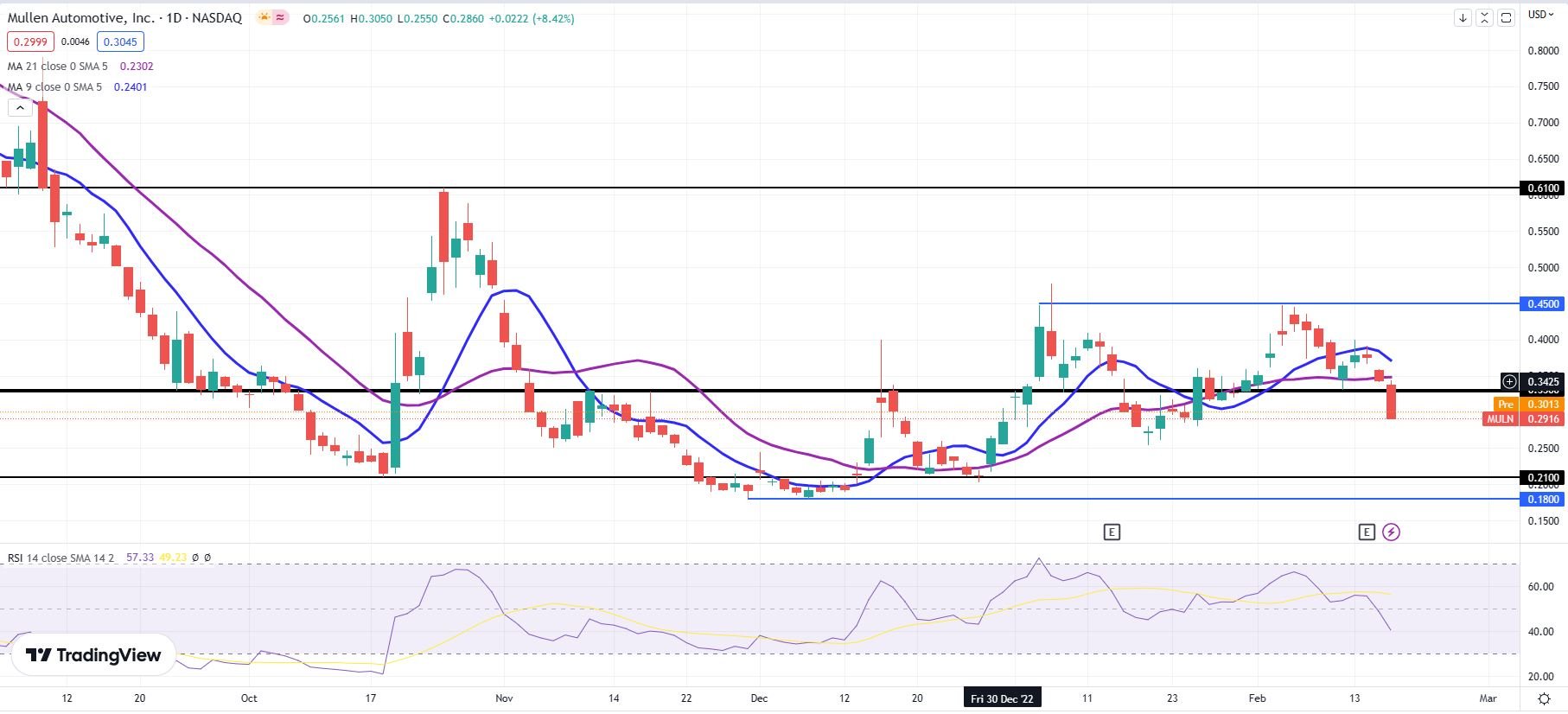
MULN daily chart
Author

Clay Webster
FXStreet
Clay Webster grew up in the US outside Buffalo, New York and Lancaster, Pennsylvania. He began investing after college following the 2008 financial crisis.
















