Microsoft stock slides ahead of earnings as Q1 GDP drops
- Microsoft stock sinks on a lower Q1 GDP reading on Wednesday.
- Preliminary US GDP for Q1 shows a QoQ slide of 0.3% annualized.
- Microsoft is set to release fiscal Q3 earnings after the close on Wednesday.
- Earnings call will revolve around European cloud expansion, tariffs and US data center investment pause.

Microsoft (MSFT) stock fell about 2% near the open on Wednesday after the United States (US) Bureau of Economic Analysis reported that US GDP in the first quarter fell 0.3% QoQ on an annualized basis. Economists had expected a 0.2% reading, and the preliminary reading looks awful when compared to the 2.4% figure from Q4 2024.
Microsoft shares have been rising lightly over the past week ahead of Wednesday's fiscal Q3 post-market earnings release. Wall Street expects the tech stalwart to report earnings per share (EPS) of $3.22 on revenue of $68.44 billion for the quarter ending in March.
The broader market is also selling off in light of the GDP figure. The Dow Jones Industrial Average (DJIA), which includes Microsoft, trended 1.6% lower near the start of Wednesday's session, while the tech-focused NASDAQ Composite lost a resounding 2.5%.
The S&P 500, which decreased about 2% at the time of writing, is the latest casualty of analyst revisions due to the Trump administration's enaction of tariffs. HSBC cut its optimistic 6,700 year-end target all the way to 5,600. The index trades near 5,447 on Wednesday morning.
Microsoft stock news
Microsoft executives, however, do not seem to be worried about the year ahead. The company announced on Wednesday morning in the runup to the earnings release that it plans on doubling its data center infrastructure in Europe by 2027 from 2023 figures. This will amount to the company's Azure cloud segment operating more than 200 data centers on the counterpart by the end of 2027.
Microsoft has already been investing steadily over the past two years and says it will add another 40% to capacity in the next two. The plan announced on Wednesday mentions investments in 16 European nations.
Microsoft outlined its five leading goals with this European expansion:
- Build a broad AI and cloud ecosystem across Europe
- Uphold Europe’s digital resilience despite geopolitical volatility
- Continue to protect the privacy of European data
- Defend European cybersecurity
- Strengthen Europe’s economic competitiveness, particularly for open source.
Earlier this year, Microsoft claimed it would spend as much as $80 billion on data centers in this fiscal year alone. But analysts began to wonder about the company's sincerity when it began slowing investments in several early-stage US facilities at the start of the year. Management simply stated at the time that they decided to remain agile with their capex rollout.
Investors will surely have further questions during the earnings call later on Wednesday as to how the C-suite is viewing those paused projects. Other questions will revolve around Microsoft's outlook on tariffs and how they will alter the company's guidance this year.
Microsoft stock forecast
Microsoft shares have only just regained the $385 to $390 former support band after falling into a clear downtrend over the past two months. A poor earnings performance or guidance retraction later on Wednesday will almost certainly send MSFT back below $385, once again losing the 50-day Simple Moving Average (SMA). In that case, Microsoft stock will probably retest the $345 to $360 range.
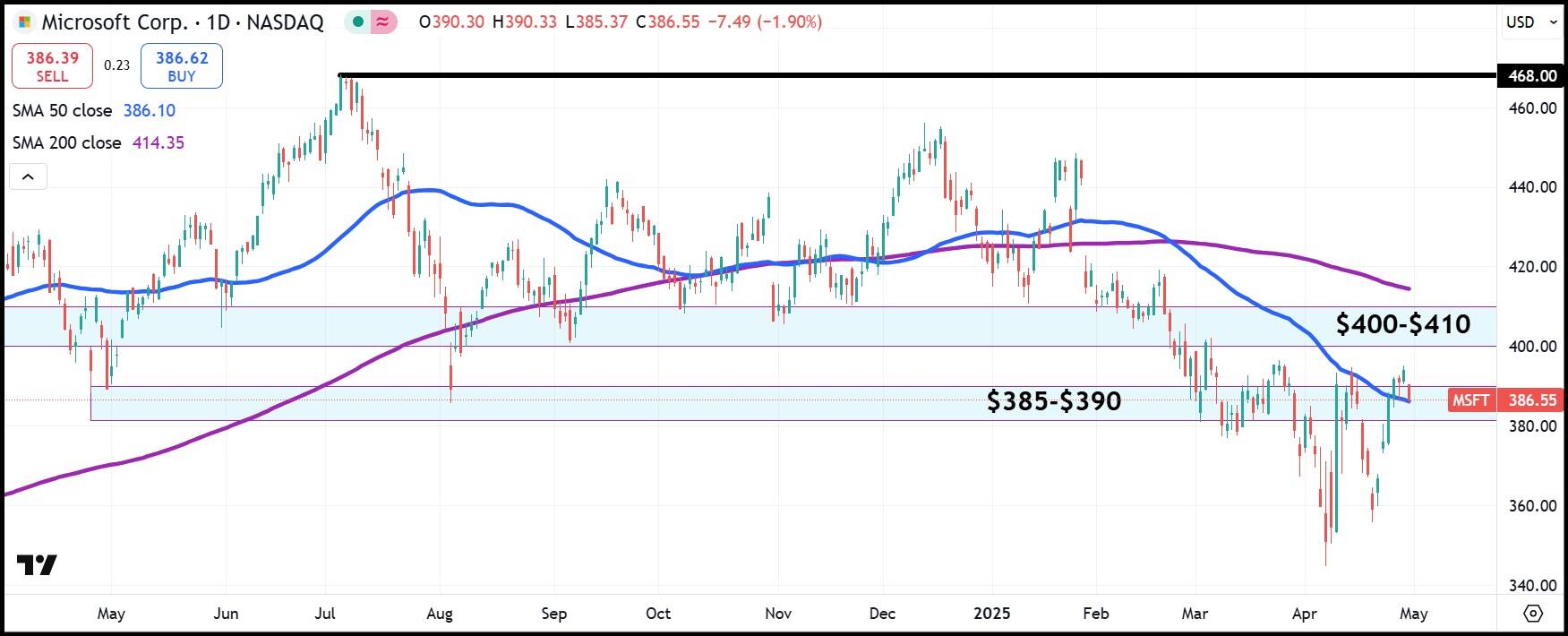
MSFT daily stock chart
A beat-a-raise quarter, however, could propel the share price back into the $400 to $410 upper support range. The 200-day SMA remains the goal for bulls as it now circles $414.
Premium
You have reached your limit of 3 free articles for this month.
Start your subscription and get access to all our original articles.
Author

Clay Webster
FXStreet
Clay Webster grew up in the US outside Buffalo, New York and Lancaster, Pennsylvania. He began investing after college following the 2008 financial crisis.