Microsoft Stock News and Forecast: MSFT jumps 8% as UK regulator blocks Activision deal
- MSFT gains 8% in Wednesday premarket.
- Microsoft reported FQ3 earnings ahead of Wall Street consensus late Tuesday.
- UK's CMA says Microsoft's acquisition of Activision would create too much power in cloud gaming.
- NASDAQ 100 futures rise 0.6%.

Microsoft (MSFT) stock has a second reason to advance higher on Wednesday as a UK regulator moved to block its $69 billion acquisition of Activision Blizzard (ATVI). The UK's Competition & Markets Authority (CMA) said that the merger would give Microsoft too much market share in the cloud gaming realm.
MSFT stock has shot up 8.1% to $297.82 in Wednesday's premarket. The entire futures market is bounding ahead on Wednesday following both Microsoft's and Alphabet's (GOOGL) positive earnings beat late Tuesday. NASDAQ 100 futures are ahead 0.6%, while the S&P 500 and the Dow have advanced more gingerly.
Microsoft stock news
Microsoft management said it would appeal the CMA's ruling, but shareholders seemed enthused – maybe because the $69 billion price tag was viewed as a bit expensive. The CMA said that Microsoft already controlled more than 60% of the cloud gaming market due to its ownership of the Windows operating system, the XBox gaming console, XCloud and the Azure cloud platform.
"We have therefore concluded that combining Activision’s strong portfolio of games with Microsoft’s current multiple cloud gaming strengths would enable Microsoft to harm current and emerging cloud gaming competitors by withholding Activision games from them and, unlike in the case of consoles, we have not found that there are any material reasons to stop it doing this," the CMA decision said.
Sony (SONY), thought to be the major loser if the Activision acquisition was approved, saw its share price shoot up 3% on the news. Meanwhile, Activision stock fell 9.6%.
"The CMA’s decision rejects a pragmatic path to address competition concerns and discourages technology innovation and investment in the United Kingdom," said Microsoft President Brad Smith. "We have already signed contracts to make Activision Blizzard’s popular games available on 150 million more devices, and we remain committed to reinforcing these agreements through regulatory remedies. We’re especially disappointed that after lengthy deliberations, this decision appears to reflect a flawed understanding of this market and the way the relevant cloud technology actually works."
The US Federal Trade Commission (FTC) has already sued to stop the buyout, and the EU regulator has until June to make its decision on the matter public. Microsoft, however, seems keen to appeal every adverse regulatory decision in its way, and this saga will likely carry on for quite awhile.
Late Tuesday Microsoft reported adjusted earnings per share for the quarter ending in March of $2.45, which bested Wall Street analyst consensus by 22 cents, on revenue of $52.86 billion, which was $1.85 billion ahead of the average forecast.
Microsoft stock forecast
Microsoft stock has leapt above the $294 handle, which was keep the shares in line in Tuesday's post-market. MSFT stock is advancing about twice as much in Wednesday's premarket as Tuesday's post-market, and share are now closing in on $298. As we said in our earnings coverage, a break above the $294 resistance level should give bulls access to $315. The RSI is neutral at best, so there is no reason to view MSFT stock as overbought yet. Traders will most likely take profits at $315, which represents a swing high from March and April of last year.
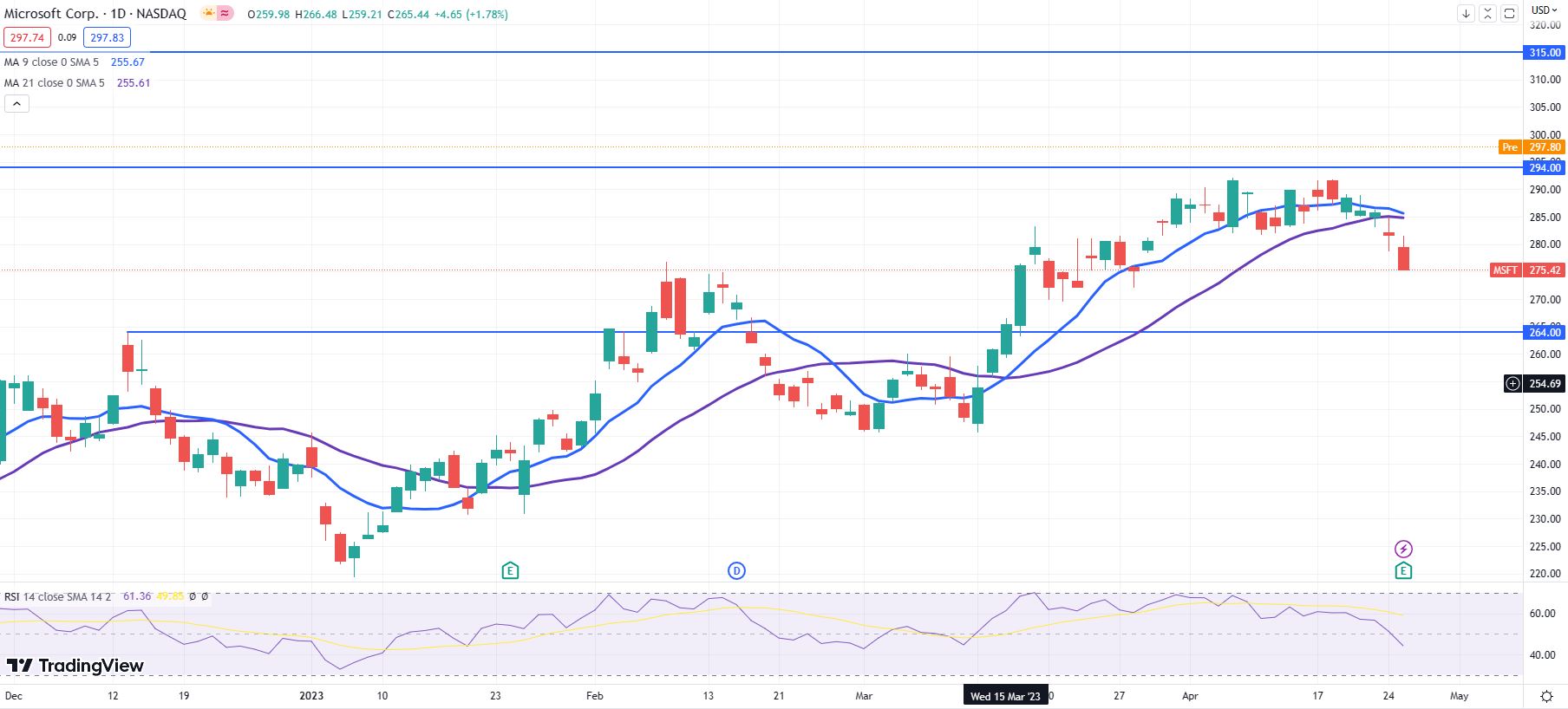
MSFT daily chart
Author

Clay Webster
FXStreet
Clay Webster grew up in the US outside Buffalo, New York and Lancaster, Pennsylvania. He began investing after college following the 2008 financial crisis.