Mexican Peso fluctuates ahead of US presidential election result
- The Mexican Peso trades little changed as traders await news of the US presidential election.
- The winner could have a significant impact on the Peso in the days to come.
- Technically, USD/MXN continues to trade below the opening chart gap it formed when it broke lower on Monday.

The Mexican Peso (MXN) fluctuates between tepid gains and losses on Tuesday as traders await the outcome of the US presidential election. The result is likely to be an important driver of the Peso over the coming days.
If the Democrat nominee Kamala Harris wins, it is expected to be positive for the Mexican Peso, whilst if the Republican nominee Donald Trump is victorious, the impact is likely to be negative, according to financial news website El Financiero. The difference is due to Trump’s threat to place tariffs on Mexican imports.
The highly-rated election forecaster 538.com indicates the probability of Vice President Harris winning is 50%, whilst former President Donald Trump has a 49% chance of victory. This leaves a 1% chance of no overall winner. Over the last 24 hours, Harris has snuck into the lead after lagging Trump for several days. This may explain the Peso’s strengthening across its main pairs on Monday.
Mexican Peso: Four US presidential election scenarios
The Mexican Peso exchange rate with the US Dollar (USD) is foreseen to fluctuate between a low of 18.30 and a high of 22.26 depending on the outcome of the US presidential election, says El Financiero.
The graphic below shows the USD/MXN in four possible US presidential election scenarios.
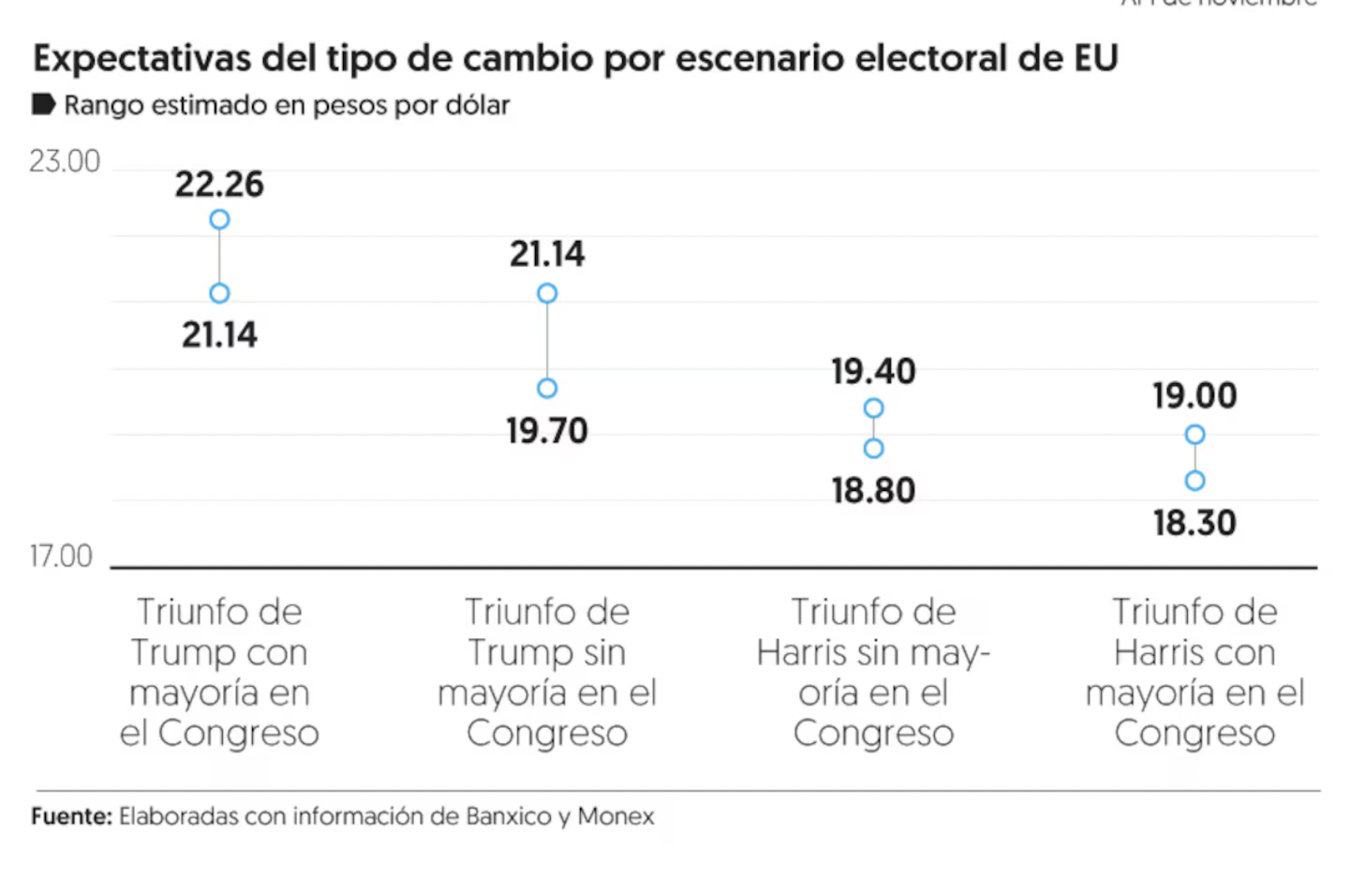
In the case of Harris winning and the Democrats securing a majority in Congress, the Peso is likely to strengthen to between 18.30 and 19.00 against the USD.
If Trump wins with a Republican majority in Congress, the Peso is likely to fall to between 21.14 and 22.26 to the US Dollar.
If Kamala Harris wins the presidency but fails to get a majority in Congress, USD/MXN is likely to fluctuate between 18.80 and 19.40.
If Trump wins without a Republican majority in Congress, the pair is likely to end up in a range between 19.70 and 21.14.
Mexican Peso prepares for the Supreme Court vs. Sheinbaum
The Mexican Peso could face material risk from domestic political factors in the coming days as the Mexican Supreme Court decides on Tuesday whether a controversial law to reform the legal system is unconstitutional.
The reform – which has already been voted through parliament – seeks the election of judges by popular vote rather than appointment. Supporters say it will eliminate corruption. Critics argue it will undermine the independence of the judiciary and hand the government too much power.
Mexican President Claudia Sheinbaum said she would await the Supreme Court's decision but added, “It has to be made very clear that eight justices cannot be above the people,” at a press conference on Monday.
Supreme Court judge and critic of the reform Juan Luis González Alcántara recently proposed a compromise that would limit the election of judges to only those of the Supreme Court and not the thousands of lower court judges in Mexico.
Anticipating delays to its proposed reforms, the Mexican parliament recently passed another law that prevents the courts from blocking the implementation of legislation. So, even if the Supreme Court decides against the implementation of the reform on Tuesday, the government may just ignore their decision and press ahead regardless.
This would lead Mexico into uncharted territory constitutionally, according to experts, with potential implications for the economy and the foreign investor confidence in the country’s courts going forward.
“This will lead to a constitutional crisis of a kind we have not seen for the duration of the 1917 constitution,” Olvera Rangel, a professor of law at the Universidad Nacional Autónoma de México (UNAM), was quoted as saying in The Guardian.
Technical Analysis: USD/MXN leaves gap open as it ranges
USD/MXN trades below the gap down it formed on Monday (orange shaded rectangle on the chart below). The gap formed after the pair completed a bullish Measured Move, or “abc” pattern last week.
USD/MXN 4-hour Chart
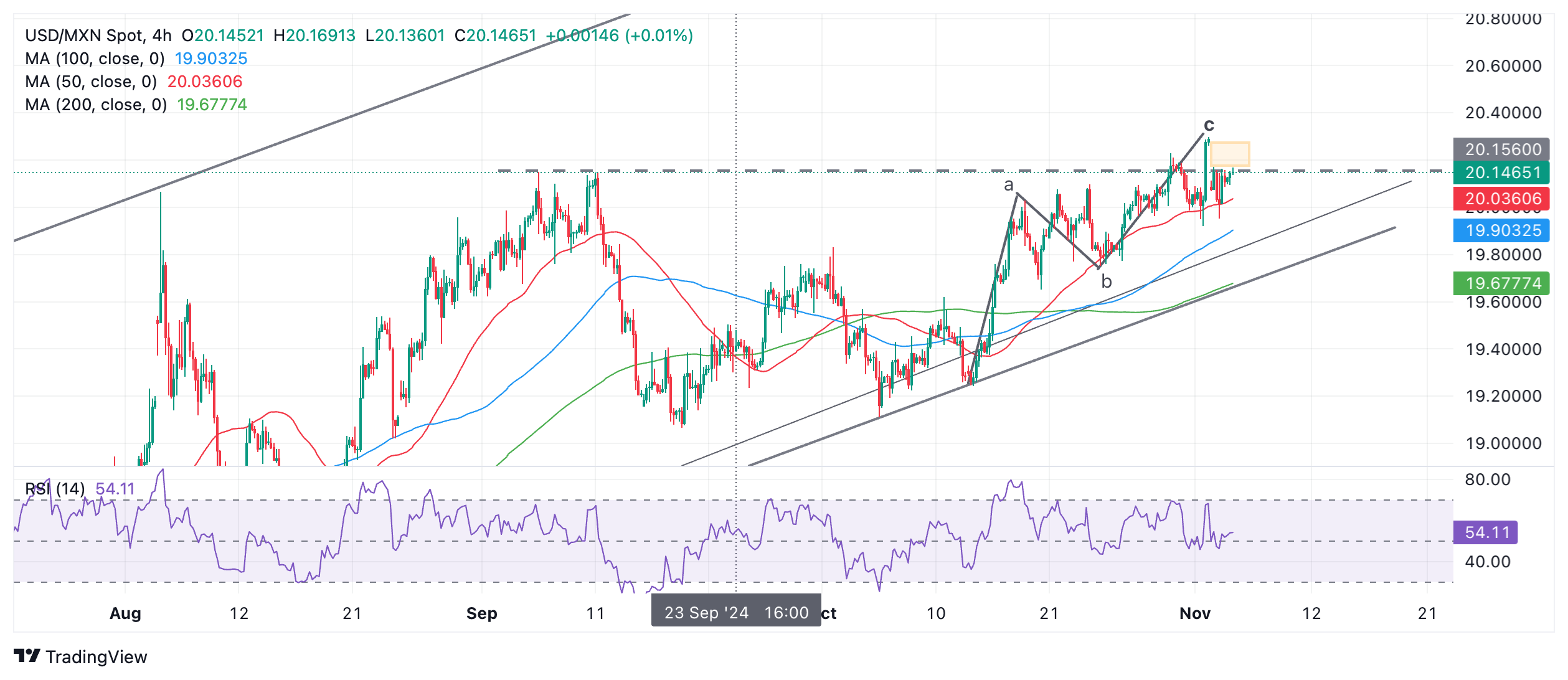
USD/MXN is still probably in an overall uptrend on a short, medium and long-term basis. Further, it is trading in a bullish rising channel. Given the technical dictum “the trend is your friend,” the odds, therefore, favor a continuation higher.
Further, gaps do not tend to remain open for long, according to technical analysis, and this suggests a mild bias for prices to rise and close the gap over coming sessions.
Banxico FAQs
The Bank of Mexico, also known as Banxico, is the country’s central bank. Its mission is to preserve the value of Mexico’s currency, the Mexican Peso (MXN), and to set the monetary policy. To this end, its main objective is to maintain low and stable inflation within target levels – at or close to its target of 3%, the midpoint in a tolerance band of between 2% and 4%.
The main tool of the Banxico to guide monetary policy is by setting interest rates. When inflation is above target, the bank will attempt to tame it by raising rates, making it more expensive for households and businesses to borrow money and thus cooling the economy. Higher interest rates are generally positive for the Mexican Peso (MXN) as they lead to higher yields, making the country a more attractive place for investors. On the contrary, lower interest rates tend to weaken MXN. The rate differential with the USD, or how the Banxico is expected to set interest rates compared with the US Federal Reserve (Fed), is a key factor.
Banxico meets eight times a year, and its monetary policy is greatly influenced by decisions of the US Federal Reserve (Fed). Therefore, the central bank’s decision-making committee usually gathers a week after the Fed. In doing so, Banxico reacts and sometimes anticipates monetary policy measures set by the Federal Reserve. For example, after the Covid-19 pandemic, before the Fed raised rates, Banxico did it first in an attempt to diminish the chances of a substantial depreciation of the Mexican Peso (MXN) and to prevent capital outflows that could destabilize the country.
Author

Joaquin Monfort
FXStreet
Joaquin Monfort is a financial writer and analyst with over 10 years experience writing about financial markets and alt data. He holds a degree in Anthropology from London University and a Diploma in Technical analysis.