Mexican Peso to recover on wide interest-rate differential, say analysts
- The Mexican Peso could recover to the 17.00s against the US Dollar, according to analysts, as election risk eases.
- Mexico’s high interest rates are likely to be the driver as they draw foreign investors seeking returns.
- USD/MXN continues pulling back in the midst of a short and medium-term uptrend.

The Mexican Peso (MXN) trades within a narrow range on Wednesday as market calm descends and the post-election volatility, which saw the Peso sell-off by over 10% in its key pairs, eases.
Several market analysts are now saying the Mexican Peso will drift higher as firm fundamentals and a carry-trade advantage counteract the damage caused by the recent politically-driven volatility.
At the time of writing, a single US Dollar (USD) buys 18.43 Mexican Pesos, EUR/MXN is trading at 19.82 and GBP/MXN at 23.47.
Mexican Peso to regain strength, say analysts
The Mexican Peso is likely to recover after its deep decline after the elections, according to analysts at Rabobank, who forecast USD/MXN rebounding to a base case target of 18.10, but possibly even lower, over the next month.
“We see USD/MXN trending back down to the 17.80 region with the potential for a move as low as 17.20 if vols subdue, though we think a return below 17.00 is unlikely,” said the bank in a note on Wednesday.
The Peso still has a big “carry” advantage over rivals, says Rabobank, due to the high interest rates in Mexico. This factor is likely to keep demand relatively high.
“MXN remains the most attractive carry currency in the world when adjusting for volatility and liquidity, despite the recent surge in vols,” says the note.
The carry trade is a type of strategy in which investors borrow in a currency where interest rates are low – such as Japanese Yen (Apr. of circa 0.0% - 0.1%) and park their money in a currency with a higher interest, such as the Peso (Apr. of circa 11.00%). The profit in the trade is the difference between what is earned from the interest and the cost of borrowing. In the above example, assuming the Yen does not appreciate against the Peso, the trade would make the investor almost all the 11.00% interest earned in a year.
Mexican Peso to bounce back as sell-off overdone, says top currency forecaster
Mexico’s relatively high interest rates are also the reason why another analyst – ranked top for his MXN calls by Bloomberg – thinks the Mexican Peso will recover after the election sell-off.
Bartosz Sawicki, Market Analyst at Polish brokerage Cinkciarz.pl, thinks the move down after the elections is “overdone” and the Peso is due a correction back to 17.00 in USD/MXN.
The Peso’s recovery will be driven primarily by the Bank of Mexico’s (Banxico) determination to keep interest rates high. Although the bank lowered rates in March from 11.25% to 11.00%, it has been reluctant to follow up with further cuts, and Sawicki thinks this hawkish stance “will remain in place and this will act in favor of the Mexican Peso.”
However, the Peso faces considerable risks in the longer term, according to Sawicki, who sees the November US Presidential elections as a “huge risk event”. If Donald Trump wins, it could undermine trade and immigration agreements between the two nations, leading to a weakening of the Peso. Not only trade but remittances from Mexicans working in the US are key components of USD/MXN flows.
Investors are carrying their money away from emerging markets
Mexico is not alone when it comes to volatile election outcomes. Financial markets and the domestic currencies of both India and South Africa also experienced turbulence after recent elections. This has led many carry traders to reconsider where they invest, according to Sawacki.
“All the investors that we spoke to in the last couple of days said they might look for other carry trade opportunities in different regions, or will probably try to wait until US presidential elections in the fourth quarter,” Sawacki said in an interview with Bloomberg News.
Technical Analysis: USD/MXN steadies after pullback
USD/MXN treads water after pulling back following the 18.99 peak reached on June 12.
Whilst it is possible the correction could have further to run, the short and medium-term trends are now bullish, suggesting price will eventually turn around and start rising again. The next target higher is situated at 19.22 (March 2023 high).
USD/MXN Daily Chart
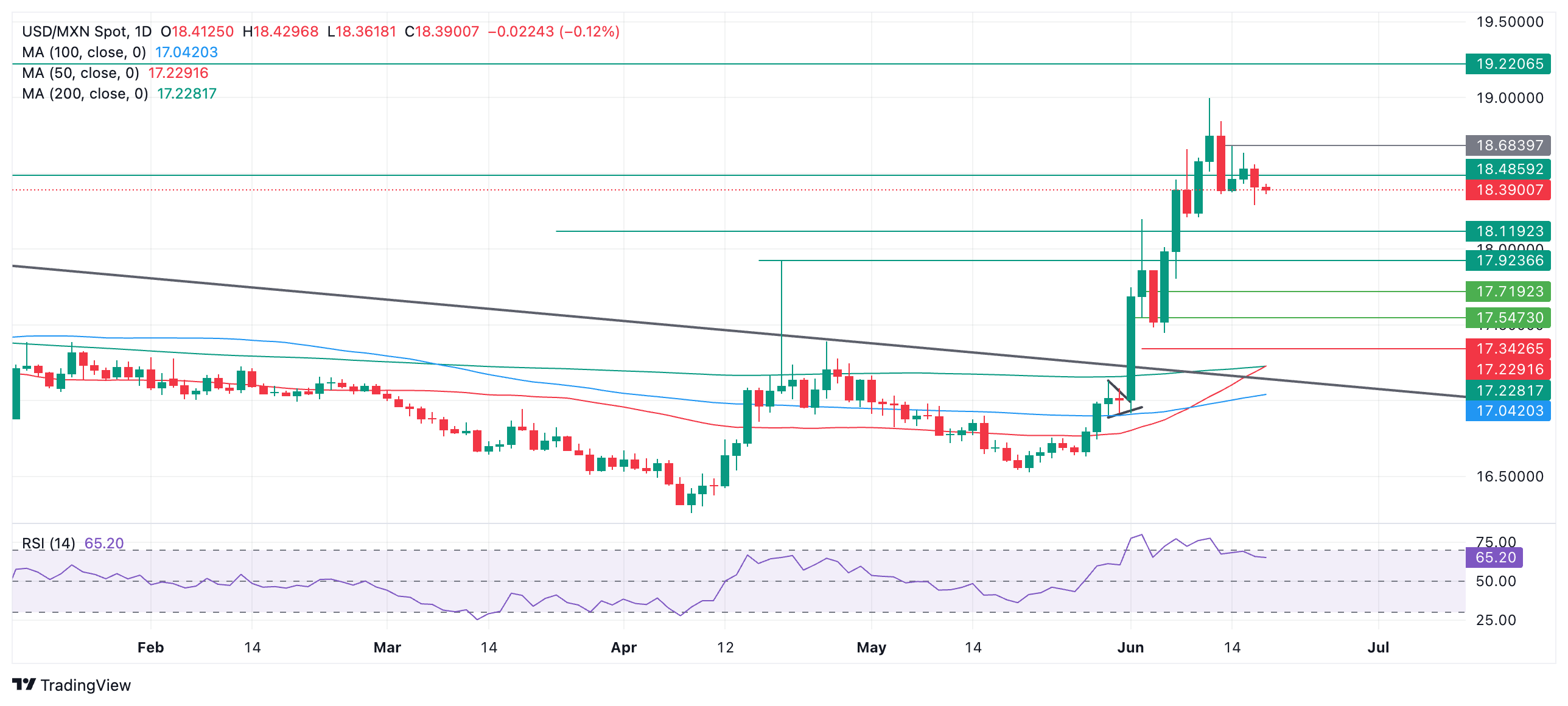
A break above Friday’s high at 18.68 would provide additional confirmation of more upside towards the target at 19.22.
The Relative Strength Index (RSI) has just exited the overbought zone, however, further suggesting a risk the correction could still go deeper. That said, the established uptrend is likely to resume eventually.
The direction of the long-term trend remains in doubt after the break above the October 2023 high. Previous to that, it was bearish.
Interest rates FAQs
Interest rates are charged by financial institutions on loans to borrowers and are paid as interest to savers and depositors. They are influenced by base lending rates, which are set by central banks in response to changes in the economy. Central banks normally have a mandate to ensure price stability, which in most cases means targeting a core inflation rate of around 2%. If inflation falls below target the central bank may cut base lending rates, with a view to stimulating lending and boosting the economy. If inflation rises substantially above 2% it normally results in the central bank raising base lending rates in an attempt to lower inflation.
Higher interest rates generally help strengthen a country’s currency as they make it a more attractive place for global investors to park their money.
Higher interest rates overall weigh on the price of Gold because they increase the opportunity cost of holding Gold instead of investing in an interest-bearing asset or placing cash in the bank. If interest rates are high that usually pushes up the price of the US Dollar (USD), and since Gold is priced in Dollars, this has the effect of lowering the price of Gold.
The Fed funds rate is the overnight rate at which US banks lend to each other. It is the oft-quoted headline rate set by the Federal Reserve at its FOMC meetings. It is set as a range, for example 4.75%-5.00%, though the upper limit (in that case 5.00%) is the quoted figure. Market expectations for future Fed funds rate are tracked by the CME FedWatch tool, which shapes how many financial markets behave in anticipation of future Federal Reserve monetary policy decisions.
Author

Joaquin Monfort
FXStreet
Joaquin Monfort is a financial writer and analyst with over 10 years experience writing about financial markets and alt data. He holds a degree in Anthropology from London University and a Diploma in Technical analysis.