Mexican Peso trades higher against USD after release of cooler inflation data

For the latest news on the Mexican Peso click here.
- The Mexican Peso is trading higher against the USD on Friday after the release of US PCE inflation data.
- Core US Personal Consumption Expenditure (PCE) slowed to 0.2% in April versus 0.3% in the previous month.
- Mexico will vote for a new President on Sunday.
- USD/MXN pulls back within a strong short-term uptrend.
The Mexican Peso (MXN) is up against the US Dollar (USD) on Friday after the release of US Personal Consumption Expenditure (PCE) data for April. The metric is the Federal Reserve's (Fed) prefered gauge of inflation and it cooled to 0.2% month-over-month in the Core PCE component from 0.3% previously. Analysts had expected it to remain unchanged at 0.3%.
The rest of the PCE data came out in line with analysts estimates, however, the undershoot in Core PCE suggests inflation may be cooling more quickly than previously thought in the US. This, in turn, increases the likelihood the Fed may see fit to start cutting interest rates. Lower interest rates tend to be negative for a currency since they attract less inflows, so the data negatively impacted the US Dollar (USD).
A major event for the Mexican Peso on the horizon is the Mexican presidential election on Sunday.
USD/MXN is exchanging hands at 16.98 at the time of writing, EUR/MXN is trading at 18.46 and GBP/MXN at 21.66.
Mexican presidential election
The Mexican presidential election on Sunday is likely to see Claudia Sheinbaum, the candidate for the Morena party, replace Andres Manuel Lopez Obrador (AMLO) as president of Mexico. Shienbaum leads the next most popular candidate by 20% in the polls.
Her tenure is likely to see an extension of Obrador’s generous welfare programme, and she has pledged to increase the minimum wage by circa 11%. This is likely to boost consumer spending, a key driver of growth in recent quarters, but could make it difficult for Banxico to bring down inflation, says Kimberley Sperrfechter, Emerging Markets Economist at Capital Economics.
Threat of being trumped
Despite Donald Trump being convicted of 34 counts of falsifying business records, he still stands a chance of being re-elected in November. Indeed, his conviction has galvanized support for the embattled nominee from within the ranks of the Republican party and led to a flood of donations to his election campaign fund, according to AP News.
The US and Mexican trade agreement (USMCA) is up for review in 2026, and there is a risk that Trump, if re-elected, might reintroduce tariffs on Mexican goods. Such a move would also hamper Mexico’s near-shoring prospects.
For this reason, Sperrfechter thinks that the Peso’s “period of outperformance has largely run its course” and expects the currency to substantially weaken to $19-$20 during the next (Mexican) president’s tenure.
Technical Analysis: USD/MXN pulls back within uptrend
USD/MXN – or the number of Pesos that can be bought with one US Dollar – pulls back and then recovers in a short-term uptrend. Given that “the trend is your friend”, the odds favor a continuation higher.
USD/MXN 4-hour Chart
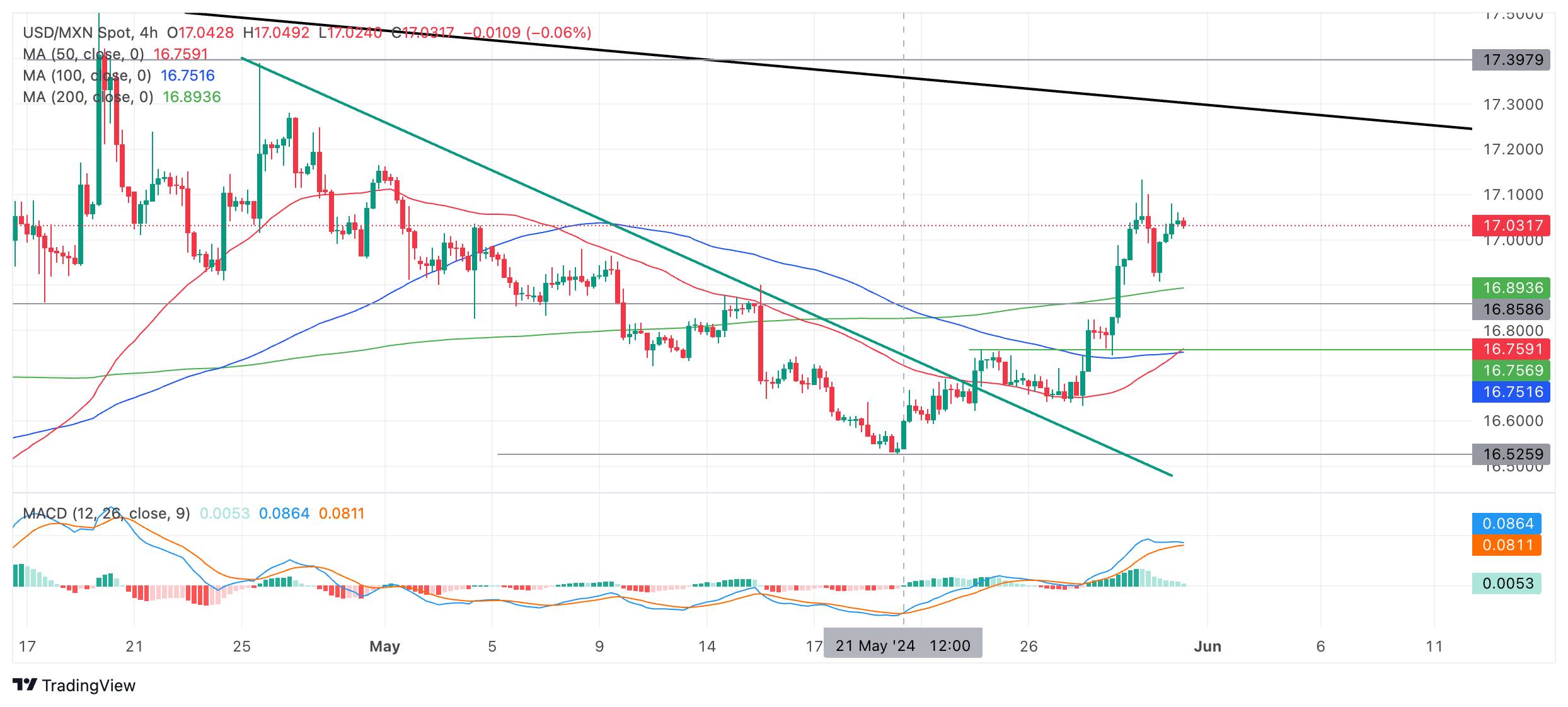
USD/MXN now sets its sights on the major trendline (black) at circa 17.25. A break above the May 30 high at 17.13 would probably confirm an extension towards the trendline target.
The medium and long-term trends remain bearish, however, raising the risk that the pair could reverse lower. As yet, there are no signs of weakness from price action, however. A decisive break above the major trendline would solidify the bullish case and indicate a bullish reversal of the medium-term.
A decisive break would be one accompanied by a long green bar that closed near its high or three consecutive green bars in a row.
Economic Indicator
Core Personal Consumption Expenditures - Price Index (YoY)
The Core Personal Consumption Expenditures (PCE), released by the US Bureau of Economic Analysis on a monthly basis, measures the changes in the prices of goods and services purchased by consumers in the United States (US). The PCE Price Index is also the Federal Reserve’s (Fed) preferred gauge of inflation. The YoY reading compares the prices of goods in the reference month to the same month a year earlier. The core reading excludes the so-called more volatile food and energy components to give a more accurate measurement of price pressures." Generally, a high reading is bullish for the US Dollar (USD), while a low reading is bearish.
Read more.Last release: Fri May 31, 2024 12:30
Frequency: Monthly
Actual: 2.8%
Consensus: 2.8%
Previous: 2.8%
Source: US Bureau of Economic Analysis
After publishing the GDP report, the US Bureau of Economic Analysis releases the Personal Consumption Expenditures (PCE) Price Index data alongside the monthly changes in Personal Spending and Personal Income. FOMC policymakers use the annual Core PCE Price Index, which excludes volatile food and energy prices, as their primary gauge of inflation. A stronger-than-expected reading could help the USD outperform its rivals as it would hint at a possible hawkish shift in the Fed’s forward guidance and vice versa.
Author

Joaquin Monfort
FXStreet
Joaquin Monfort is a financial writer and analyst with over 10 years experience writing about financial markets and alt data. He holds a degree in Anthropology from London University and a Diploma in Technical analysis.















