Mexican Peso steadies ahead of US-Mexico trade talks, US CPI
- The Mexican Peso steadies against the US Dollar ahead of Wednesday’s US CPI release, which may guide Fed expectations.
- The US and Mexico prepare for trade talks, scheduled to take place in Canada on Wednesday.
- USD/MXN pauses above 19.00 with US-China trade talks limiting the pair’s gains.
The Mexican Peso (MXN) is trading flat against the US Dollar (USD) during Tuesday’s US session, as investor focus remained on the ongoing US–China trade talks in London.
A recent pickup in risk appetite, driven by encouraging signals from the negotiations, has helped stabilize the US Dollar, keeping USD/MXN confined to a narrow range around 19.05.
US Consumer Price Index and US-Mexico trade talks take the spotlight
On Wednesday, the United States will release the Consumer Price Index (CPI) for May, which is expected to inform expectations for the Federal Reserve (Fed). Additionally, Mexican President Claudia Sheinbaum will be meeting with US Deputy Secretary of State Christopher Landau in Canada. These talks are scheduled to take place in Canada, where both nations will be attending the Group of Seven (G7) summit.
The talks are expected to address tensions and bilateral relations between the US and Mexico, which have been under pressure due to tariffs placed on Mexican imports to the US.
Tensions between the US and Mexico have escalated after the US increased its tariff rate on steel and aluminum imports to 50% from 25% last week. Mexico filed for an exemption against these tariffs on Friday and has threatened to announce retaliatory tariffs if no progress is made in talks this week.
Mexican Peso daily digest: USD/MXN remains focused on interest rates and trade relations
- Mexico will release its Industrial output data for April at 14:00 GMT on Wednesday. The May report showed industrial output contracting by 0.9% MoM in March.
- US Consumer Price Index (CPI) data for May will be released at 14:30 GMT on Wednesday.
- Headline inflation is projected to rise to 0.3% MoM in May, up from 0.2% in April, with the annual rate climbing to 2.5% from 2.3%.
- Core CPI, which strips out food and energy prices, is also forecast to increase 0.3% MoM, compared to 0.2% previously, with the annual reading rising to 2.9% from 2.8%.
- This data is highly significant, as it will play a major role in shaping market expectations around the Fed’s rate path.
- According to the CME FedWatch Tool, market participants expect the Fed to leave interest rates unchanged within the current 4.25% to 4.50% range at both the June and July meetings, with a 53.6% probability of a rate cut priced in for September.
- Talks in London between senior US and Chinese officials have shown encouraging signs of progress, helping to lift risk sentiment and stabilize the US Dollar.
- On Tuesday, US Treasury Secretary Scott Bessent, US Trade Representative Jamieson Greer, and Commerce Secretary Howard Lutnick continued their discussions with China’s Vice Premier He Lifeng in London for a second day.
- Last Friday’s US Nonfarm Payrolls (NFP) report surprised to the upside, with the May labour market data showing 139,000 new jobs added, outperforming analyst expectations of a 130,000 increase.
- This stronger-than-expected print reinforced the resilience of the US economy and helped lift the US Dollar.
Mexican Peso technical analysis: USD/MXN stalls above 19.00
USD/MXN is trading near 19.05 on Tuesday, holding just above the key 61.8% Fibonacci retracement level at 19.01, drawn from the July low to the February high.
This zone has provided strong technical support over recent sessions, helping to stabilize the pair after sustained downside pressure.
USD/MXN daily chart
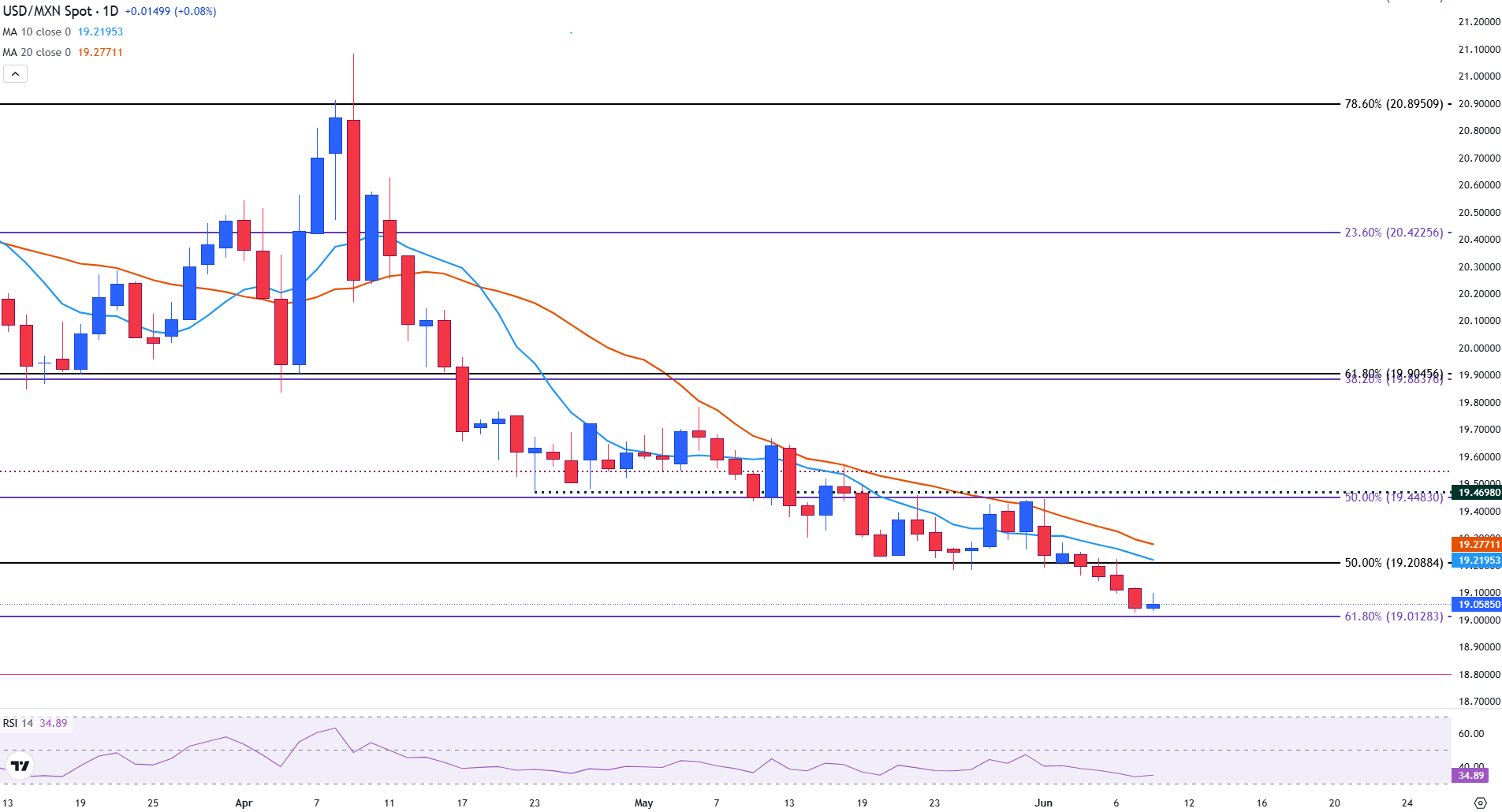
Immediate resistance is seen between 19.21 and 19.28, where the 10-day and 20-day Simple Moving Averages (SMAs) are capping upside attempts.
A confirmed move above this range could open the door toward the 19.47–19.74 zone, where broader retracement levels from the November 2021–April 2024 move are providing additional technical barriers.
On the downside, a break below 19.01 would be significant and could trigger a deeper pullback toward 18.85 and possibly 18.60.
Meanwhile, the Relative Strength Index (RSI) is hovering near 34, suggesting bearish momentum is slowing but not yet reversing. The next directional move will likely be driven by key macro events, including Wednesday’s US CPI report and developments in global trade relations.
Mexican Peso FAQs
The Mexican Peso (MXN) is the most traded currency among its Latin American peers. Its value is broadly determined by the performance of the Mexican economy, the country’s central bank’s policy, the amount of foreign investment in the country and even the levels of remittances sent by Mexicans who live abroad, particularly in the United States. Geopolitical trends can also move MXN: for example, the process of nearshoring – or the decision by some firms to relocate manufacturing capacity and supply chains closer to their home countries – is also seen as a catalyst for the Mexican currency as the country is considered a key manufacturing hub in the American continent. Another catalyst for MXN is Oil prices as Mexico is a key exporter of the commodity.
The main objective of Mexico’s central bank, also known as Banxico, is to maintain inflation at low and stable levels (at or close to its target of 3%, the midpoint in a tolerance band of between 2% and 4%). To this end, the bank sets an appropriate level of interest rates. When inflation is too high, Banxico will attempt to tame it by raising interest rates, making it more expensive for households and businesses to borrow money, thus cooling demand and the overall economy. Higher interest rates are generally positive for the Mexican Peso (MXN) as they lead to higher yields, making the country a more attractive place for investors. On the contrary, lower interest rates tend to weaken MXN.
Macroeconomic data releases are key to assess the state of the economy and can have an impact on the Mexican Peso (MXN) valuation. A strong Mexican economy, based on high economic growth, low unemployment and high confidence is good for MXN. Not only does it attract more foreign investment but it may encourage the Bank of Mexico (Banxico) to increase interest rates, particularly if this strength comes together with elevated inflation. However, if economic data is weak, MXN is likely to depreciate.
As an emerging-market currency, the Mexican Peso (MXN) tends to strive during risk-on periods, or when investors perceive that broader market risks are low and thus are eager to engage with investments that carry a higher risk. Conversely, MXN tends to weaken at times of market turbulence or economic uncertainty as investors tend to sell higher-risk assets and flee to the more-stable safe havens.
Author

Tammy Da Costa, CFTe®
FXStreet
Tammy is an economist and market analyst with a deep passion for financial markets, particularly commodities and geopolitics.