Mexican Peso recovers against USD after release of US Nonfarm Payrolls
- The Mexican Peso recovers after declining to a new low for the year.
- The Peso fell on investors' concerns regarding the Mexican government’s proposed controversial reforms to the judiciary.
- USD/MXN falls after a weak Nonfarm Payrolls figure hits US Dollar pairs.

The Mexican Peso (MXN) trades lower in its key pairs on Friday, stabilizing after a volatile 24-hours in which the currency hit new year-to-date (YTD) lows only to bottom out and recover. Investor concerns over controversial new reforms to the way judges are elected were the main cause of the Peso’s sharp sell-off.
USD/MXN is trading lower in the 18.80s after the much-anticipated release of the US Bureau of Labor Statistics’ Nonfarm Payrolls (NFP) report for August showed lower than expected hirings.
Nonfarm Payrolls (NFP) in the US rose by 142,000 in August, the US Bureau of Labor Statistics (BLS) reported on Friday. This reading followed the 89,000 increase (revised from 114,000) recorded in July and fell short of the market expectation of 160,000.
Mexican Peso rises against USD after Nonfarm Payrolls decline
The Mexican Peso rises against the US Dollar (USD) after the release of Nonfarm Payrolls on Friday.
Downside may be capped, however, by some positive data points in the NFP report.
The US Unemployment Rate, for example, fell to 4.2% in August from 4.3%, as expected.
Average Hourly Earnings rose by 0.4% MoM, although the previous month was revised down to a negative 0.1% (from 0.2%). Nevertheless, the result beat expectations of a 0.3% rise. This translated into a 2.8% gain YoY which was higher than the 2.6% of July and expectations of 2.7%. The inflationary earnings figures may impact Fed rate-cut expectations.
Average Weekly Hours and the Labor Force Participation Rate, meanwhile, remained unchanged from the previous month.
According to the CME FedWatch tool, the market-based probabilities for a 0.50% rate cut from the Federal Reserve (Fed) at its September 18 meeting moderated down to 37% from being marginally above 40% prior to the release.
Data out in Mexico, meanwhile, showed Auto Exports rose by 1.7% YoY in August after registering a decline of 2.7% YoY in the previous month of July, according to data from INEGI. Auto Production, meanwhile, rose by 8.3% YoY against the 2.7% of July.
At the time of writing, one US Dollar (USD) buys 19.79 Mexican Pesos, EUR/MXN trades at 21.98, and GBP/MXN at 26.09.
Mexican Peso under pressure on the back of political reforms
The Mexican Peso is in an established downtrend in most pairs ever since the government sought to push through a controversial bill of reforms to the judiciary.
The reforms seek to counter the perceived corruption in the judiciary by electing judges through popular vote rather than by appointment. However, critics argue the bill will compromise the independence of judges and fail to combat corruption, which is more located among lower-ranking officials and members of law enforcement agencies.
On Wednesday, the government succeeded in passing the bill, winning the vote by 357 in favour versus 130 against.
The reforms will now be debated in Mexico’s upper house, where the government is one seat short of the two-thirds majority it needs to get the bill passed. Most experts believe, however, that it will still get voted through.
After that, it still needs to be “passed to 32 local congresses for their approval. Once the bill is approved in 17 of those states, the changes to the Mexican Constitution will be officially made,” says Christian Borjan Valencia, analyst at FXStreet.
From a financial perspective, the reforms run the risk of leading to a decline in foreign investment. This, in turn, would reduce demand for the Peso, leading to a further depreciation of the currency.
The US ambassador for Mexico, Ken Salazar, said that although reforms to the judiciary were needed, he was against the current bill, which was raising concerns among investors in the US. He warned that it could jeopardize the two countries’ close relationship, which includes a free trade deal.
“If it is not done in the right way, it could cause a lot of damage to the relationship,” said Salazar at a press conference on Tuesday.
Technical Analysis: USD/MXN makes new YTD high of 20.15
USD/MXN broke to new 2024 highs on Thursday, reaching a peak of 20.15 before falling back to close near its opening price. In the process, the price formed a technical set-up called a bearish Shooting Star Japanese candlestick (shaded rectangle on the chart below).
This pattern occurs at market tops when the price moves to a peak and then rolls over all in the same day. It can be evidence of the start of a pullback, correction, or even, in some cases, a reversal of the bull trend. If the following day is also bearish, it provides added bearish confirmation to the Shooting Star. However, until Friday’s close, that will not be known.
USD/MXN Daily Chart
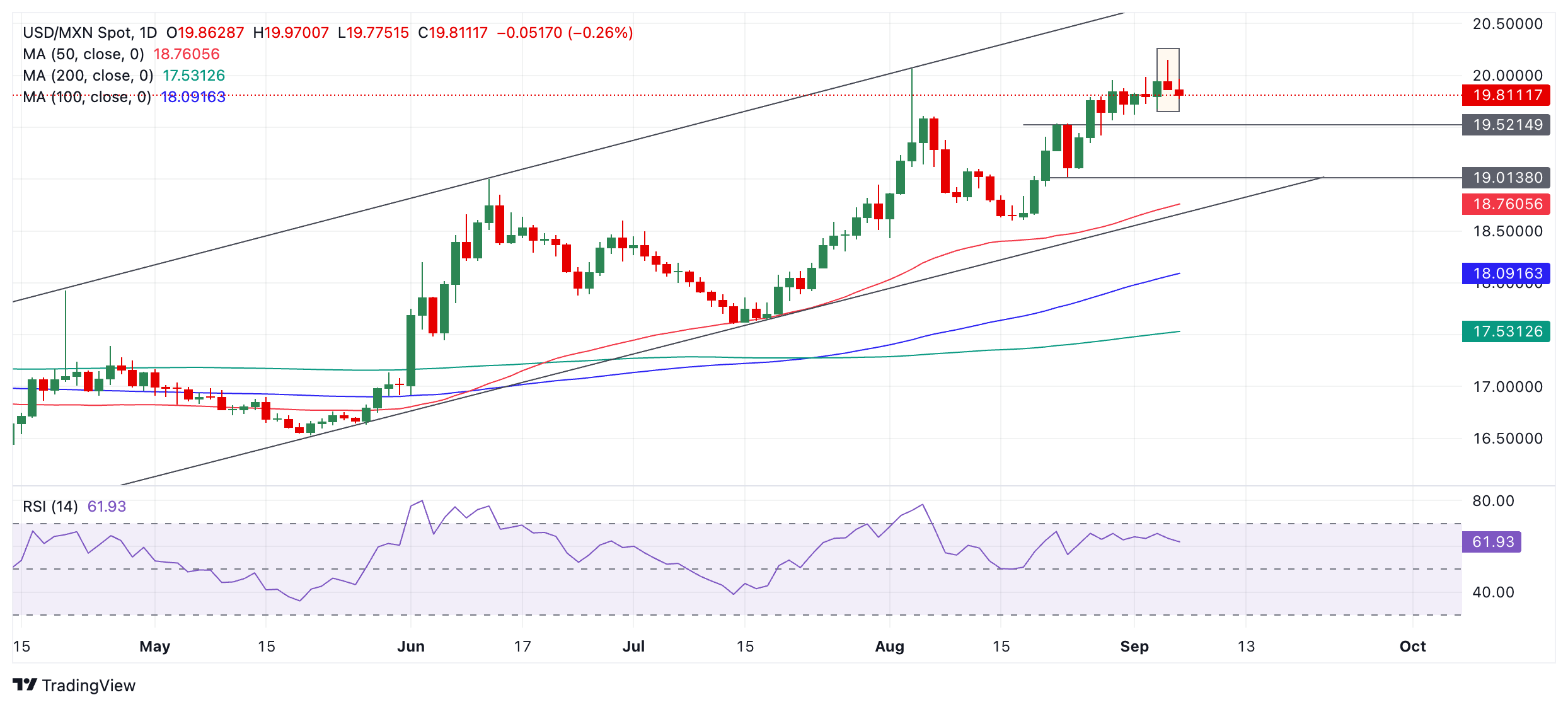
Another quite bearish sign is that the Relative Strength Index (RSI) momentum indicator is diverging with price when compared to the August 5 peak. At the September 5 peak, the RSI was lower than it was on Thursday, even though the price made a higher high. The non-confirmation from RSI suggests a lack of bullish momentum accompanying the September peak, which could be indicative of underlying weakness. Again, it suggests the risk of a pullback evolving.
Despite these bearish signs, however, the overall trend remains bullish, and since according to technical analysis theory “the trend is your friend,” this favors more upside. As such, any weakness may be temporary before the pair rallies again.
A break above the high of the Shooting Star at 20.15 would provide added confirmation of a continuation of the bull trend, with the next target at the upper channel line in the 20.60s.
Economic Indicator
Nonfarm Payrolls
The Nonfarm Payrolls release presents the number of new jobs created in the US during the previous month in all non-agricultural businesses; it is released by the US Bureau of Labor Statistics (BLS). The monthly changes in payrolls can be extremely volatile. The number is also subject to strong reviews, which can also trigger volatility in the Forex board. Generally speaking, a high reading is seen as bullish for the US Dollar (USD), while a low reading is seen as bearish, although previous months' reviews and the Unemployment Rate are as relevant as the headline figure. The market's reaction, therefore, depends on how the market assesses all the data contained in the BLS report as a whole.
Read more.Last release: Fri Sep 06, 2024 12:30
Frequency: Monthly
Actual: 142K
Consensus: 160K
Previous: 114K
Source: US Bureau of Labor Statistics
America’s monthly jobs report is considered the most important economic indicator for forex traders. Released on the first Friday following the reported month, the change in the number of positions is closely correlated with the overall performance of the economy and is monitored by policymakers. Full employment is one of the Federal Reserve’s mandates and it considers developments in the labor market when setting its policies, thus impacting currencies. Despite several leading indicators shaping estimates, Nonfarm Payrolls tend to surprise markets and trigger substantial volatility. Actual figures beating the consensus tend to be USD bullish.
Author

Joaquin Monfort
FXStreet
Joaquin Monfort is a financial writer and analyst with over 10 years experience writing about financial markets and alt data. He holds a degree in Anthropology from London University and a Diploma in Technical analysis.