Mexican Peso slumps as US recession fears boost US Dollar despite surprise GDP beat
- Mexican Peso depreciates as USD/MXN rises to 19.60 as safe-haven demand lifts Greenback.
- Mexico dodges technical recession, but outlook remains fragile, warns Pantheon Macroeconomics.
- US GDP contraction, weak jobs data, and sticky inflation spark stagflation concerns.
- Core PCE dips but stays above Fed’s 2% target, fueling rate cut speculatio

The Mexican Peso lost some ground against the US Dollar and edged down over 0.31% late during the North American session due to fears that the US could face an economic recession, as revealed by data. At the same time, Mexico’s economy surprisingly expanded on the first quarter, dodging a “technical recession.” At the time of writing, the USD/MXN trades at 19.60 as the Asian session begins.
US and Mexican economic data drove the USD/MXN pair on Wednesday. In the US, the Gross Domestic Product (GDP) for the first quarter of 2025 missed estimates and revealed that the economy is shrinking. On the other side of the border, the Instituto Nacional de Estadistica Geografia e Informatica (INEGI) revealed that the economy grew, contrary to economists' estimates.
Andres Abadia, Chief Latin American economist at Pantheon Macroeconomics, wrote in a note to clients, "The quarter-to-quarter gain helped the Mexican economy avoid a technical recession, but it does little to alter the weak trajectory.”
Although economic growth divergence favored the Peso, other US data sparked a flight to the Greenback's safe-haven status. Soft labor market data and high prices triggered an alarm about a possible stagflationary scenario in the US.
ADP revealed that companies hired fewer people in April than in March. Thirty minutes after the US cash equity market opened, the Federal Reserve’s favorite inflation gauge, the Core Personal Consumption Expenditures (PCE) Price Index, revealed that inflation dipped as expected. Yet, it remained above the Fed’s 2% goal.
Daily digest market movers: Mexican Peso fails to rally on goodish GDP data
- Mexico’s economic data revealed on Monday showed that the Balance of Trade printed a surplus and that labor market conditions remain solid as the Unemployment Rate ticked lower in March compared to February
- Economic data revealed last week showcasing the ongoing economic slowdown as Retail Sales in February missed estimates. However, not all has been said, as traders await GDP for Q1.
- INEGI revealed that the GDP for the first quarter of 2025 came at 0.2% quarterly. The figure exceeded the forecast of 0% and improved compared to last year’s Q4 contraction of -0.6%, aligned with estimates.
- Across the border, the US. GDP contracted by 0.3% in Q1 2025, missing expectations for a 0.4% expansion and marking a sharp slowdown from Q4 2024’s 2.4% growth, according to the Commerce Department.
- US ADP employment data for April showed that private companies added 62K jobs, well below the 108K estimate, suggesting that Friday’s Nonfarm Payrolls may also disappoint.
- As expected, the Core PCE Price Index—the Fed’s preferred inflation gauge—rose 2.6% YoY in March, easing from February’s 3%, pointing to continued disinflation.
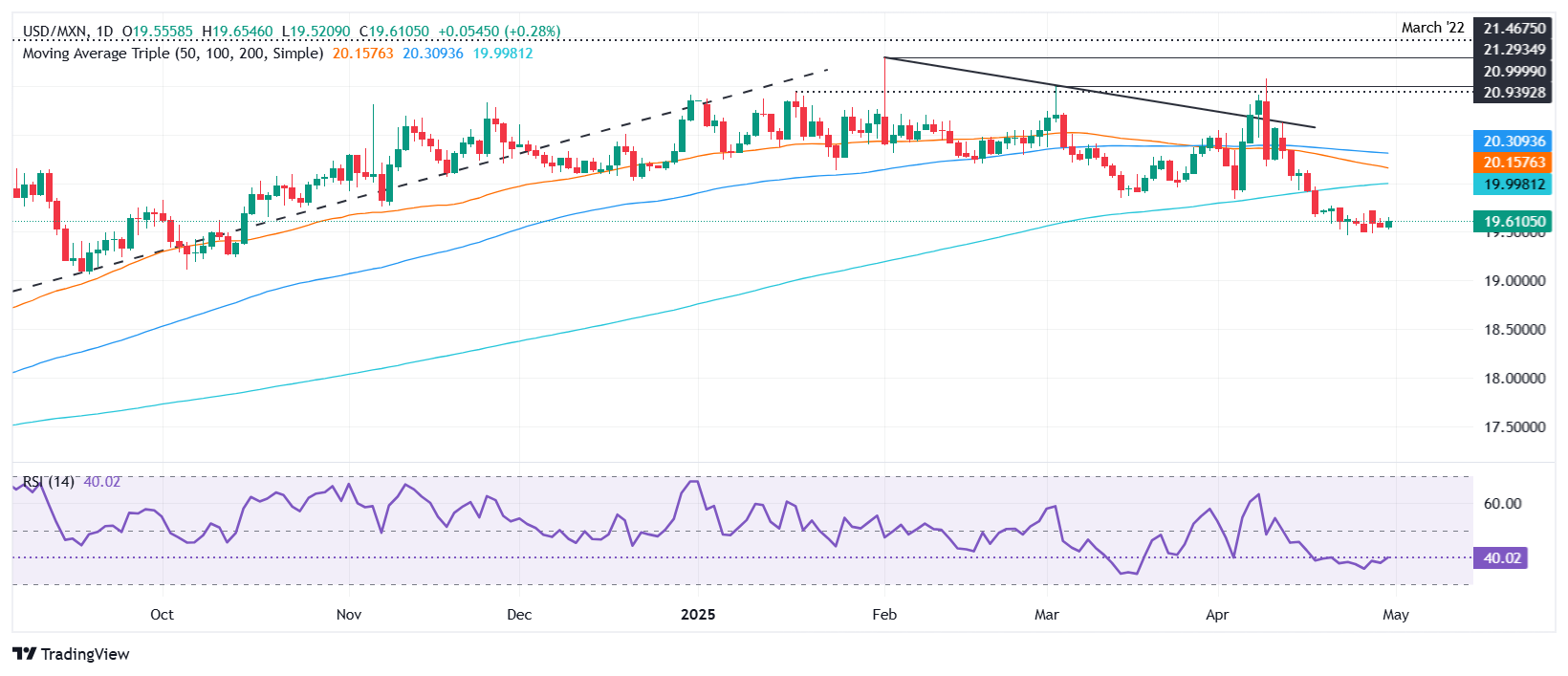
USD/MXN technical outlook: Mexican Peso remains bullish as USD/MXN stays below 200-day SMA
From a technical perspective, the USD/MXN remains downward biased, but it has consolidated during the last ten days. As depicted by price action, it seems that sellers lack the strength to push the pair below the April 23 year-to-date (YTD) low of 19.46, which might send the pair drifting if it clears that level. In that outcome the next support would be the 19.00 psychological level.
Conversely, if USD/MXN rallies past the 200-day SMA at 19.96, this can clear the path to challenge the 20.00 figure followed by the 50-day SMA at 20.12.
Mexican Peso FAQs
The Mexican Peso (MXN) is the most traded currency among its Latin American peers. Its value is broadly determined by the performance of the Mexican economy, the country’s central bank’s policy, the amount of foreign investment in the country and even the levels of remittances sent by Mexicans who live abroad, particularly in the United States. Geopolitical trends can also move MXN: for example, the process of nearshoring – or the decision by some firms to relocate manufacturing capacity and supply chains closer to their home countries – is also seen as a catalyst for the Mexican currency as the country is considered a key manufacturing hub in the American continent. Another catalyst for MXN is Oil prices as Mexico is a key exporter of the commodity.
The main objective of Mexico’s central bank, also known as Banxico, is to maintain inflation at low and stable levels (at or close to its target of 3%, the midpoint in a tolerance band of between 2% and 4%). To this end, the bank sets an appropriate level of interest rates. When inflation is too high, Banxico will attempt to tame it by raising interest rates, making it more expensive for households and businesses to borrow money, thus cooling demand and the overall economy. Higher interest rates are generally positive for the Mexican Peso (MXN) as they lead to higher yields, making the country a more attractive place for investors. On the contrary, lower interest rates tend to weaken MXN.
Macroeconomic data releases are key to assess the state of the economy and can have an impact on the Mexican Peso (MXN) valuation. A strong Mexican economy, based on high economic growth, low unemployment and high confidence is good for MXN. Not only does it attract more foreign investment but it may encourage the Bank of Mexico (Banxico) to increase interest rates, particularly if this strength comes together with elevated inflation. However, if economic data is weak, MXN is likely to depreciate.
As an emerging-market currency, the Mexican Peso (MXN) tends to strive during risk-on periods, or when investors perceive that broader market risks are low and thus are eager to engage with investments that carry a higher risk. Conversely, MXN tends to weaken at times of market turbulence or economic uncertainty as investors tend to sell higher-risk assets and flee to the more-stable safe havens.
Author

Christian Borjon Valencia
FXStreet
Markets analyst, news editor, and trading instructor with over 14 years of experience across FX, commodities, US equity indices, and global macro markets.