Mexican Peso holds firm as markets stay choppy before Fed day
- Mexican Peso weakened 0.14% as risk-off sentiment and profit-taking weigh ahead of the Fed’s policy decision.
- US data is mixed, with strong industrial production but weak housing figures, while Trump’s trade rhetoric overshadows economic releases.
- Mexico’s economic slowdown is in focus, with Aggregate Demand and Private Spending data due before Banxico’s March 27 meeting.

The Mexican Peso (MXN) lost some ground against the US Dollar (USD) on Tuesday as traders brace for the United States (US) Federal Reserve (Fed) monetary policy decision on Wednesday. Data from the US was mixed, though it was overshadowed by US President Donald Trump's trade rhetoric. The USD/MXN is trading at 19,94, up by 0.14%.
The market mood turned pessimistic as investors seemed to book profits ahead of the Fed’s meeting. Participants expect the Fed to stay pat while eyeing whether it will adopt a dovish or hawkish tilt on its forecasts in the Summary of Economic Projections (SEP).
Earlier, data from the US revealed that Industrial Production improved, yet housing data was mixed. However, the main driver remains Trump’s policies and geopolitical developments.
In Mexico, the Instituto Nacional de Estadística Geografía e Informatica (INEGI) will feature the release of Aggregate Demand and Private Spending data, each on Wednesday and Thursday. This could show how deep the ongoing slowdown in Mexico’s economy is a week before the Banco de Mexico (Banxico) March 27 monetary policy meeting.
Daily digest market movers: Mexican Peso trims Monday’s gains ahead of Fed’s meeting
- The Organization for Economic Cooperation and Development (OECD) claimed that US President Donald Trump’s tariffs on Mexican products could spur a recession in Mexico.
- The OECD updated its forecasts, which include 25% tariffs applied on most goods from April. The OECD projects that Mexico’s economy will be severely impacted, contracting 1.3% in 2025 and 0.6% next year.
- Last Wednesday, Mexican Finance Minister Edgar Amador Zamora said the national economy is expanding but shows signs of slowing down linked to trade tensions with the US.
- US Industrial Production grew 0.7% MoM in February, surpassing expectations of 0.2% and accelerating from January’s 0.3% increase, driven by strength in motor vehicle production.
- Housing data presented a mixed picture. Building Permits declined 1.2%, falling from 1.473 million to 1.456 million. Housing Starts, however, surged 11.2%, rising from 1.35 million to 1.501 million, signaling stronger construction activity.
- Money market has priced in 61 basis points of easing by the Fed in 2025, which has sent US Treasury yields plunging alongside the American Currency.
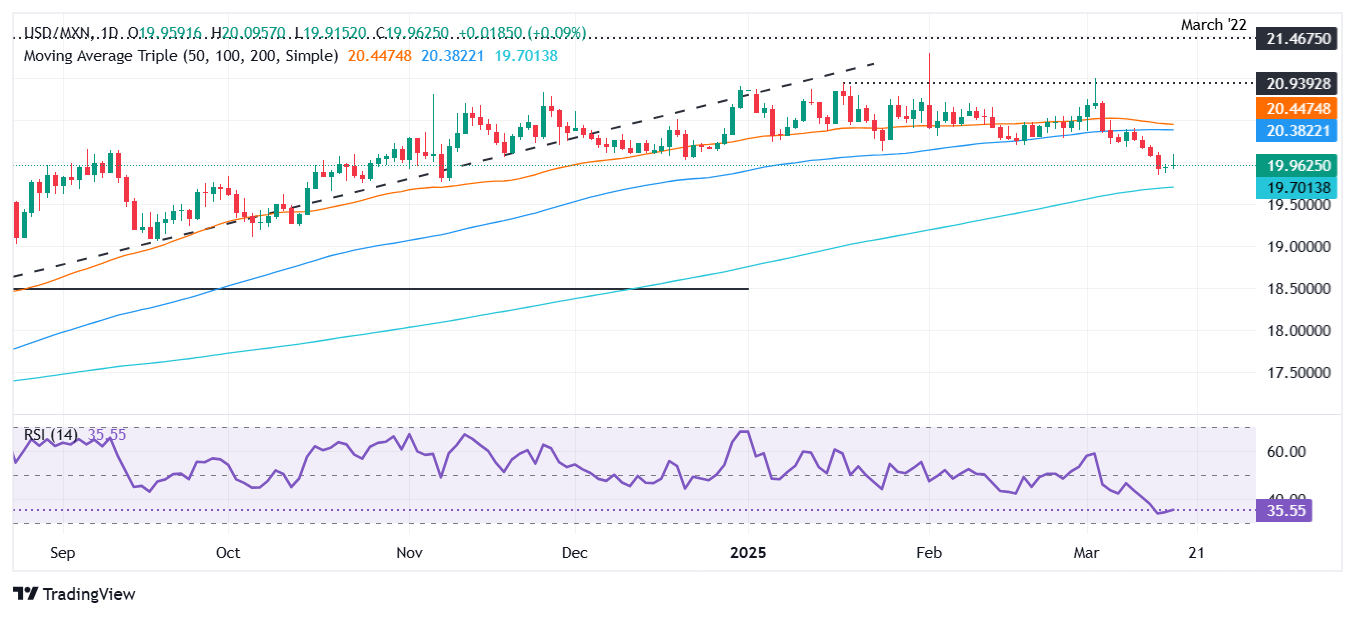
USD/MXN technical outlook: Mexican Peso retreats as USD/MXN climbs above 19.90
USD/MXN registers anemical gains, yet the exotic pair remains below the 20.00 figure, suggesting that further downside is seen. Price action forms a ‘gravestone doji,’ implying that bears are in charge. The Relative Strength Index (RSI) is in bearish territory but hints buyers halted the downtrend near the 19.90 – 20.00 range.
A breach of 19.90 would exacerbate a drop to challenge the 200-day Simple Moving Average (SMA) at 19.65. Once hurdled, the next key support levels would be 19.50, 19.00, and the August 20, 2024 low at 18.64.
Conversely, if USD/MXN rallies past 20.00, this would clear the path to test the 100-day SMA at 20.35.
Mexican Peso FAQs
The Mexican Peso (MXN) is the most traded currency among its Latin American peers. Its value is broadly determined by the performance of the Mexican economy, the country’s central bank’s policy, the amount of foreign investment in the country and even the levels of remittances sent by Mexicans who live abroad, particularly in the United States. Geopolitical trends can also move MXN: for example, the process of nearshoring – or the decision by some firms to relocate manufacturing capacity and supply chains closer to their home countries – is also seen as a catalyst for the Mexican currency as the country is considered a key manufacturing hub in the American continent. Another catalyst for MXN is Oil prices as Mexico is a key exporter of the commodity.
The main objective of Mexico’s central bank, also known as Banxico, is to maintain inflation at low and stable levels (at or close to its target of 3%, the midpoint in a tolerance band of between 2% and 4%). To this end, the bank sets an appropriate level of interest rates. When inflation is too high, Banxico will attempt to tame it by raising interest rates, making it more expensive for households and businesses to borrow money, thus cooling demand and the overall economy. Higher interest rates are generally positive for the Mexican Peso (MXN) as they lead to higher yields, making the country a more attractive place for investors. On the contrary, lower interest rates tend to weaken MXN.
Macroeconomic data releases are key to assess the state of the economy and can have an impact on the Mexican Peso (MXN) valuation. A strong Mexican economy, based on high economic growth, low unemployment and high confidence is good for MXN. Not only does it attract more foreign investment but it may encourage the Bank of Mexico (Banxico) to increase interest rates, particularly if this strength comes together with elevated inflation. However, if economic data is weak, MXN is likely to depreciate.
As an emerging-market currency, the Mexican Peso (MXN) tends to strive during risk-on periods, or when investors perceive that broader market risks are low and thus are eager to engage with investments that carry a higher risk. Conversely, MXN tends to weaken at times of market turbulence or economic uncertainty as investors tend to sell higher-risk assets and flee to the more-stable safe havens.
Author

Christian Borjon Valencia
FXStreet
Markets analyst, news editor, and trading instructor with over 14 years of experience across FX, commodities, US equity indices, and global macro markets.