Mexican Peso continues rising after Finmin reassures markets
- The Mexican Peso recovers on Wednesday after the Mexican Finance Minister gives an interview seeking to calm investor fears.
- Rogelio Ramírez de la O says the newly elected government will exercise fiscal discipline and encourage investment.
- USD/MXN pulls back after becoming overbought and touching a major Moving Average in the weekly timeframe, but bulls still dominate.

The Mexican Peso (MXN) recovers by over a percent in its most traded pairs on Wednesday after the Mexican Finance Minister, Rogelio Ramírez de la O, steps in to prevent a further depreciation of the Peso following the 5.0% election-related decline on Monday and Tuesday.
Ramírez de la O said that the newly elected government would exercise fiscal discipline and ensure the continued smooth flow of foreign and domestic investment. His remarks helped ease investor fears about the sweeping changes the left-leaning Claudia Sheinbaum administration might make given its predicted large majority.
Mexican economic data, meanwhile, showed Consumer Confidence fell to 46.7 in May from 47.7 in the previous month – dropping to a seven-month low. On a seasonally adjusted basis Consumer Confidence fell to 46.7 from 47.3 in the same month, according to data released by INEGI on Wednesday.
USD/MXN is exchanging hands at 17.52 at the time of writing, EUR/MXN is trading at 19.03 and GBP/MXN at 22.37.
Mexican Peso recovers after De la O intervention
The Mexican Peso recovers on Wednesday after a massive decline following Sunday’s election after Finance Minister De la O said: “We want to confirm to international organizations and private investors that our project is based on financial discipline, abiding by the autonomy of the Bank of Mexico, adherence to the rule of law and facilitating national and foreign private investment,” according to El Financiero.
Although all the votes from the Mexican election have not yet been counted – final results are expected on June 8 – estimates suggest the Morena party has probably won a supermajority (over two-thirds) in the lower house of the Mexican Parliament and an almost-supermajority in the Senate. It is now also certain Dr. Claudia Sheinbaum will be the next president of Mexico.
The Mexican Peso dropped like a stone on the news of the election, however, as investors feared that with a supermajority, Sheinbaum’s legislation would be able to enact changes to the constitution that could hurt the economy.
As if to prove investors right, economic data out from Mexico on Tuesday showed an unexpected slowdown in Gross Fixed Investment, which grew 3.0% year-over-year in March from 12.5% in February. Whilst investment in construction remained strong (9.4%), it fell 4.7% for transportation equipment. On a monthly basis, however, the metric showed a faster 0.8% growth rate compared to the previous month’s 0.7%, according to data from INEGI.
Technical Analysis: USD/MXN retreats from 100-week SMA
USD/MXN – or the number of Pesos that can be bought with one US Dollar – soared and hit its second upside target at 18.12 (100-week Simple Moving Average) on Tuesday. It has retreated back down to below the April 19 high of 17.82 since then.
The pair surged following the presidential election on Sunday, and both the short and intermediate-term trends are probably now bullish, overall favoring bullish over bearish bets and more upside over those time frames (up to six months).
USD/MXN Daily Chart
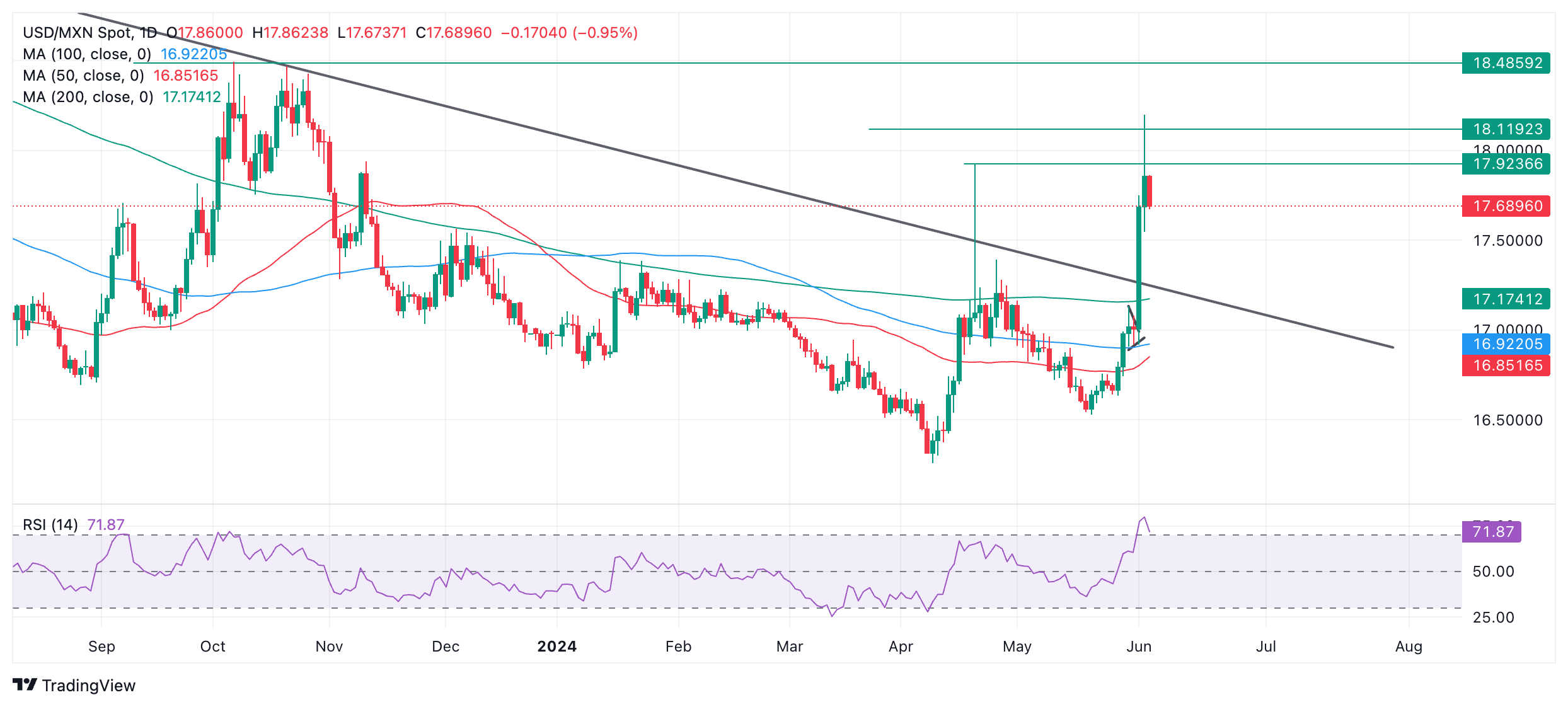
A continuation of the uptrend could see USD/MXN reach the next target at 18.49 (October 2023 high).
USD/MXN is overbought according to the Relative Strength Index (RSI), and this increases the chances of a deeper correction unfolding. Given the dominance of the bullish trend, however, the pair is expected to recover and continue pushing higher. However, there are no signs yet that the pullback has ended, suggesting more downside could come before the pair finds its feet.
One possible level where the pullback could find support is at 17.34, the midpoint of the long green Japanese Marabuzo candlestick pattern that formed during Monday’s rally (June 3). If that level is surpassed, the old trendline in the 17.10s is likely to offer support. If that area is broken, it could be a sign the short and intermediate-term trends may have reversed.
The long-term trend is probably still bearish, suggesting a risk of a reversal lower remains in the background if the uptrend runs out of steam and price starts to plummet. Although price is pulling back, it is not strong enough yet to suggest a change of trend.
Mexican Peso FAQs
The Mexican Peso (MXN) is the most traded currency among its Latin American peers. Its value is broadly determined by the performance of the Mexican economy, the country’s central bank’s policy, the amount of foreign investment in the country and even the levels of remittances sent by Mexicans who live abroad, particularly in the United States. Geopolitical trends can also move MXN: for example, the process of nearshoring – or the decision by some firms to relocate manufacturing capacity and supply chains closer to their home countries – is also seen as a catalyst for the Mexican currency as the country is considered a key manufacturing hub in the American continent. Another catalyst for MXN is Oil prices as Mexico is a key exporter of the commodity.
The main objective of Mexico’s central bank, also known as Banxico, is to maintain inflation at low and stable levels (at or close to its target of 3%, the midpoint in a tolerance band of between 2% and 4%). To this end, the bank sets an appropriate level of interest rates. When inflation is too high, Banxico will attempt to tame it by raising interest rates, making it more expensive for households and businesses to borrow money, thus cooling demand and the overall economy. Higher interest rates are generally positive for the Mexican Peso (MXN) as they lead to higher yields, making the country a more attractive place for investors. On the contrary, lower interest rates tend to weaken MXN.
Macroeconomic data releases are key to assess the state of the economy and can have an impact on the Mexican Peso (MXN) valuation. A strong Mexican economy, based on high economic growth, low unemployment and high confidence is good for MXN. Not only does it attract more foreign investment but it may encourage the Bank of Mexico (Banxico) to increase interest rates, particularly if this strength comes together with elevated inflation. However, if economic data is weak, MXN is likely to depreciate.
As an emerging-market currency, the Mexican Peso (MXN) tends to strive during risk-on periods, or when investors perceive that broader market risks are low and thus are eager to engage with investments that carry a higher risk. Conversely, MXN tends to weaken at times of market turbulence or economic uncertainty as investors tend to sell higher-risk assets and flee to the more-stable safe havens.
Author

Joaquin Monfort
FXStreet
Joaquin Monfort is a financial writer and analyst with over 10 years experience writing about financial markets and alt data. He holds a degree in Anthropology from London University and a Diploma in Technical analysis.
















