Mexican Peso surges ignoring dovish tilted Banxico’s minutes

Most recent article: Mexican Peso weakens as GDP contracts in Q4, growth outlook dims
- Mexican Peso appreciates, shrugging off dovish Banxico stance, weaker economic outlook.
- Mexico’s December Retail Sales exceed estimates but slow from prior month.
- Banxico minutes reaffirm dovish stance, highlighting progress on disinflation.
- Q4 GDP final reading expected to confirm economic slowdown on Friday.
The Mexican Peso staged a comeback, rising over 0.23% against the Greenback. Retail Sales in December exceeded estimates, yet they lagged compared to the previous month’s figures. The USD/MXN trades at 20.39 after hitting a daily high of 20.46.
Mexico’s economic docket revealed that consumer spending dipped compared to November’s data but exceeded private economists' pessimistic expectations. Meanwhile, Banco de Mexico (Banxico) revealed its latest Meeting Minutes, reaffirming the Mexican institution's dovish stance, and suggested that further rate cuts are eyed.
On Wednesday, Banxico revealed its quarterly report for Q4 2024, in which the central bank downwardly revised its growth forecast for 2025. Furthermore, the bank expects weaker consumption and private spending, reflecting the highly uncertain environment.
Regarding their 50basis-point rate cut in the latest monetary policy decision, the Governing Board ruled out they’re comfortable with the current inflation levels. It highlighted the progress of the disinflationary process.
On Friday, the Instituto Nacional de Estadistica Geografia e Informatica (INEGI) will feature the final GDP reading for Q4 2024, which is expected to show a quarterly contraction and is foreseen expanding annually.
Daily digest market movers: Mexican Peso climbs, unfazed by weaker economic outlook
- Banxico’s latest minutes acknowledged that growth risks are tilted to the downside. The Governing Board expects the economy will grow 0.6% in 2025, down from the 1.2% previously foreseen. The forecast is well below the estimate from Mexico’s Finance Ministry of 2.3% and beneath the Citi Expectations Survey of 1%.
- For 2026, Banxico estimates that Mexico’s economy will expand by 1.8%.
- Mexico’s Retail Sales rose by 0.1% MoM, above estimates for a -0.4% shrinkage. On an annual basis, sales improved from a -1.9% contraction to -0.2% YoY.
- Mexico’s President Claudia Sheinbaum said that Marcelo Ebrard, Mexico’s Secretary of Economy, will meet with the US Commerce Secretary today about tariffs.
- Monetary policy divergence between Banxico and the Fed favors further USD/MXN upside. The Fed is expected to keep rates steady, while Banxico is foreseen cutting rates again by 50 basis points at the next meeting.
- The USD/MXN is advancing due to weakness in the Greenback. The US Dollar Index (DXY) dropped 0.65% to 106.45.
- Trade disputes between the US and Mexico remain front and center. Although the countries found common ground previously, USD/MXN traders should know that there is a 30-day pause and that tensions could arise toward the end of February.
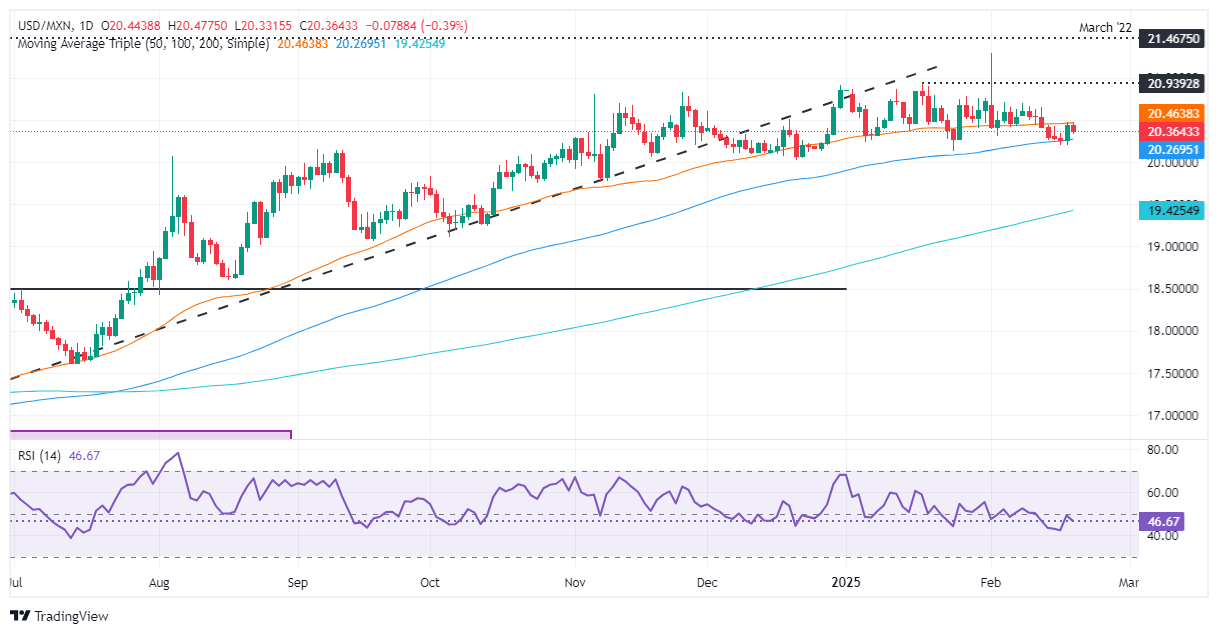
USD/MXN technical outlook: Mexican Peso is steady as USD/MXN is below 50-day SMA
The USD/MXN continued consolidating below the 50-day Simple Moving Average (SMA), keeping bulls in check. Further weakness could drive the exchange rate below the 100-day SMA at 20.22 and threaten to challenge the psychological 20.00 figure. If cleared, the next support would be the October 18, 2024 low at 19.64, ahead of the 200-day SMA at 19.37.
Conversely, if USD/MXN climbs past the 50-day SMA, further gains lie ahead of the 20.50 mark.
Mexican Peso FAQs
The Mexican Peso (MXN) is the most traded currency among its Latin American peers. Its value is broadly determined by the performance of the Mexican economy, the country’s central bank’s policy, the amount of foreign investment in the country and even the levels of remittances sent by Mexicans who live abroad, particularly in the United States. Geopolitical trends can also move MXN: for example, the process of nearshoring – or the decision by some firms to relocate manufacturing capacity and supply chains closer to their home countries – is also seen as a catalyst for the Mexican currency as the country is considered a key manufacturing hub in the American continent. Another catalyst for MXN is Oil prices as Mexico is a key exporter of the commodity.
The main objective of Mexico’s central bank, also known as Banxico, is to maintain inflation at low and stable levels (at or close to its target of 3%, the midpoint in a tolerance band of between 2% and 4%). To this end, the bank sets an appropriate level of interest rates. When inflation is too high, Banxico will attempt to tame it by raising interest rates, making it more expensive for households and businesses to borrow money, thus cooling demand and the overall economy. Higher interest rates are generally positive for the Mexican Peso (MXN) as they lead to higher yields, making the country a more attractive place for investors. On the contrary, lower interest rates tend to weaken MXN.
Macroeconomic data releases are key to assess the state of the economy and can have an impact on the Mexican Peso (MXN) valuation. A strong Mexican economy, based on high economic growth, low unemployment and high confidence is good for MXN. Not only does it attract more foreign investment but it may encourage the Bank of Mexico (Banxico) to increase interest rates, particularly if this strength comes together with elevated inflation. However, if economic data is weak, MXN is likely to depreciate.
As an emerging-market currency, the Mexican Peso (MXN) tends to strive during risk-on periods, or when investors perceive that broader market risks are low and thus are eager to engage with investments that carry a higher risk. Conversely, MXN tends to weaken at times of market turbulence or economic uncertainty as investors tend to sell higher-risk assets and flee to the more-stable safe havens.
Author

Christian Borjon Valencia
FXStreet
Markets analyst, news editor, and trading instructor with over 14 years of experience across FX, commodities, US equity indices, and global macro markets.














