Mexican Peso steadies near 19.90 as traders await Fed's decision

Most recent article: Mexican Peso slips slightly as traders await Fed decision
- Mexican Peso extends gains, while US data takes a backseat; Trump tariffs pose new risks.
- US Retail Sales beat expectations, but manufacturing activity in New York collapses, keeping the US Dollar under pressure.
- OECD warns Trump’s tariffs could trigger a Mexican recession as economic growth forecasts remain well below government targets.
The Mexican Peso extended its gains against the US Dollar for the fourth consecutive trading day as Mexican financial markets remained closed due to a national holiday. Data from the United States (US) was overshadowed by an “unexpected” optimism in the financial market as most US equity indices recovered. The USD/MXN trades at 19.90, virtually unchanged.
Wall Street traded with modest gains on Monday. Following a decent February Retail Sales report, the US Dollar treads water, while activity plummeted in the NY Fed Empire State Manufacturing Index. All this happened as the Mexican economic docket remains absent with traders awaiting the release of Aggregate Demand and Private Spending figures on March 19 and 20, respectively.
In the meantime, the Organization for Economic Cooperation and Development (OECD) claimed that US President Donald Trump’s tariffs on Mexican products could spur a recession in Mexico, alongside an economic slowdown in the US.
Private economists polled by Banco de Mexico in February revealed they expect the economy to grow at a 0.81% pace. Nevertheless, last Friday’s dismal Industrial Production figures and a deterioration in Consumer Confidence would likely weigh on the economy, which is expected to miss the Finance Minister's forecasts above the 2% threshold.
Daily digest market movers: Mexican Peso unfazed by OECD’s economic projections
- Banxico is expected to continue easing policy at the March 27 meeting spurred by the evolution of the disinflation process and a stagnant economy.
- Last Wednesday, Mexican Finance Minister Edgar Amador Zamora said the national economy is expanding but shows signs of slowing down linked to trade tensions with the US.
- The OECD updates its forecasts, which include 25% tariffs applied on most goods from April. According to the OECD, the US economy is projected to grow by 2.2% in 2025 and 1.6% in 2026.
- The OECD projects that Mexico’s economy will be severely impacted, contracting -1.3% in 2025 and -0.6% next year.
- US Retail Sales in February rose by 0.2% MoM, missing estimates of 0.6%, and improved compared to January’s -1.2% fall.
- The New York Fed showed that manufacturing activity dipped from 5.7 to -20, with input prices increasing to their highest level in more than two years.
- Money market has priced in 64 basis points of easing by the Fed in 2025, which has sent US Treasury yields plunging alongside the American Currency.
- Trade tensions between the US and Mexico remain in focus with the Mexican Peso's outlook hinged on negotiations. A trade agreement could support a currency recovery, easing economic uncertainty. Nevertheless, higher tariffs and the USD/MXN may continue rising as protectionist policies could dampen Mexico’s economic growth, potentially leading to a recession.
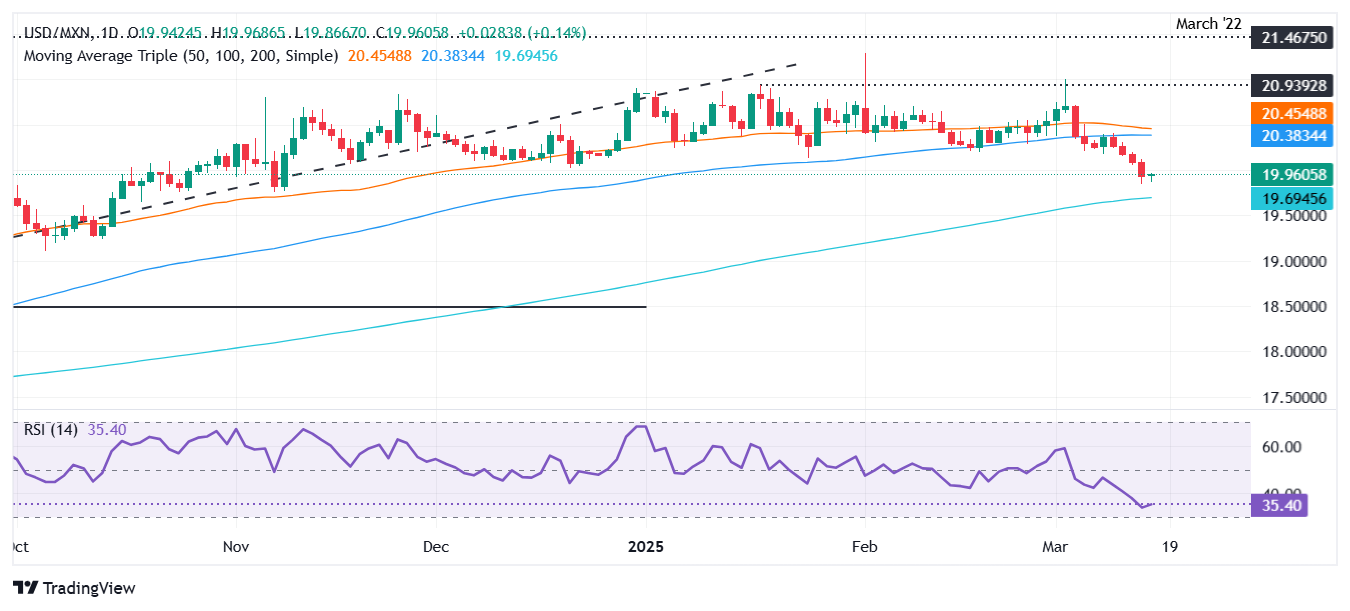
USD/MXN technical outlook: Mexican Peso climbs as USD/MXN drops below 20.00
The USD/MXN remains below the 20.00 figure, which keeps sellers hopeful of lower spot prices. Nevertheless, if they're going to revisit 2024 levels, they must clear the 200-day Simple Moving Average (SMA) at 19.65. In that outcome, the next key support levels would be 19.50, 19.00, and August 20, 2024 low at 18.64.
Otherwise, if USD/MXN rallies past 20.00, this would clear the path to test the 100-day SMA at 20.35.
Tariffs FAQs
Tariffs are customs duties levied on certain merchandise imports or a category of products. Tariffs are designed to help local producers and manufacturers be more competitive in the market by providing a price advantage over similar goods that can be imported. Tariffs are widely used as tools of protectionism, along with trade barriers and import quotas.
Although tariffs and taxes both generate government revenue to fund public goods and services, they have several distinctions. Tariffs are prepaid at the port of entry, while taxes are paid at the time of purchase. Taxes are imposed on individual taxpayers and businesses, while tariffs are paid by importers.
There are two schools of thought among economists regarding the usage of tariffs. While some argue that tariffs are necessary to protect domestic industries and address trade imbalances, others see them as a harmful tool that could potentially drive prices higher over the long term and lead to a damaging trade war by encouraging tit-for-tat tariffs.
During the run-up to the presidential election in November 2024, Donald Trump made it clear that he intends to use tariffs to support the US economy and American producers. In 2024, Mexico, China and Canada accounted for 42% of total US imports. In this period, Mexico stood out as the top exporter with $466.6 billion, according to the US Census Bureau. Hence, Trump wants to focus on these three nations when imposing tariffs. He also plans to use the revenue generated through tariffs to lower personal income taxes.
Author

Christian Borjon Valencia
FXStreet
Markets analyst, news editor, and trading instructor with over 14 years of experience across FX, commodities, US equity indices, and global macro markets.