Mexican Peso struggles as markets react to weak data, trade anxiety

Most recent article: Mexican Peso rallies as tariff fears ease, eyes on Banxico’s decision
- Mexican Peso slips amid rising bets on Banxico rate cut and global uncertainty.
- Mexico’s economic data disappoints with private spending plunging and activity estimates pointing to contraction in February.
- Banxico expected to cut rates by 50 bps on March 27 as inflation remains above target and GDP is revised down.
- US-Mexico trade tensions and Fed caution keep the USD/MXN buoyant with traders eyeing next week’s inflation and rate decisions.
The Mexican Peso remained defensive against the US Dollar on Friday, fueled by fears about trade policies the United States (US) implemented amid a busy week in the central bank space. Softer data in Mexico suggest the economy is slowing down harder than expected, hence the Peso’s depreciation. The USD/MXN trades at 20.23, up 0.45%.
During the week, Mexico’s economic data was mixed following the release of Aggregate Demand and Private Spending figures. The former expanded, but spending plunged in the fourth quarter of last year. A preliminary reading of economic activity estimates that the economy contracted in February, increasing the odds that Banco de Mexico (Banxico) would continue to ease policy even though inflation hadn’t reached the 3% goal.
The latest Citi Mexico Expectations survey revealed a unanimous consensus that Banxico would cut interest rates by 50 basis points (bps) at the March 27 meeting. Most analysts revised Mexico’s primary reference rate for 2025 downward and revised up the headline and core inflation figures.
Of note is that the Gross Domestic Product (GDP) was revised down, while the USD/MXN exchange rate was adjusted slightly lower.
Across the border, the US economic docket remained empty on Friday, but traders continued to digest the Federal Reserve’s (Fed) monetary policy decision on Wednesday.
The statement revealed that policymakers see the policy as appropriate and hinted they would cool the pace of the balance sheet reduction. Fed Chair Powell said they’re not in a rush to cut rates and acknowledged some uncertainty about the future of the economy due to US tariffs.
Other officials crossed the newswires on Friday yet failed to trigger a USD/MXN exchange rate reaction. New York Fed President John Williams said the current modestly restrictive monetary policy is “entirely appropriate,” adding that uncertainty makes it hard to know how the economy will perform.
The Chicago Fed’s Austan Goolsbee said that when there is a lot of uncertainty, you must wait for things to clear up.
Next week, Mexico’s economic docket will feature March’s mid-month inflation figures, Retail Sales, Trade Balance numbers and Banxico’s interest rate decision. In the US, traders would eye the Fed’s preferred inflation gauge, the core Personal Consumption Expenditures (PCE) Price Index.
Daily digest market movers: Mexican Peso slumps as economists eye dovish Banxico
- The Citi Mexico Expectations Survey showed that most analysts expect interest rates to end at 8% in 2025, down from 8.25% in the previous release. The USD/MXN is expected to end at 20.98, down from 21.00 in the last survey.
- March’s mid-month inflation is expected to rise from 3.77% in February to 3.80% YoY, as depicted in the poll, and core prices are foreseen edging up from 3.61% to 3.65% YoY.
- Inflation expectations remained anchored in the high 3% range, while GDP is foreseen expanding by 0.6%, down from 0.8% in the last survey.
- Mexico’s Global Indicator of Economic Activity fell 0.7% YoY in February. Compared to January, the economy most likely grew 0.2% MoM.
- The Organization for Economic Cooperation & Development revealed earlier this week that US tariffs on Mexican products could spur a recession in Mexico.
- Traders had priced the Fed to ease policy by 71 basis points (bps) throughout the year, as revealed by data from the Chicago Board of Trade.
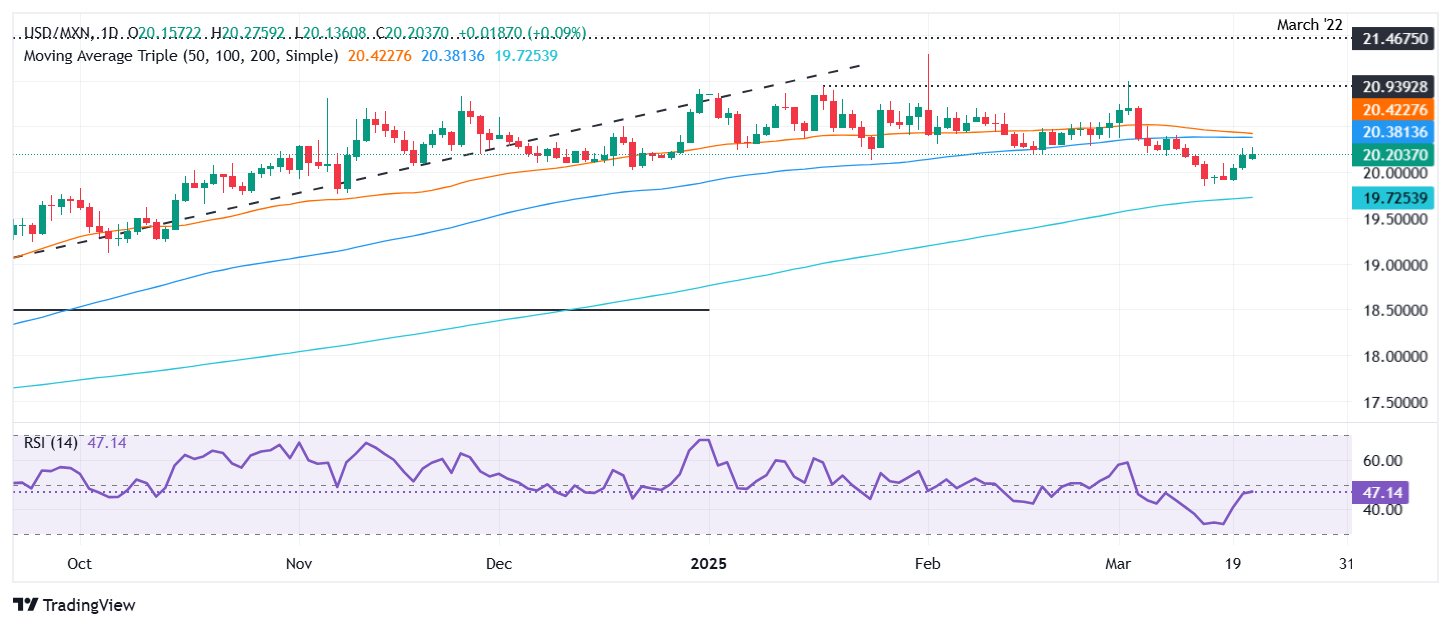
USD/MXN technical outlook: Mexican Peso retreats as USD/MXN climbs above 20.20
USD/MXN consolidates after bouncing off yearly lows reached on March 14 at 19.84, but it remains capped by the 20.30 figure, defended by sellers, which are also leaning into the 100-day Simple Moving Average (SMA) at 20.35 and the 50-day SMA at 20.40.
The Relative Strength Index (RSI) is bearish. However, in the short-term, it favors buyers. The index is about to cross above its neutral line, which would pave the way for further upside.
In that outcome, USD/MXN needs to clear the 100 and 50-day SMAs. Once surpassed, the next ceiling level would be the March 4 peak at 20.99. Conversely, the first key support is 20.00, followed by the YTD low of 19.84, ahead of the 200-day SMA at 19.68.
Banxico FAQs
The Bank of Mexico, also known as Banxico, is the country’s central bank. Its mission is to preserve the value of Mexico’s currency, the Mexican Peso (MXN), and to set the monetary policy. To this end, its main objective is to maintain low and stable inflation within target levels – at or close to its target of 3%, the midpoint in a tolerance band of between 2% and 4%.
The main tool of the Banxico to guide monetary policy is by setting interest rates. When inflation is above target, the bank will attempt to tame it by raising rates, making it more expensive for households and businesses to borrow money and thus cooling the economy. Higher interest rates are generally positive for the Mexican Peso (MXN) as they lead to higher yields, making the country a more attractive place for investors. On the contrary, lower interest rates tend to weaken MXN. The rate differential with the USD, or how the Banxico is expected to set interest rates compared with the US Federal Reserve (Fed), is a key factor.
Banxico meets eight times a year, and its monetary policy is greatly influenced by decisions of the US Federal Reserve (Fed). Therefore, the central bank’s decision-making committee usually gathers a week after the Fed. In doing so, Banxico reacts and sometimes anticipates monetary policy measures set by the Federal Reserve. For example, after the Covid-19 pandemic, before the Fed raised rates, Banxico did it first in an attempt to diminish the chances of a substantial depreciation of the Mexican Peso (MXN) and to prevent capital outflows that could destabilize the country.
Author

Christian Borjon Valencia
FXStreet
Markets analyst, news editor, and trading instructor with over 14 years of experience across FX, commodities, US equity indices, and global macro markets.

















