Mexican Peso plunges, hits 9-week low amid escalation of US-China trade war
- Mexican Peso is under pressure as China retaliates with 50% tariffs, lifting total duties to 84% on US goods.
- US 10-year yield spikes to 4.513%; traders speculate Fed may act on bond market dislocation.
- Mexico’s March inflation aligns with Banxico’s target, keeping the door open for a 50 bps rate cut in May.


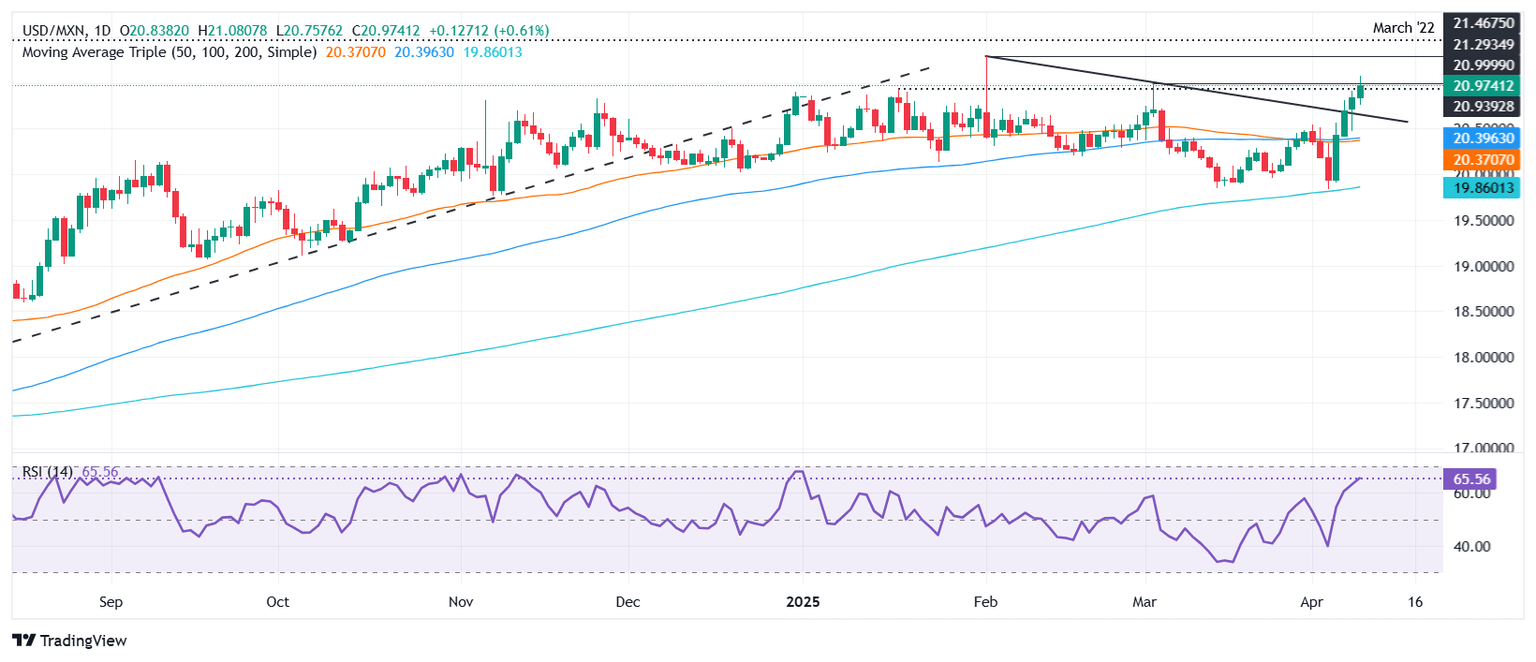
The Mexican Peso (MXN) extended its losses against the US Dollar (USD) as US-China tensions escalated after the US imposed further tariffs on Chinese imports, while the latter retaliated reciprocally. Volatility remains high and usually undermines risk appetite, sending the Peso lower. USD/MXN trades at 20.96 after hitting a 9-week high of 21.07, registering gains of 0.64%.
The financial markets' narrative remains around the “trade war.” As tariffs of 104% were enacted at midnight EST on China’s products, the latter response was of the same size, adding 50% duties on US goods exports to China, for a total of 84%.
The headline pressured US Treasuries, with the US 10-year T-note yield soaring to a daily high of 4.513%. Fears of a dislocation in the US financial markets have investors speculating about a “Fed put” if the yield of the US 10-year note rises past 4.50%, which could trigger an intervention by the US central bank.
Aside from this, back to economic data, Mexico’s headline inflation in March rose in line with expectations, though it stood within Banco de Mexico’s (Banxico) 3% plus or minus 1% goal. Core inflation was also aligned with estimates, revealed the Instituto Nacional de Estadística, Geografía e Informática (INEGI).
Despite the slight price jump, market participants are eying a Banxico rate cut at the May meeting.
The US economic docket features some Fed speakers, with San Francisco Fed President Mary Daly and Minneapolis Fed Neel Kashkari. Traders also await the latest Fed meeting minutes and US inflation data, which will be announced on Thursday.
Daily digest market movers: Mexican Peso plunges as CPI justifies Banxico’s further easing
- INEGI revealed that Mexico’s Consumer Price Index (CPI) rose 3.80% YoY in March, which aligned with estimates but was up from 3.77% in the previous month. Excluding volatile items, the so-called Core CPI rose by 3.64%, as projected.
- Citi Mexico Expectations Survey revealed that Banxico will likely cut rates to 8% towards year-end. Regarding the USD/MXN pair exchange rate, it is expected to hit 20.90, and inflation will remain within Banxico’s 2% to 4% range at 3.7%.
- Mexico’s Gross Domestic Product (GDP) is expected to grow by 0.3% in 2025, less than the previous survey of 0.6%
- Banxico’s Governor, Victoria Rodríguez Ceja, stated that the central bank will remain attentive to US trade policies and their impact on the country, with a primary focus on inflation.
USD/MXN technical outlook: Mexican Peso treads water as USD/MXN looms near 21.00
USD/MXN is expected to remain within the year's heights as volatility exerts downward pressure on the Emerging Market (EM) currency. Price action suggests the uptrend is intact, and if buyers push spot prices past the current daily peak of 21.07, a challenge of the year-to-date (YTD) high of 21.28 is on the cards. On further strength, 21.50 is up next, with a chance of seeing the USD/MXN pair close to 22.00.
On the downside, if USD/MXN drops below 20.50, the next support would be the confluence of the 50-day and 100-day Simple Moving Averages (SMAs) near 20.34/36. If surpassed, the next floor level is the psychological 20.00 figure.
Mexican Peso FAQs
The Mexican Peso (MXN) is the most traded currency among its Latin American peers. Its value is broadly determined by the performance of the Mexican economy, the country’s central bank’s policy, the amount of foreign investment in the country and even the levels of remittances sent by Mexicans who live abroad, particularly in the United States. Geopolitical trends can also move MXN: for example, the process of nearshoring – or the decision by some firms to relocate manufacturing capacity and supply chains closer to their home countries – is also seen as a catalyst for the Mexican currency as the country is considered a key manufacturing hub in the American continent. Another catalyst for MXN is Oil prices as Mexico is a key exporter of the commodity.
The main objective of Mexico’s central bank, also known as Banxico, is to maintain inflation at low and stable levels (at or close to its target of 3%, the midpoint in a tolerance band of between 2% and 4%). To this end, the bank sets an appropriate level of interest rates. When inflation is too high, Banxico will attempt to tame it by raising interest rates, making it more expensive for households and businesses to borrow money, thus cooling demand and the overall economy. Higher interest rates are generally positive for the Mexican Peso (MXN) as they lead to higher yields, making the country a more attractive place for investors. On the contrary, lower interest rates tend to weaken MXN.
Macroeconomic data releases are key to assess the state of the economy and can have an impact on the Mexican Peso (MXN) valuation. A strong Mexican economy, based on high economic growth, low unemployment and high confidence is good for MXN. Not only does it attract more foreign investment but it may encourage the Bank of Mexico (Banxico) to increase interest rates, particularly if this strength comes together with elevated inflation. However, if economic data is weak, MXN is likely to depreciate.
As an emerging-market currency, the Mexican Peso (MXN) tends to strive during risk-on periods, or when investors perceive that broader market risks are low and thus are eager to engage with investments that carry a higher risk. Conversely, MXN tends to weaken at times of market turbulence or economic uncertainty as investors tend to sell higher-risk assets and flee to the more-stable safe havens.
Author
Christian Borjon Valencia
FXStreet
Markets analyst, news editor, and trading instructor with over 14 years of experience across FX, commodities, US equity indices, and global macro markets.